
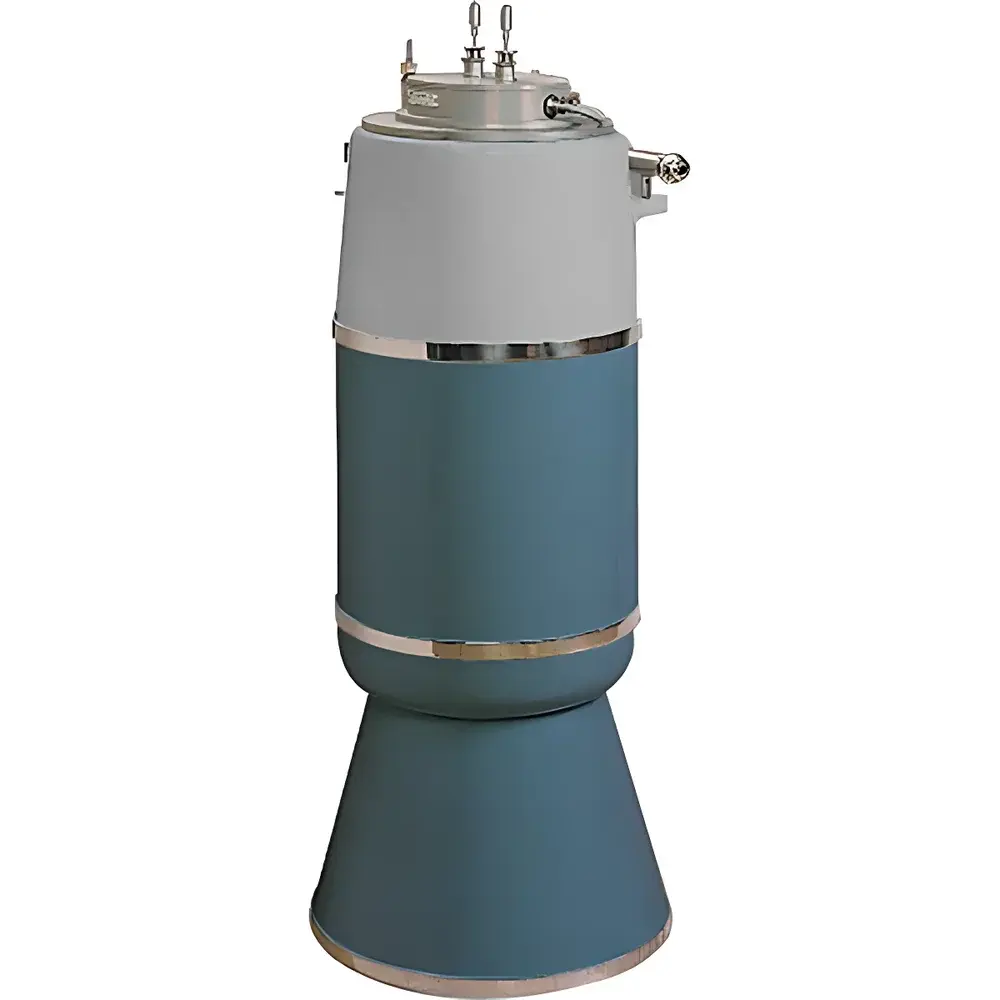
SETARAM BT2.15 Ultra-Low-Temperature Microcalorimeter
| Brand | SETARAM |
|---|---|
| Origin | France |
| Model | BT2.15 |
| Temperature Range | –196 to +200 °C |
| Temperature Accuracy | ±0.1 °C |
| Heating/Cooling Rate | 0.01–1 K/min |
| Detection Principle | 3D Calvet-type Heat Flow Calorimetry |
| Operating Modes | Isothermal & Non-Isothermal |
| Sample Environment | Open or Controlled-Atmosphere (including pressurized & mixing cells) |
Overview
The SETARAM BT2.15 Ultra-Low-Temperature Microcalorimeter is a high-sensitivity, open-system heat flow calorimeter engineered for quantitative thermodynamic characterization across an exceptional temperature range—from liquid nitrogen temperatures (–196 °C) up to 200 °C. Unlike conventional differential scanning calorimeters (DSC), the BT2.15 implements SETARAM’s proprietary 3D Calvet sensor architecture: a spherical, multi-thermocouple array surrounding the sample and reference positions, enabling near-ideal thermal symmetry and minimizing heat loss artifacts. This design delivers superior signal-to-noise ratio and baseline stability—critical for detecting minute enthalpic changes associated with weak interactions, slow solid-state transformations, or low-concentration catalytic adsorption/desorption events. The instrument operates in both isothermal and dynamic (ramp-based) modes, supporting true in situ mixing experiments via interchangeable reaction cells—including pressure-controlled, gas-tight, and dual-compartment mixing vessels—making it uniquely suited for studying heterogeneous exchange processes (solid–solid, gas–solid, liquid–solid, liquid–liquid) under precisely defined thermal and environmental conditions.
Key Features
- 3D Calvet detection geometry ensures uniform heat flux capture from all spatial directions, delivering high reproducibility and intrinsic compensation for thermal gradients.
- Extended cryogenic capability down to –196 °C using integrated liquid nitrogen cooling, with precise temperature control maintained within ±0.1 °C across the full operating range.
- Programmable heating/cooling rates from 0.01 to 1 K/min, optimized for resolving overlapping transitions in complex materials such as polymer blends or clathrate hydrates.
- Modular cell system supports application-specific configurations: hermetic pressure cells (up to 10 MPa), magnetic stirring-enabled mixing cells, and inert-atmosphere sealed cells compatible with air-sensitive samples.
- Robust mechanical architecture with active vibration damping and electromagnetic shielding, ensuring measurement integrity in shared laboratory environments.
Sample Compatibility & Compliance
The BT2.15 accommodates diverse sample forms—including powders, gels, suspensions, thin films, and bulk solids—with minimal mass requirements (typically 1–50 mg). Its open-system flexibility enables direct integration with external gas dosing lines, liquid injection manifolds, or electrochemical modules. From a regulatory standpoint, data acquisition complies with GLP and GMP principles: time-stamped raw heat flow records, user-accessible calibration logs, and audit-trail-enabled software support traceability per FDA 21 CFR Part 11 requirements. Method validation protocols align with ISO 11357 (Plastics — Differential Scanning Calorimetry) and ASTM E1269 (Heat Capacity Measurements), while low-temperature crystallization studies conform to ISO 21028-1 (Cryogenic Safety) guidelines.
Software & Data Management
Control and analysis are performed via SETARAM’s C80/MS80-compatible T.A. Analysis Suite v4.x—a Windows-based platform supporting real-time visualization, multi-step protocol scripting, and automated baseline correction. Raw thermograms are stored in vendor-neutral ASCII format; processed data export includes CSV, Excel, and PDF report generation with customizable metadata fields (operator ID, calibration certificate number, cell type, purge gas composition). The software embeds thermodynamic modeling tools for van’t Hoff analysis, kinetic deconvolution (e.g., Ozawa–Flynn–Wall), and phase diagram construction—enabling direct derivation of ΔH, ΔS, activation energy (Ea), and mixing enthalpies without third-party post-processing.
Applications
- Low-temperature phase behavior of hydrocarbon systems: wax appearance temperature (WAT), asphaltene precipitation onset, and hydrate formation kinetics in petroleum fluids.
- Crystallization thermodynamics of pharmaceutical polymorphs and amorphous dispersions below 0 °C—critical for cold-chain formulation stability assessment.
- Adsorption enthalpy mapping of CO2, H2, or CH4 on metal–organic frameworks (MOFs) and activated carbons at cryogenic temperatures.
- Superconductor transition thermodynamics: precise determination of critical temperature (Tc) shifts induced by dopants or lattice strain.
- Hydration/dehydration energetics in cementitious systems and geopolymers, including quantification of bound water enthalpy in calcium silicate hydrates (C–S–H).
FAQ
What distinguishes the BT2.15 from standard DSC instruments?
The BT2.15 employs 3D Calvet calorimetry—not differential temperature sensing—providing absolute heat flow measurement with inherent compensation for heat losses and superior sensitivity for low-enthalpy events.
Can the BT2.15 perform isothermal titration calorimetry (ITC)?
No—it is not configured for sequential micro-injection; however, its mixing cells support single-step in situ reactions with real-time enthalpy integration over minutes to hours.
Is liquid nitrogen handling automated?
Yes—optional LN2 auto-fill system with level monitoring and vapor-phase cooling management minimizes manual intervention and improves run-to-run consistency.
Does the system support vacuum or reactive gas environments?
Yes—standard cells operate under N2, Ar, or He; optional corrosion-resistant cells accommodate H2S, NH3, or Cl2 with appropriate safety interlocks.
How is calibration verified across the full temperature range?
Certified reference materials (e.g., high-purity In, Sn, Zn, Bi, and KCl) are used at defined points; temperature accuracy is validated per ISO 17025-accredited procedures with documented uncertainty budgets.



