
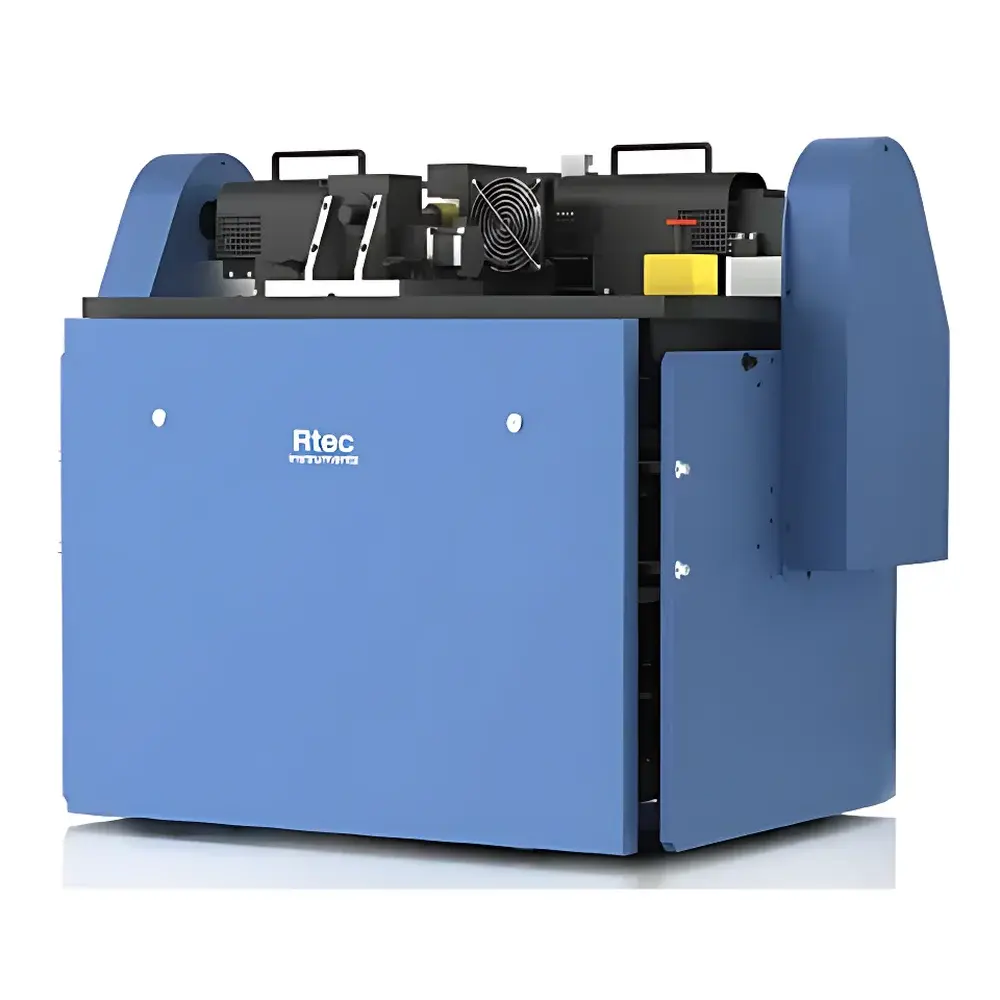
Rtec TRT-1000 Rolling Contact Fatigue (RCF) Tester
| Brand | Rtec |
|---|---|
| Origin | Switzerland |
| Model | TRT-1000 |
| Maximum Friction Force | 8000 N |
| Friction Force Resolution | 0.15 N |
| Maximum Test Temperature | 150 °C |
| Drive Type | Dual High-Torque Servo Motors |
| Force Actuation | Electromechanical Servo Loading |
| Environmental Control | Integrated Temperature Chamber (–20 °C to 150 °C) |
| Data Acquisition Rate | Up to 200 kHz |
| Compliance | ASTM D4170, ISO 6856, DIN 51819-1, EN 15380, GLP-Compatible Logging |
Overview
The Rtec TRT-1000 Rolling Contact Fatigue (RCF) Tester is a precision-engineered dual-roller tribological testing system designed for fundamental and applied research into subsurface-initiated failure mechanisms under rolling-sliding contact conditions. Operating on the principle of controlled elastohydrodynamic (EHD) or mixed-lubrication contact between two independently driven rollers, the TRT-1000 replicates critical stress states found in real-world components such as railway wheels/rails, gear teeth, bearing races, and electric motor shafts. Its architecture integrates high-fidelity servo actuation, closed-loop environmental control, and multi-sensor real-time monitoring to deliver reproducible, quantifiable RCF initiation and propagation data—enabling correlation between surface degradation, subsurface crack nucleation, and lubricant film breakdown.
Key Features
- Dual independent high-torque servo motors enabling precise control of rotational speed, slip ratio (0–100%), and direction—supporting both pure rolling and defined sliding-rolling regimes.
- Electromechanical servo force application with 8000 N maximum normal load and 0.15 N resolution; force drift < ±0.02% FS over 24 h, validated per ISO 17025-accredited calibration protocols.
- Integrated temperature-controlled chamber operating from –20 °C to +150 °C, with programmable ramp rates (0.1–5 °C/min) and stability ±0.5 °C at steady state.
- Real-time multi-channel acquisition at up to 200 kHz, synchronized across torque, acoustic emission (AE), normal force, roller displacement, and lubricant flow sensors.
- Patented dynamic torque transducer with <1 µrad angular resolution, enabling direct calculation of instantaneous coefficient of friction (COF) and traction curves.
- Wideband acoustic emission sensor (100 kHz–1.2 MHz) with adjustable threshold triggering for early-stage micro-crack detection and delamination onset localization.
Sample Compatibility & Compliance
The TRT-1000 accommodates cylindrical roller specimens (diameter 10–50 mm, length ≥25 mm) and flat counterfaces, supporting metallic alloys (bearing steels, titanium, stainless grades), ceramics (Si₃N₄, ZrO₂), polymer composites, and coated systems (DLC, CrN, Ni-P). Lubricant delivery supports static bath, continuous recirculation (flow rate 0.1–10 L/min), and mist injection configurations. All test sequences comply with ASTM D4170 (rolling wear of lubricants), ISO 6856 (RCF testing of bearing steels), DIN 51819-1 (lubricant traction measurement), and EN 15380 (railway wheel-rail interface simulation). Audit-ready data logs include timestamped metadata, sensor calibration certificates, environmental setpoints, and operator-defined pass/fail criteria—fully traceable for GLP and GMP environments.
Software & Data Management
TRT-1000 is operated via Rtec’s proprietary Tribometer Control Suite (TCS v5.x), a Windows-based platform supporting protocol-driven test automation, adaptive feedback logic, and post-test spectral analysis. Users define test sequences using modular command blocks (e.g., “ramp load to 4000 N → hold 5 min → increase slip ratio linearly to 5% over 300 s”). Conditional termination rules—such as “halt if AE RMS exceeds 2× baseline” or “stop when COF rises >30% from initial value”—are embedded directly into the protocol. Raw data exports support ASCII (.txt), CSV, HDF5, and MATLAB (.mat) formats. TCS includes built-in FFT, envelope spectrum, and time-frequency analysis tools for AE signal decomposition, alongside ISO 10816-compliant vibration severity assessment. All user actions, parameter changes, and calibration events are logged with digital signatures in accordance with FDA 21 CFR Part 11 requirements.
Applications
The TRT-1000 serves cross-sector R&D and quality assurance laboratories requiring mechanistic understanding of rolling contact durability. In aerospace, it evaluates gear oil performance under thermal cycling and extreme pressure additives. In rail infrastructure, it simulates wheel-rail interaction to assess corrugation resistance and third-body formation. For EV drivetrain development, it characterizes lubricant traction behavior at elevated temperatures and low-viscosity formulations. Wind turbine bearing manufacturers use it to validate surface-hardened coatings under combined thermal-mechanical loading. Lubricant formulators apply it for ASTM D4170-compliant screening of anti-wear and extreme-pressure (EP) additive packages. Additional use cases include coating adhesion validation for electric motor bearings and fatigue life modeling of powder metallurgy steel components.
FAQ
What types of failure modes can the TRT-1000 detect and quantify?
It identifies subsurface-originated spalling, pitting, white etching cracks (WECs), and surface wear via synchronized torque hysteresis, AE burst counting, and post-test optical profilometry correlation.
Can the TRT-1000 simulate mixed-lubrication or boundary-lubrication regimes?
Yes—by precisely controlling entrainment velocity, load, temperature, and lubricant viscosity, users replicate EHD, mixed, and full boundary regimes per Dowson-Higginson parameter mapping.
Is remote operation and monitoring supported?
TCS supports secure remote desktop access and live dashboard streaming (via optional VPN-configured Ethernet); all data remains stored locally unless explicitly exported.
How is calibration traceability maintained?
Force, torque, and temperature sensors are calibrated annually against NIST-traceable standards; calibration certificates and uncertainty budgets are embedded in each test report.
Does the system support custom specimen geometries beyond standard rollers?
Custom fixtures—including cam-follower, ball-on-disk, and conformal elliptical contacts—are available as OEM options with mechanical and thermal interface validation.



