
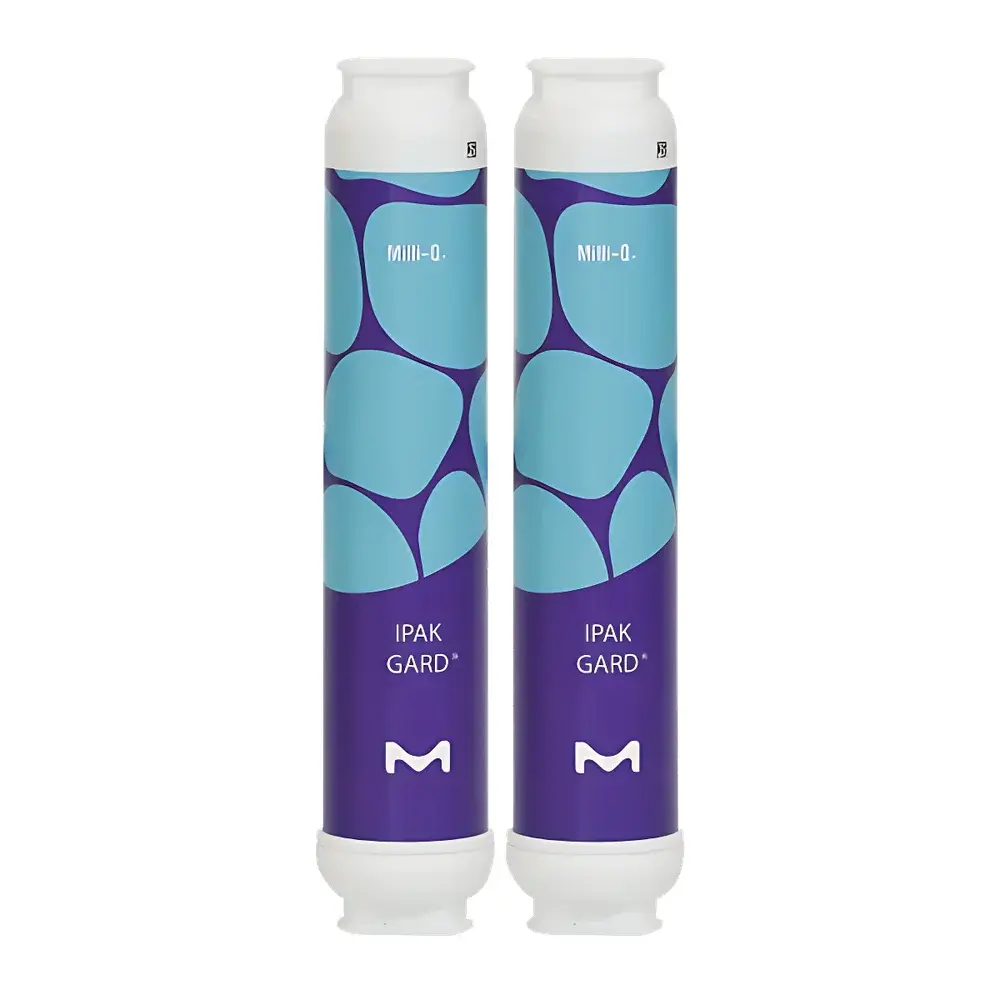
Merck Milli-Q IPAK Gard® Pre-Treatment Cartridge
| Brand | Merck |
|---|---|
| Origin | France |
| Manufacturer Type | Authorized Distributor |
| Origin Category | Imported |
| Model | IPAK Gard® |
| Pricing | Available Upon Request |
| Purified Water Grade | Type I (Ultra-Pure Water) |
| Resistivity | 18.2 MΩ·cm @ 25 °C |
| Heavy Metals & Soluble Silica | < 0.1 ppb |
| Total Organic Carbon (TOC) | < 5 ppb |
| Microbial Count / Endotoxins | < 0.001 EU/mL |
| Particles (> 0.1 µm) | < 1 particle/mL |
Overview
The Merck Milli-Q IPAK Gard® Pre-Treatment Cartridge is an engineered component designed for integration into ultra-pure water systems—specifically those within the Milli-Q portfolio—to ensure consistent feedwater quality prior to reverse osmosis (RO) and subsequent polishing stages. As a critical first-line defense in multi-stage water purification architectures, the IPAK Gard® cartridge operates on dual-mechanism filtration: pleated depth filtration combined with catalytic carbon adsorption. This design targets colloidal matter, suspended particulates (≥ 0.5 µm), free chlorine, chloramines, and low-molecular-weight organic contaminants—common challenges in municipal tap water supplies. Its function is not to produce Type I water directly, but to extend RO membrane life, reduce fouling frequency, and improve long-term system stability by delivering chemically and physically conditioned feedwater.
Key Features
- Pleated polypropylene depth filter media with high surface area and graded porosity, enabling efficient retention of sub-micron particles and colloids without rapid pressure drop.
- High-activity catalytic carbon core that dechlorinates via redox reaction—not simple adsorption—ensuring stable performance across variable chlorine concentrations and extended service life.
- Optional polyphosphate bead formulation available for regions with hard water; releases controlled doses of sequestering agents to inhibit CaCO₃ and CaSO₄ scale formation on downstream RO membranes.
- ISO 9001-certified manufacturing in France under Merck’s stringent quality control protocols; each batch traceable to production lot and validated for extractables compliance per USP and EP 2.2.42.
- Standardized 10-inch x 2.5-inch housing interface compatible with Milli-Q Integral, Advantage A10, and RiOs series pre-treatment modules.
Sample Compatibility & Compliance
The IPAK Gard® cartridge is intended exclusively for use with Merck Milli-Q ultra-pure water systems and must be installed upstream of the primary RO stage. It is not suitable for direct potable water treatment or industrial process streams outside certified laboratory water purification workflows. The cartridge complies with ISO 3696:1987 (Grade 1 water specifications), ASTM D1193-06 (Type I reagent water), and supports GLP/GMP-aligned operations when deployed in conjunction with Milli-Q systems configured for 21 CFR Part 11 audit trails. Endotoxin and microbial retention performance is verified per ISO 13408-1:2018 (sterile filtration validation principles), though the unit itself is not sterile upon delivery and requires system-integrated UV or 0.22 µm final filtration for endotoxin control.
Software & Data Management
While the IPAK Gard® cartridge is a passive hardware component with no embedded electronics or firmware, its operational status is monitored indirectly through Milli-Q system diagnostics—including inlet pressure differential, flow rate decay trends, and RO rejection efficiency metrics. When paired with Milli-Q Connect cloud-enabled platforms, cartridge replacement intervals can be logged, correlated with water quality logs (e.g., real-time resistivity, TOC, and particle counters), and integrated into preventive maintenance schedules. All usage data adheres to ALCOA+ principles (Attributable, Legible, Contemporaneous, Original, Accurate, Complete, Consistent, Enduring, Available) for regulatory submissions requiring full traceability.
Applications
- HPLC and UHPLC mobile phase preparation where chloride-induced column degradation or baseline drift must be minimized.
- Cell culture media formulation requiring low endotoxin and metal-free water to prevent cytotoxic effects.
- ICP-MS and GF-AAS analysis where sub-ppt elemental contamination could compromise detection limits.
- Next-generation sequencing library prep, where residual organics may inhibit enzymatic reactions or cause adapter dimer formation.
- Pharmaceutical QC labs operating under Annex 1 and USP purified water monograph requirements.
FAQ
What is the recommended service life of the IPAK Gard® cartridge?
Typical replacement interval is 6–12 months depending on inlet water quality (e.g., chlorine concentration, turbidity, hardness); system pressure differential > 0.3 bar above baseline indicates exhaustion.
Can IPAK Gard® be used with non-Merck water systems?
No—mechanical and hydraulic compatibility is validated only for Milli-Q platform integration; third-party use voids warranty and may compromise downstream purification performance.
Does the polyphosphate version affect TOC levels?
Polyphosphate beads are non-leaching and USP-grade; independent testing confirms no measurable TOC contribution (< 0.1 ppb) under normal operating conditions.
Is the cartridge sterilizable by autoclaving?
No—polypropylene and carbon components are not autoclave-rated; steam exposure degrades structural integrity and catalytic activity.
How is cartridge authenticity verified?
Each unit bears a unique QR code linked to Merck’s global serial registry; counterfeit detection is supported via Milli-Q system firmware v5.2+ authentication handshake during installation.



