
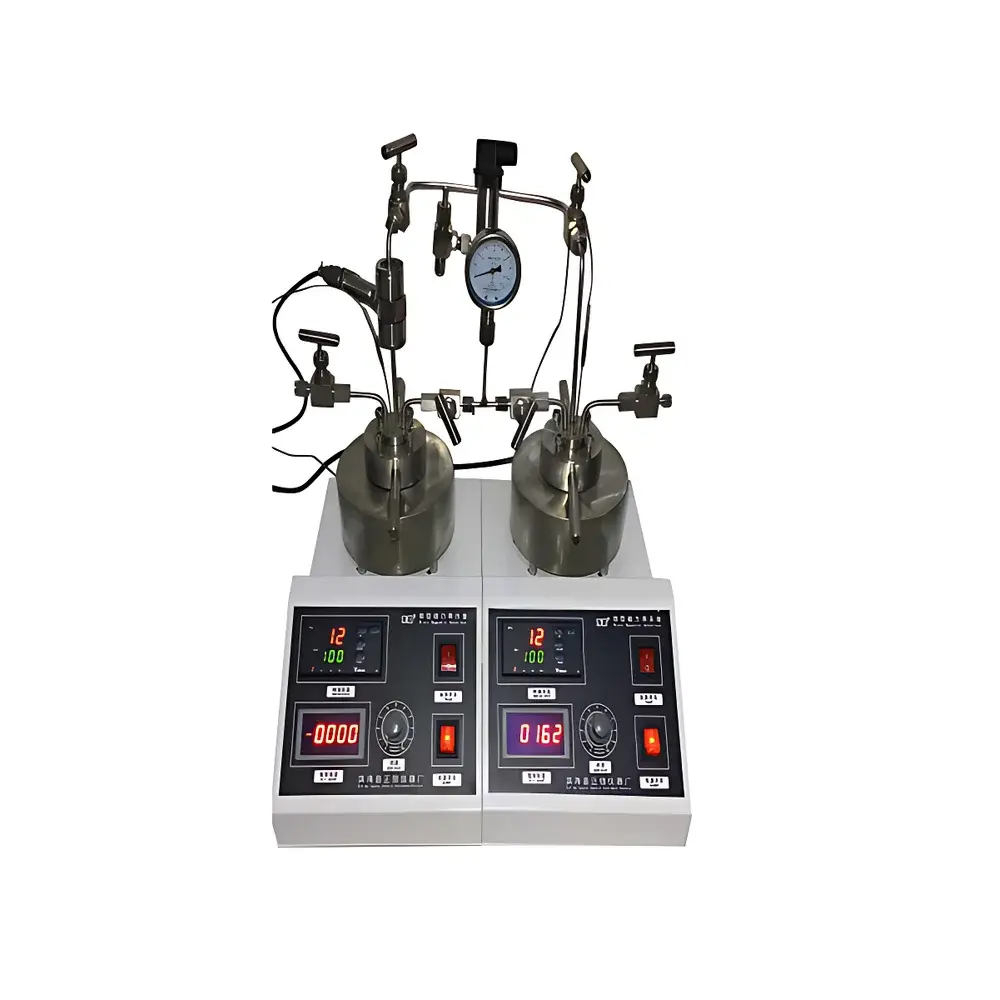
Zhengxin PSA-2 Dual-Station Magnetic Stirring Reactor System
| Brand | Zhengxin Instrument Factory |
|---|---|
| Origin | Jiangsu, China |
| Manufacturer Type | Authorized Distributor |
| Country of Origin | China |
| Model | PSA-2-100mL |
| Capacity | 100 mL per vessel (dual-station) |
| Vessel Material | Forged 316L stainless steel (optional: 304 SS, Hastelloy, titanium, zirconium, PTFE/PPL/quartz lining) |
| Operating Pressure Range | –0.1 to 60 MPa |
| Temperature Range | 0–350 °C |
| Heating Method | Modular electric heating block |
| Heating Power | 400–1800 W |
| Stirring Speed | 0–1500 rpm |
| Stirring Type | Magnetic coupling (external drive + internal magnetic stir bar) |
| Temperature Control | LCD-based PID controller with auto-tuning (AT), timer function (0–999 min/h), forward/reverse rotation capability |
| Vacuum Level | Up to –0.1 MPa (absolute) |
| Pressure Monitoring | Stainless steel analog pressure gauge |
| Compliance | Designed for laboratory-scale synthesis under GLP-aligned workflows |
| Accessories | High-pressure inlet/outlet needle valves (3 mm Swagelok®-compatible ferrule), PT100 immersion temperature sensor, explosion-proof safety shield (optional), liquid sampling tube (optional) |
Overview
The Zhengxin PSA-2 Dual-Station Magnetic Stirring Reactor System is an engineered solution for parallel small-volume chemical synthesis, catalytic screening, and kinetic studies under controlled temperature, pressure, and inert-atmosphere conditions. Based on sealed-vessel batch reactor architecture, the system employs magnetic coupling to transmit rotational torque across pressure-tight boundaries—eliminating mechanical shaft seals and minimizing leakage risk. Each reactor station operates independently, enabling comparative experiments (e.g., catalyst A vs. catalyst B under identical thermal profiles) or process parameter optimization (temperature, residence time, gas partial pressure) without cross-contamination. The dual-station configuration supports reproducible scale-down studies aligned with ASTM E2500 and ICH Q5C guidelines for process validation support. Constructed from forged 316L stainless steel, the vessels meet ASME BPVC Section VIII Div. 1 design principles for low-to-medium pressure containment (≤60 MPa), with optional linings (PTFE, PPL, quartz) accommodating aggressive reagents including HF, oleum, or anhydrous halides.
Key Features
- Forged 316L stainless steel reactor bodies with electropolished interior finish (Ra ≤ 0.4 µm) for corrosion resistance and ease of cleaning.
- Modular electric heating blocks with uniform thermal distribution (±1.5 °C across vessel height), rated for continuous operation up to 350 °C.
- High-torque brushless DC motor driving external magnetic drive assembly—capable of sustaining 1500 rpm under viscous load (up to 5000 mPa·s) without speed drift.
- PID temperature controller with auto-tuning (AT) algorithm, real-time deviation compensation, and dual timer modes:恒温定时 (isothermal hold timer) and 运行定时 (total run timer).
- Integrated pressure monitoring via calibrated stainless steel Bourdon-tube gauge (0–60 MPa range, Class 1.6 accuracy), supplemented by optional digital pressure transducer output (4–20 mA) for data logging.
- Gas handling subsystem with dual 3 mm Swagelok®-compatible needle valves (inlet/outlet), enabling vacuum evacuation (down to –0.1 MPa abs), inert gas purging (N₂, Ar), and controlled reagent dosing.
- Quick-release flange design with dual-seal configuration (metal C-ring + elastomer O-ring) ensures leak-tight integrity during thermal cycling and pressure ramping.
Sample Compatibility & Compliance
The PSA-2 accommodates heterogeneous, homogeneous, and gas–liquid–solid reaction systems. Standard configurations support organic synthesis (Grignard, hydrogenation, amidation), hydrothermal crystallization, electrochemical precursor preparation, and polymerization initiation. Optional linings extend compatibility to hydrofluoric acid, molten alkali metals, and high-purity semiconductor precursors. All wetted materials comply with USP Class VI biocompatibility requirements where applicable. The system is designed to operate within ISO/IEC 17025-accredited laboratories; pressure and temperature control logs—when paired with optional RS485/Modbus-enabled controllers—support audit trails compliant with FDA 21 CFR Part 11 for electronic records and signatures.
Software & Data Management
While the base unit features standalone LCD PID operation, optional integration with Zhengxin’s ZxControl v3.2 software enables centralized monitoring of both reactors via USB or Ethernet. Software functions include real-time graphing of T/P/rpm trends, automated CSV export, alarm-triggered email notifications (e.g., overpressure, temperature deviation > ±3 °C), and GLP-compliant electronic lab notebook (ELN) metadata tagging (operator ID, batch ID, SOP version). Raw sensor data (PT100 resistance, strain-gauge pressure feedback) is timestamped at 1 Hz resolution and stored with cryptographic hash verification to prevent post-acquisition tampering.
Applications
- Catalyst screening campaigns requiring statistical replication under identical thermal–pressure histories.
- Hydrogenation kinetics studies using H₂ partial pressure control and in situ temperature profiling.
- Development of metal–organic frameworks (MOFs) via solvothermal synthesis with precise nucleation temperature ramps.
- Stability testing of pharmaceutical intermediates under accelerated oxidative stress (O₂ headspace, elevated T/P).
- Academic research in green chemistry: solvent-free esterification, mechanochemical activation in confined volume.
FAQ
Can the PSA-2 be operated under vacuum and positive pressure in the same experiment?
Yes—the dual needle valve configuration allows sequential vacuum degassing, inert gas backfilling, and subsequent pressurization to target setpoints up to 60 MPa.
Is third-party calibration documentation available for the pressure gauge and temperature sensor?
Calibration certificates traceable to NIM (National Institute of Metrology, China) are provided upon request, with optional UKAS or DAkkS accreditation via authorized metrology partners.
What safety certifications does the system carry?
The electrical heating module conforms to IEC 61010-1:2010 for laboratory equipment; pressure vessels are CE-marked per PED 2014/68/EU when configured with certified relief devices.
Can custom reactor geometries or port layouts be fabricated?
Yes—Zhengxin accepts OEM drawings for non-standard flange patterns, additional sampling ports, or integrated sight glasses, subject to minimum order quantity and lead-time agreement.
How is maintenance performed on the magnetic drive assembly?
The external magnet rotor and internal stir bar require no scheduled lubrication; periodic inspection of the static seal integrity (every 200 cycles) is recommended using helium leak detection per ASTM E499.



