
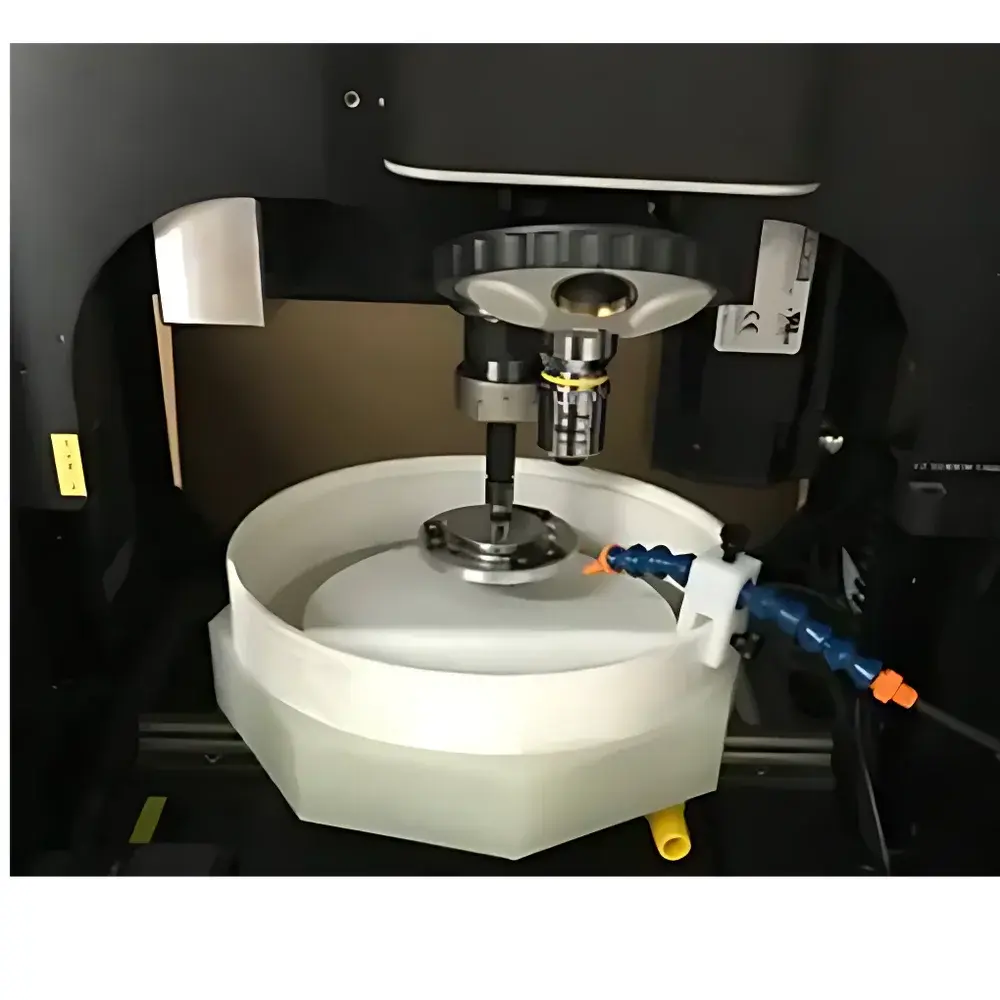
Rtec CP-6 Chemical Mechanical Polishing (CMP) Tester
| Brand | Rtec |
|---|---|
| Origin | Switzerland |
| Model | CP-6 |
| Dimensions (L×W×D) | 770 × 920 × 1860 mm |
| Platen Count | 1 |
| Platen Diameter | 400 mm |
| Platen Speed | 0–90 rpm |
| Integrated In-situ Sensors | Friction Torque, Acoustic Emission, Surface Temperature |
| Motion Control | Motorized X-Y Stage with Programmable Wafer Oscillation |
| In-line 3D Profilometry | Confocal + Interferometric + Bright/Dark Field Modes |
| Vertical Load Range | Programmable (Typical Range: 0–50 N, Configurable per Application) |
| Sample Compatibility | 50–300 mm wafers and substrates |
| Compliance | Designed for ASTM F2639, ISO/IEC 17025-aligned workflows, supports GLP/GMP data integrity requirements |
Overview
The Rtec CP-6 Chemical Mechanical Polishing (CMP) Tester is a research-grade, in-situ metrology-integrated platform engineered for fundamental investigation and process optimization of CMP in semiconductor fabrication, advanced packaging, and functional thin-film development. Unlike conventional benchtop polishers, the CP-6 implements a true tribological test architecture grounded in controlled Couette flow mechanics, interfacial shear stress measurement, and real-time surface topography evolution tracking. It operates by applying precisely regulated normal load and rotational motion between a rotating platen and a wafer/substrate mounted on a motorized carrier, while simultaneously acquiring synchronized physical and topographic data streams. This enables quantitative correlation between mechanical input parameters (load, speed, oscillation profile), interfacial phenomena (friction coefficient, acoustic emission bursts, localized temperature rise), and surface output metrics (removal rate, roughness evolution, pad wear volume, defect generation). The system is purpose-built for method development, slurry evaluation, pad conditioning studies, endpoint detection algorithm validation, and failure root-cause analysis under reproducible, instrumented conditions.
Key Features
- Integrated in-situ 3D surface profilometer with sub-10 nm vertical resolution, combining confocal microscopy, white-light interferometry, and bright/dark field imaging for multi-modal surface characterization during polishing
- High-fidelity torque sensor (±0.001 N·m resolution) enabling real-time friction coefficient calculation and endpoint detection based on dynamic shear response
- Acoustic emission (AE) monitoring channel for non-invasive detection of abrasive fracture, particle agglomeration, or micro-defect formation at the wafer-pad interface
- Dual-point thermocouple array for simultaneous measurement of polishing pad surface temperature and near-wafer interfacial temperature, supporting thermal removal mechanism studies
- Motorized X-Y translation stage with programmable oscillation patterns (linear, circular, Lissajous), allowing precise simulation of production-style carrier motion and multi-axis trajectory synthesis
- Software-controlled variable downforce (0–50 N typical range) and platen speed (0–90 rpm), fully decoupled and independently adjustable for DOE-driven process mapping
- Quick-change carrier system accommodating wafers from 50 mm to 300 mm diameter, with optional vacuum chucking and edge-guard configurations
Sample Compatibility & Compliance
The CP-6 accommodates rigid and semi-rigid planar substrates including silicon, SiC, GaN, sapphire, glass, and metal-coated wafers. Its modular carrier design supports standard SEMI-compliant backside handling and enables integration with electrochemical modules for electrochemical-mechanical polishing (ECMP) studies. All hardware and firmware comply with CE marking directives for laboratory equipment. Data acquisition and storage adhere to principles aligned with ISO/IEC 17025:2017 for testing laboratories, and audit trails, electronic signatures, and user-access controls meet foundational expectations for FDA 21 CFR Part 11 compliance in regulated environments. Calibration protocols follow traceable NIST standards where applicable.
Software & Data Management
The proprietary Rtec CMP Studio software provides a unified interface for experiment sequencing, real-time parameter visualization, and post-test multi-channel data fusion. Users define recipes using hierarchical templates—preloaded with ASTM F2639-compliant test sequences—or build custom workflows via drag-and-drop logic blocks. All raw sensor signals (torque, AE RMS, temperature, Z-position) are timestamped and stored in HDF5 format for interoperability with MATLAB, Python (NumPy/Pandas), and JMP. The software includes built-in algorithms for automatic endpoint identification (derivative-based torque inflection, AE energy thresholding), 3D wear volume quantification via surface registration and difference mapping, and ISO 25178-compliant roughness parameter extraction (Sa, Sq, Sz, Sdr). Audit logs record all user actions, parameter changes, and calibration events with immutable timestamps.
Applications
- Slurry formulation screening: Quantifying removal rate vs. pH, oxidizer concentration, and abrasive type under identical mechanical conditions
- Pad wear modeling: Correlating cumulative material loss (measured volumetrically via 3D profilometry) with frictional work and thermal accumulation
- Endpoint detection validation: Benchmarking optical, electrical, and mechanical endpoint methods against in-situ torque and AE signatures
- Defect mechanism analysis: Linking AE burst patterns and localized temperature spikes to scratch formation or delamination onset
- Process window definition: Mapping stability boundaries for planarity, dishing, and erosion across load/speed/oscillation parameter space
- Advanced substrate preparation: Optimizing CMP for compound semiconductors, TSVs, and heterogeneous integration stacks requiring sub-nanometer surface control
FAQ
What wafer sizes does the CP-6 support?
The system accepts substrates from 50 mm (2″) up to 300 mm (12″) in diameter using interchangeable carriers and centering fixtures.
Is the 3D profilometer capable of measuring during active polishing?
Yes—the integrated optical head is synchronized with platen rotation and carrier motion, enabling continuous topographic capture at up to 10 Hz frame rate without interrupting the polishing process.
Can the CP-6 be used for electrochemical-mechanical polishing (ECMP)?
The platform features auxiliary I/O ports and mounting provisions for integrating potentiostats and electrolyte delivery systems; ECMP-ready configurations are available upon request.
How is data traceability ensured for regulatory submissions?
All measurements include embedded metadata (user ID, timestamp, calibration status, environmental conditions), and the software supports 21 CFR Part 11-compliant electronic signatures and role-based access control.
What maintenance is required for long-term torque sensor accuracy?
The high-resolution torque transducer is factory-calibrated and requires no routine recalibration; annual verification against traceable reference standards is recommended for GxP applications.



