
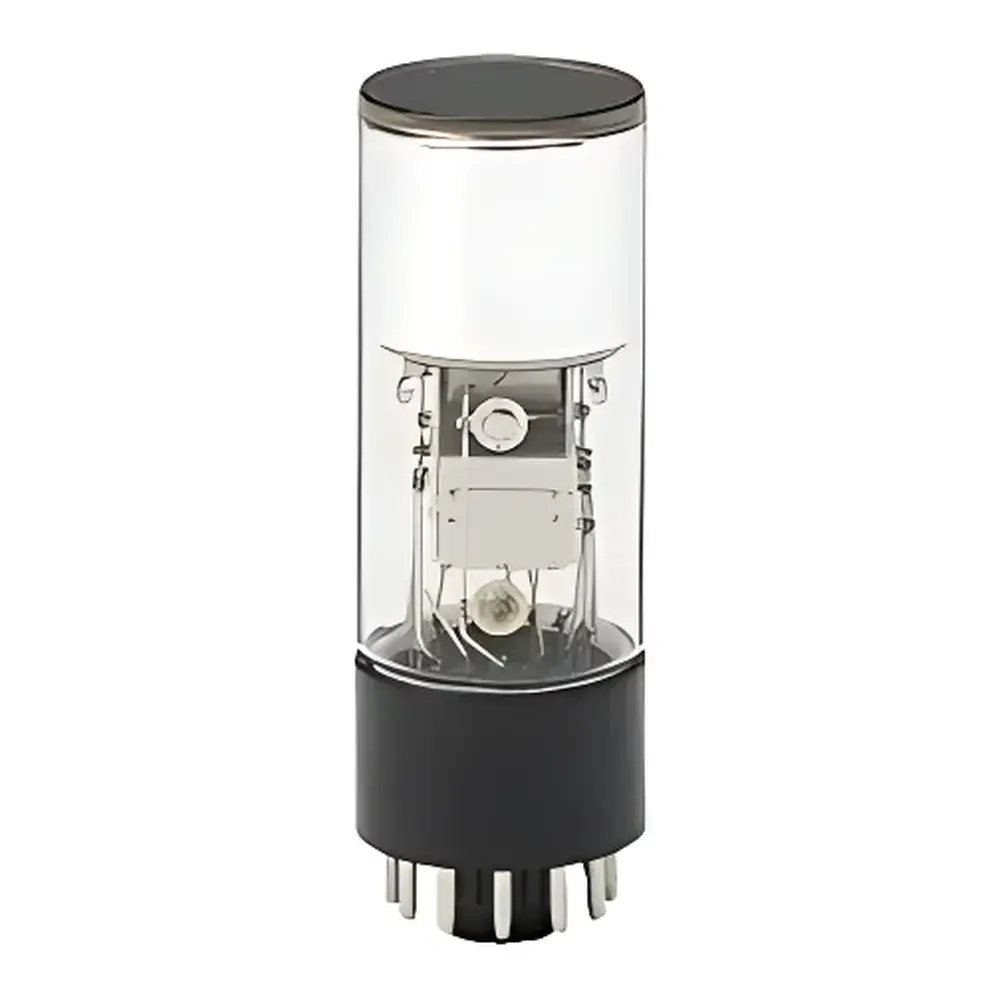
Hamamatsu R-Series End-Window Photomultiplier Tubes (PMTs)
| Origin | Israel |
|---|---|
| Supplier Type | Authorized Distributor |
| Origin Category | Imported |
| Model Series | R-Series |
| Pricing | Available Upon Request |
Overview
Hamamatsu R-Series end-window photomultiplier tubes (PMTs) are high-gain, vacuum-based photon detection devices engineered for ultra-low-light measurement applications across spectroscopy, analytical instrumentation, and fundamental research. Operating on the principle of secondary electron emission within a multi-stage dynode chain, these PMTs convert incident photons—typically in the ultraviolet to near-infrared spectral range—into measurable electrical current with single-photon sensitivity, sub-nanosecond temporal resolution, and exceptional signal-to-noise ratio. Designed to interface seamlessly with spectrometers, fluorometers, scintillation counters, and time-resolved optical systems, the R-Series offers standardized mechanical configurations and stable gain characteristics under controlled bias voltage conditions. Their performance is governed by quantum efficiency, cathode spectral response, dark current, pulse linearity, and afterpulse behavior—all critical parameters for quantitative photometric analysis in regulated environments.
Key Features
- End-window geometry optimized for direct illumination and uniform photocathode response across active aperture
- Wide spectral coverage: selectable short-wavelength cutoffs down to 115 nm (solar-blind UV), long-wavelength limits up to 1700 nm (extended InGaAs-based variants)
- Multiple standard envelope diameters: 10 mm to 132 mm; square formats including 10×10 mm, 24×24 mm, 60×60 mm, and 76×76 mm
- High quantum efficiency cathodes: bialkali (S-20), multialkali (S-25), GaAsP, and solar-blind Cs-Te options available per model
- Stable gain reproducibility (<±5% unit-to-unit variation at fixed HV) and low dark count rates (<100 cps typical at 25°C for 25-mm tubes)
- Ruggedized ceramic/metal construction compliant with IEC 61000-4 EMC immunity standards and RoHS directives
Sample Compatibility & Compliance
The R-Series PMTs are compatible with standard C-mount, flange-mounted, or custom-integrated optical housings used in OEM spectrometers, atomic absorption analyzers, and laser-induced fluorescence platforms. Each tube undergoes individual calibration traceable to NIST-certified radiometric standards, with documented spectral responsivity curves supplied per lot. Units intended for regulated laboratory use meet ISO/IEC 17025 requirements for detector characterization and are suitable for GLP/GMP-compliant workflows where audit-ready documentation—including gain vs. voltage curves, dark current profiles, and pulse height distribution data—is required. For pharmaceutical QC applications involving USP or ASTM E275-22 spectrophotometric validation, Hamamatsu provides optional factory-applied calibration certificates and serial-numbered test reports.
Software & Data Management
While the R-Series PMTs operate as analog signal sources, they integrate directly with industry-standard data acquisition systems such as National Instruments DAQmx, Keysight U1001A digitizers, and Becker & Hickl SPC-150N TCSPC modules. Hamamatsu’s optional PMT evaluation kits include LabVIEW-compatible drivers and Python APIs for real-time gain stabilization, temperature-compensated bias control, and pulse counting histogram generation. All firmware and configuration files adhere to IEEE 1588 Precision Time Protocol (PTP) synchronization standards when deployed in multi-channel coincidence-detection setups. Audit trails for HV settings, operating hours, and thermal drift logs can be exported in CSV or HDF5 format for 21 CFR Part 11–compliant electronic records management.
Applications
- Spectroscopic detection in UV-Vis-NIR absorbance, fluorescence, and Raman spectrometers
- Low-level chemiluminescence and bioluminescence quantification in clinical immunoassays
- Scintillation counting for gamma-ray spectroscopy and environmental radionuclide monitoring
- Laser scanning confocal microscopy (LSCM) and time-correlated single-photon counting (TCSPC)
- Plasma diagnostics and thin-film thickness monitoring via optical emission spectroscopy (OES)
- Neutrino detection infrastructure and high-energy physics experiments requiring large-area photon collection
FAQ
What is the typical rise time and transit time spread (TTS) for R-Series PMTs?
Typical anode rise time ranges from 1.2 ns to 4.5 ns depending on tube diameter and dynode structure; TTS is specified between 0.8 ns and 2.3 ns FWHM for fast-timing models.
Are R-Series PMTs compatible with magnetic shielding requirements in MRI-adjacent instrumentation?
Yes—optional mu-metal shielding sleeves and magnetically insensitive dynode configurations (e.g., box-and-grid or linear-focused) are available upon request.
Can Hamamatsu provide spectral calibration data for specific lot numbers?
Yes—certified spectral responsivity curves (A/W vs. wavelength) and quantum efficiency plots are included with each shipment for traceability.
Do these PMTs require regulated high-voltage power supplies?
Yes—stable operation mandates low-noise, ripple-free HV sources (e.g., Hamamatsu C11204 series) delivering ±0.01% voltage stability over 8-hour continuous operation.
Is there a recommended warm-up period before achieving photometric stability?
A minimum 30-minute thermal equilibration is advised prior to quantitative measurements to minimize gain drift and dark current drift.
Related Products





