
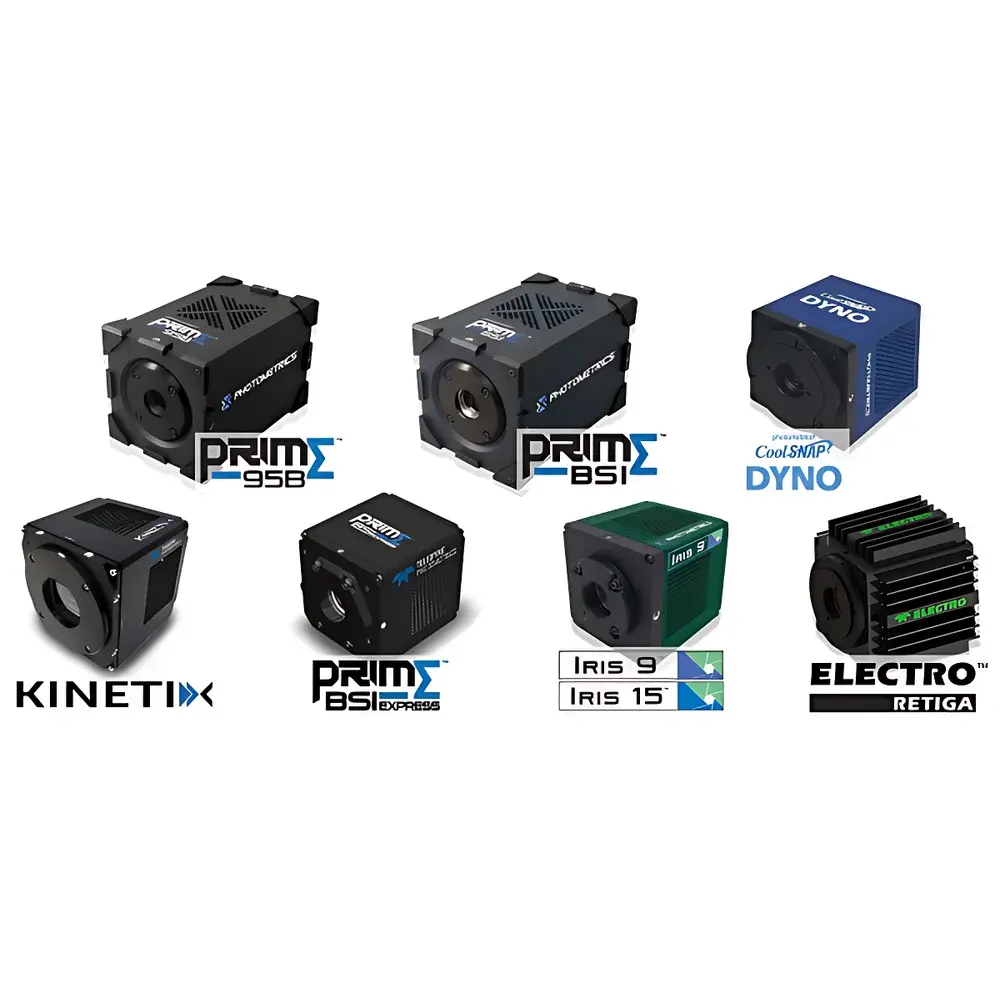
Teledyne Photometrics Kinetix High-Speed Large-Field-of-View sCMOS Camera
| Brand | Teledyne Photometrics |
|---|---|
| Origin | USA |
| Model | Kinetix |
| Image Resolution | 3200 × 3200 |
| Pixel Size | 6.5 µm × 6.5 µm |
| Sensor Format | 20.8 mm × 20.8 mm (29 mm diagonal) |
| Readout Speed | 400 fps at full resolution |
| Dynamic Range | 16-bit |
| Quantum Efficiency | 95% |
| Interface | PCIe Gen3 x4 |
| Cooling | Thermoelectric (TE), adjustable to −10 °C below ambient |
Overview
The Teledyne Photometrics Kinetix is a scientific-grade sCMOS camera engineered for demanding quantitative fluorescence microscopy, high-speed live-cell imaging, and wide-field structural biology applications. Built upon a back-illuminated, large-format sCMOS sensor, the Kinetix delivers an optimal balance of speed, field of view, sensitivity, and dynamic range—enabling researchers to capture rapid biological events across expansive sample areas without compromising photon detection fidelity. Its measurement principle relies on high-fidelity photon-to-digital conversion via a low-noise, correlated double sampling (CDS) architecture, combined with advanced on-chip binning and parallel readout channels. With a 29 mm diagonal field of view—the largest among commercially available sCMOS cameras at full-frame 3200 × 3200 resolution—the Kinetix eliminates the need for image tiling or stage scanning in many wide-field applications, reducing acquisition time and motion-induced artifacts.
Key Features
- Back-illuminated sCMOS sensor with 95% peak quantum efficiency at 560 nm—maximizing signal capture from common fluorophores including GFP, mCherry, and Alexa Fluor dyes.
- Full-resolution frame rate of 400 fps over 3200 × 3200 pixels—supporting sub-second temporal resolution for calcium dynamics, vesicle trafficking, and cilia beating analysis.
- True 16-bit digitization with >30,000:1 dynamic range—enabling simultaneous visualization of dim and saturated structures within a single exposure.
- 6.5 µm pixel pitch optimized for diffraction-limited imaging with 40×–100× objectives; maintains Nyquist sampling while minimizing read noise (≤1.3 e⁻ RMS typical).
- Thermoelectric cooling system stabilizes sensor temperature up to 10 °C below ambient—reducing dark current to <0.5 e⁻/pix/sec at −10 °C, critical for long-exposure super-resolution or TIRF experiments.
- PCIe Gen3 ×4 interface ensures sustained data throughput >2.5 GB/s—eliminating frame buffering bottlenecks during continuous high-speed acquisition.
Sample Compatibility & Compliance
The Kinetix integrates seamlessly into inverted and upright microscope platforms from Nikon, Olympus, Zeiss, and Leica via standard C-mount or F-mount adapters. It supports both epifluorescence and transmitted-light modalities—including brightfield, DIC, and phase contrast—and is routinely deployed in confocal, light-sheet, and structured illumination microscopy (SIM) systems. From a regulatory standpoint, the camera’s firmware and driver architecture support audit-ready operation in GLP- and GMP-compliant environments. While the hardware itself is not FDA-cleared as a medical device, its output data meets ISO/IEC 17025 traceability requirements when used with calibrated light sources and documented acquisition protocols. Firmware logging includes timestamped metadata (exposure, gain, temperature, ROI settings), satisfying basic 21 CFR Part 11 electronic record integrity criteria when paired with compliant host software.
Software & Data Management
The Kinetix is fully supported by Photometrics’ proprietary Vision software (Windows/Linux/macOS), offering real-time display, hardware-triggered acquisition, multi-channel time-lapse sequencing, and ROI-based binning. It also provides native SDKs (C/C++, Python, MATLAB) for integration into custom acquisition pipelines—commonly used in automated high-content screening (HCS) and AI-driven image analysis workflows. All acquired frames are saved in standardized, non-proprietary formats (TIFF, HDF5) with embedded EXIF-like metadata, ensuring compatibility with open-source tools such as Fiji/ImageJ, QuPath, and Napari. Onboard FPGA-based preprocessing options include flat-field correction, background subtraction, and real-time histogram equalization—reducing post-acquisition computational load without altering raw data provenance.
Applications
- Live-cell calcium imaging in neuronal networks and cardiomyocytes requiring both spatial coverage and temporal fidelity.
- Wide-field single-molecule localization microscopy (SMLM), where high QE and low noise directly improve localization precision and labeling density tolerance.
- High-throughput phenotypic screening in drug discovery, leveraging the large FOV to monitor hundreds of wells or organoids per acquisition cycle.
- Dynamic intracellular organelle tracking—including mitochondria fission/fusion, lysosomal motility, and Golgi reorganization—under physiological shear or pharmacological perturbation.
- Developmental biology studies in zebrafish, Drosophila, and C. elegans embryos, where extended depth-of-field illumination benefits from uniform illumination across the full sensor area.
FAQ
What is the maximum sustained frame rate at region-of-interest (ROI) modes?
At 1024 × 1024 ROI, the Kinetix achieves up to 1,200 fps; at 512 × 512, it reaches 2,500 fps—maintaining full 16-bit depth and linearity.
Does the Kinetix support hardware synchronization with external devices?
Yes—TTL-compatible trigger input/output ports enable precise coordination with lasers, shutters, piezo stages, and other synchronized peripherals.
Is there a vacuum-cooled variant available for ultra-low-noise applications?
No—vacuum-cooled variants are not offered for the Kinetix platform; thermoelectric cooling to −10 °C is the standard thermal management solution.
Can the Kinetix be used with third-party microscope control software such as Micro-Manager or μManager?
Yes—fully compatible via the official Micro-Manager device adapter (v2.0+), supporting all core acquisition functions including multi-dimensional timelapse and hardware triggering.
What is the sensor’s full-well capacity and how does it impact dynamic range?
The sensor features a nominal full-well capacity of ~30,000 e⁻—combined with sub-electron read noise, this yields an effective dynamic range exceeding 30,000:1, validated per EMVA 1288 standards.





