
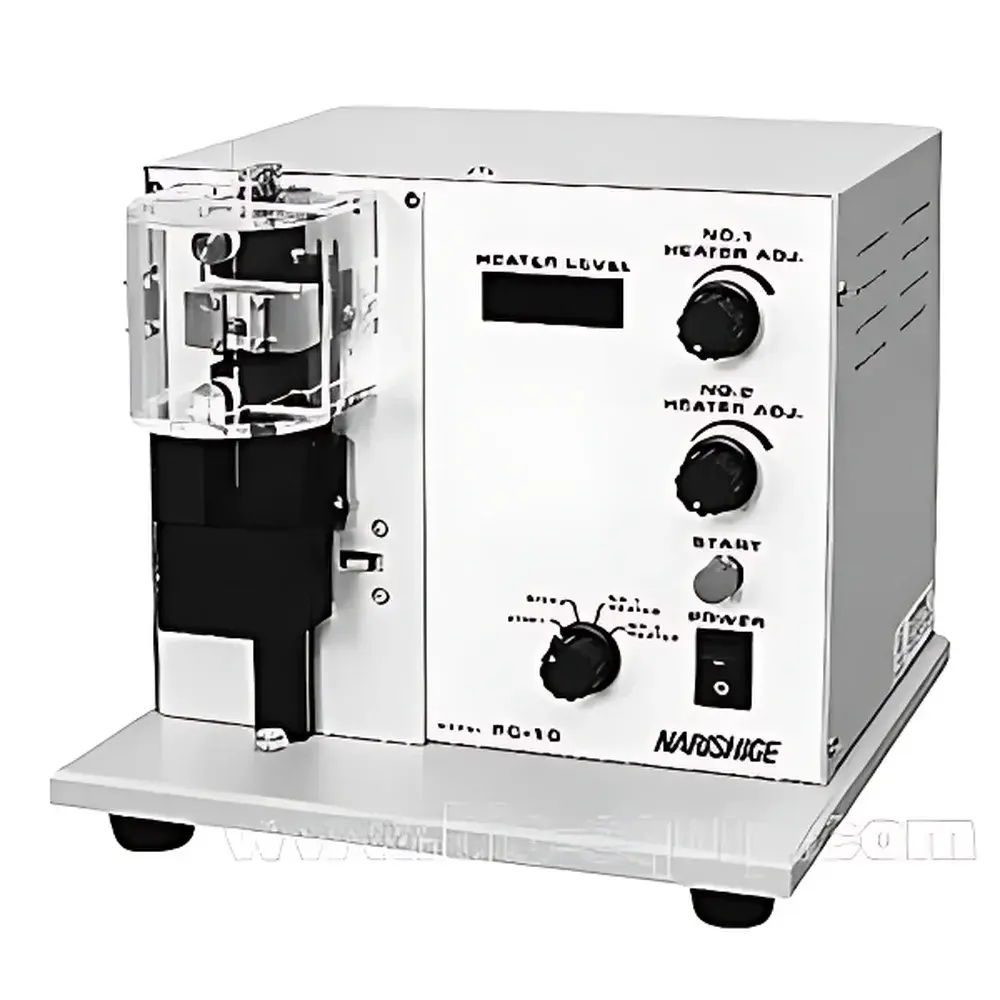
Narishige PC-100 Micropipette Puller
| Brand | Narishige |
|---|---|
| Origin | Japan |
| Model | PC-100 |
| Pulling Modes | Single- and Double-Pull |
| Tip Diameter Range | 0.1 µm (single-pull) to several–tens of µm (double-pull) |
| Capillary Compatibility | 1.0–1.5 mm OD glass capillaries |
| Heating Control | Digital voltage display with voltage stabilization |
| Preheating Function | Yes |
| Pulling Environment | Enclosed draft-free chamber |
| Power Supply | AC 100–240 V, 50/60 Hz |
Overview
The Narishige PC-100 Micropipette Puller is an entry-level, benchtop-controlled horizontal pipette puller engineered for reproducible fabrication of precision glass micropipettes used in electrophysiology, microinjection, patch-clamp recording, and intracellular delivery applications. It operates on the principle of resistive heating and controlled mechanical tension: a precisely regulated current passes through a platinum or nichrome wire heater loop positioned around a vertically suspended glass capillary; upon reaching the softening temperature of borosilicate or soda-lime glass (~600–800 °C), symmetric axial tension is applied to draw the molten zone into two tapered, mirror-symmetric pipettes. The PC-100 implements this fundamental two-stage thermomechanical process—heat initiation followed by programmable pull timing and force—with digital feedback control over heater voltage, enabling consistent thermal input across successive pulls. Its compact horizontal architecture minimizes footprint while maintaining mechanical rigidity critical for tip symmetry and reproducibility.
Key Features
- Dual-mode pulling capability: supports both single-pull (for blunt or moderately tapered electrodes) and double-pull (for ultra-fine, symmetrical tips with independent control of front/back taper angles)
- Digital voltage display with built-in voltage stabilization circuitry ensures consistent heater power delivery across ambient fluctuations, directly contributing to inter-run repeatability
- Integrated preheating function allows capillary equilibration prior to pull initiation—reducing thermal shock and improving tip geometry consistency
- Optically enclosed, draft-free pulling chamber eliminates convective air currents that cause asymmetric necking or bending during drawdown
- Simple parameter interface with dedicated dials for heat, pull, and velocity settings—no software installation or computer dependency required
- Designed for standard 1.0–1.5 mm outer diameter borosilicate glass capillaries (e.g., Sutter BF150-110-10, Harvard 30-30-1), compatible with filament-based and laser-assisted coating workflows
Sample Compatibility & Compliance
The PC-100 accommodates standard thin-walled and thick-walled borosilicate glass capillaries (e.g., GC150TF-10, TW100F-4) commonly used in neuroscience and developmental biology laboratories. While the instrument itself does not carry CE, UKCA, or FDA clearance as a medical device, its output—micropipettes—is routinely employed in GLP-compliant electrophysiology assays and ISO 13485-aligned in vitro diagnostic development workflows. Users are responsible for validating pipette geometry (tip opening, wall thickness, taper angle) per application-specific requirements (e.g., ASTM F2985 for microelectrode characterization, USP for particle size distribution of injected formulations). No hazardous materials or regulated substances are consumed during operation.
Software & Data Management
The PC-100 is a standalone analog-digital hybrid instrument with no embedded firmware, network interface, or data logging capability. All operational parameters—including heater voltage (displayed in volts), pull duration (ms), and pull speed (arbitrary units)—are set manually via front-panel controls and observed in real time. This design prioritizes reliability, electromagnetic immunity, and ease of qualification in regulated environments where audit trails and electronic records are managed externally (e.g., via lab notebooks compliant with 21 CFR Part 11 when paired with validated SOPs). Parameter replication relies on documented operator protocols rather than software-based method storage.
Applications
- Production of patch-clamp electrodes for whole-cell and cell-attached recordings in primary neuronal cultures and brain slices
- Fabrication of injection pipettes for zygote microinjection (e.g., CRISPR/Cas9 RNP delivery in mouse or zebrafish embryos)
- Generation of recording electrodes for extracellular field potential measurements in acute tissue preparations
- Preparation of aspiration pipettes for single-cell isolation and cytoplasmic content extraction
- Routine maintenance of pipette inventories in core electrophysiology or transgenic facility labs requiring high-volume, low-variability output
FAQ
What types of glass capillaries are compatible with the PC-100?
Standard 1.0–1.5 mm outer diameter borosilicate capillaries with wall thicknesses ranging from 0.5 to 1.0 mm are recommended. Quartz and fused silica capillaries are not supported due to higher softening temperatures.
Can the PC-100 produce patch pipettes with sub-micron tip openings?
Yes—single-pull mode routinely achieves tip inner diameters of ~0.1 µm under optimized conditions; double-pull mode offers greater control over tip geometry but typically yields larger openings (1–20 µm), depending on pull parameters and glass composition.
Is calibration required before use?
No formal calibration is specified by Narishige; however, users should perform initial validation using scanning electron microscopy (SEM) or optical interferometry to correlate voltage/duration settings with resulting tip dimensions for their specific capillary batch and ambient conditions.
Does the PC-100 support automated protocol loading?
No—it is a manually operated instrument without memory, USB, or serial connectivity. Method transfer depends on standardized operator training and written SOPs.
What maintenance does the heater filament require?
Platinum or nichrome heater loops require periodic visual inspection for deformation or oxidation; replacement is recommended after ~500–1000 pulls or if inconsistent heating is observed. Cleaning with ethanol-soaked lint-free swabs is advised between sessions.




