
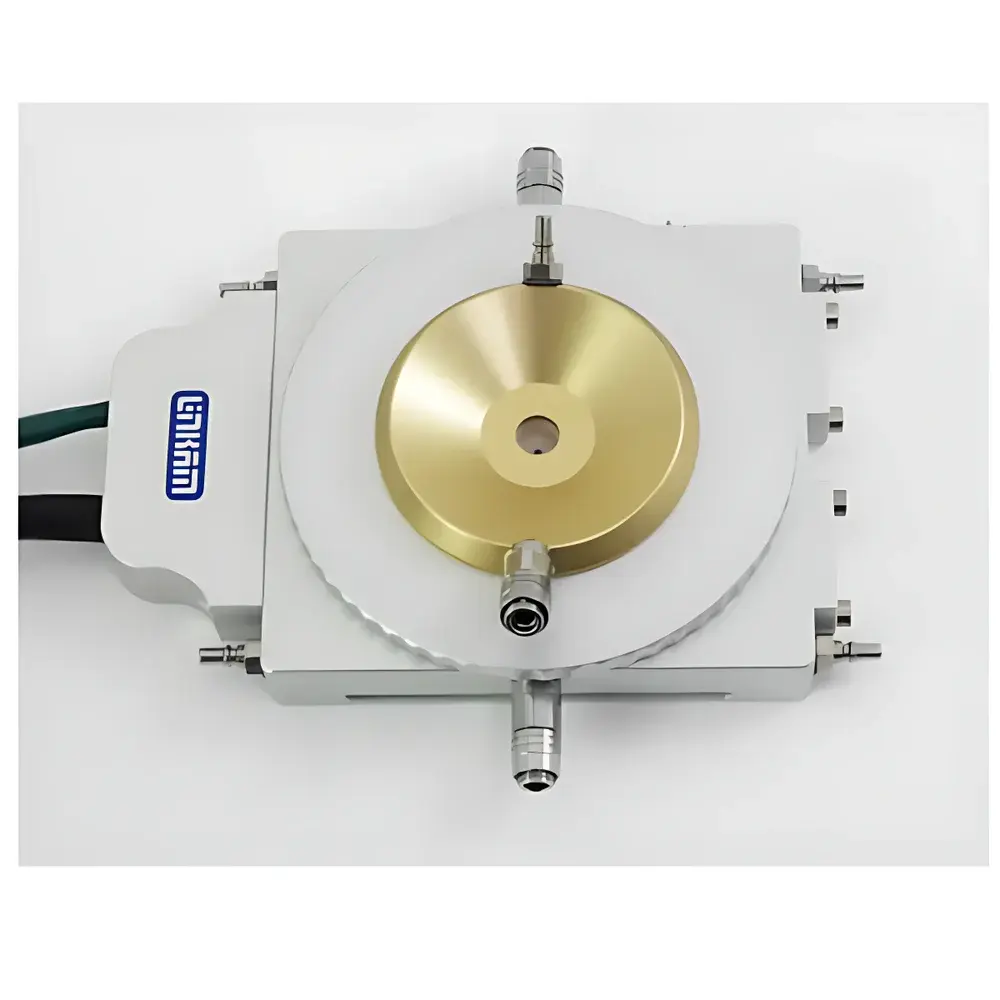
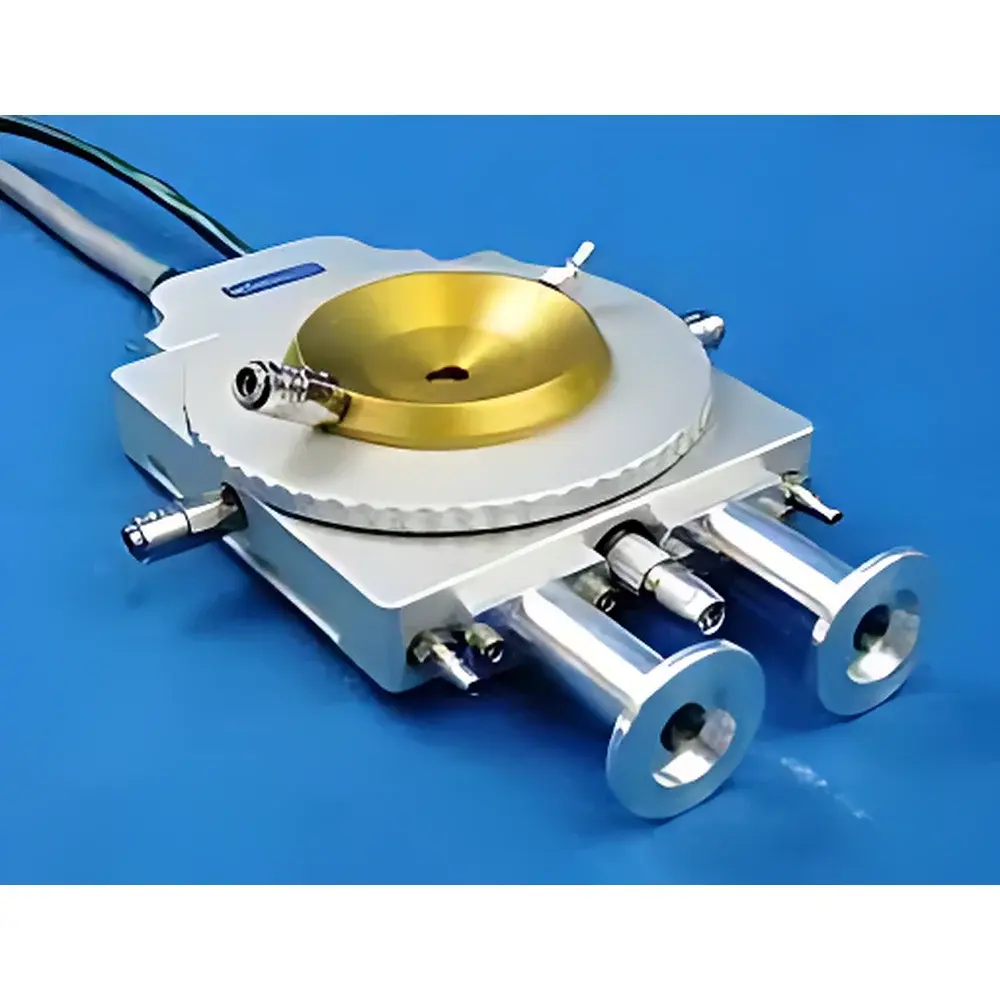
Linkam TS1500 High-Temperature Heating Stage
| Brand | Linkam |
|---|---|
| Origin | United Kingdom |
| Model | TS1500 |
| Temperature Range | Ambient to 1500 °C |
| Temperature Accuracy & Stability | ±1 °C over full range |
| Optical Aperture Diameter | 1.7 mm |
| Sample Chamber Dimensions | φ7 × 6 mm or φ7 × 3 mm |
| Maximum Heating Rate | 200 °C/min |
| Minimum Objective/Condenser Working Distance | 6.0 mm / 14.8 mm |
| Vacuum Compatibility | Down to 10⁻³ mbar |
Overview
The Linkam TS1500 High-Temperature Heating Stage is an engineered solution for in situ thermal analysis under optical microscopy, specifically designed for metallurgical, ceramic, geological, and high-performance polymer research. It operates on resistive heating principles using a platinum-wound ceramic crucible as the primary thermal element, enabling precise, repeatable temperature control from ambient up to 1500 °C. The stage integrates a calibrated thermocouple bonded flush with the inner surface of the crucible, ensuring direct contact measurement at the sample plane. A 7 mm sapphire window serves as both the sample support and thermal conduction interface—selected for its exceptional thermal conductivity (>35 W/m·K at 1000 °C), optical transparency across visible and near-IR spectra, and mechanical stability under thermal cycling. Radiant heat distribution is optimized via a double-shielded, water-cooled aluminum housing and a removable radiation shield cap, minimizing thermal gradient across the optical path and protecting objective lenses from radiative loading.
Key Features
- Full-range temperature control from ambient to 1500 °C with ±1 °C accuracy and long-term stability, verified per ISO/IEC 17025 traceable calibration protocols
- Ultra-fast ramp rates up to 200 °C/min enabled by closed-loop DC-powered heating and solid-state thermal protection circuitry
- Hermetically sealed sample chamber (φ7 × 6 mm standard; optional φ7 × 3 mm variant) compatible with inert gas purging (N₂, Ar) or vacuum operation down to 10⁻³ mbar
- Integrated sapphire sample platform ensures uniform thermal transfer and minimal optical distortion during high-temperature imaging
- Dual independent water-cooling circuits for stage body and radiation shield cap—maintains external housing below 40 °C even at 1500 °C internal temperature
- Modular electrode feedthrough option (up to 4 terminals) for simultaneous electrical stimulation and thermal observation (e.g., resistance heating, current-induced phase transitions)
- Optimized optical geometry: 1.7 mm central aperture aligned with microscope optical axis; minimum objective working distance of 6.0 mm supports use with long-working-distance metallurgical objectives
Sample Compatibility & Compliance
The TS1500 accommodates bulk metallic alloys, sintered ceramics, mineral thin sections, and high-temperature polymers in standard metallurgical sample formats (e.g., polished mounts, embedded discs, or free-standing flakes ≤7 mm diameter). Its hermetic chamber design supports ASTM E112-compliant grain growth studies under controlled atmospheres and enables ISO 11358-1 thermal degradation analysis of engineering thermoplastics. The stage meets mechanical and electrical safety requirements per IEC 61010-1 for laboratory equipment and is fully compatible with GLP-compliant workflows when paired with validated temperature logging software. All materials in contact with the sample chamber—including sapphire, alumina ceramic, and platinum-sheathed thermocouples—are chemically inert above 1000 °C and compliant with USP material classification for high-purity thermal environments.
Software & Data Management
The TS1500 interfaces with Linkam’s proprietary TMS94 temperature control software via USB 2.0, supporting multi-step ramp-hold programs, real-time temperature profiling, and synchronized data logging at user-defined intervals (down to 100 ms resolution). Software output files comply with ASTM E2070 standards for thermal analysis data formatting and are exportable in CSV, XML, and HDF5 formats for integration into MATLAB, Python (NumPy/Pandas), or LIMS platforms. Audit trail functionality satisfies FDA 21 CFR Part 11 requirements when configured with electronic signatures and user-access controls. Temperature profiles can be time-stamped and cross-referenced with external image acquisition systems (e.g., via TTL triggers) for correlation of microstructural evolution with thermal history.
Applications
- In situ observation of solid-state phase transformations (e.g., austenite–ferrite, martensitic, peritectic reactions) in alloy systems
- Real-time sintering kinetics and pore coalescence analysis in advanced ceramics and powder metallurgy compacts
- Thermal expansion coefficient (CTE) measurement via digital image correlation (DIC) on calibrated substrates
- High-temperature oxidation behavior and scale formation kinetics on coated superalloys
- Crystallization and melt–recrystallization dynamics in semi-crystalline polymers and glass-ceramics
- Electro-thermal coupling studies in functional oxides (e.g., VO₂ metal–insulator transition) using integrated electrode variants
FAQ
What is the maximum recommended objective working distance for optimal optical performance?
A minimum objective working distance of 6.0 mm is required to maintain clearance between the TS1500’s top surface and the objective front lens—verified for long-working-distance metallurgical objectives (e.g., Olympus LMPLFLN series).
Can the TS1500 be used under vacuum without modification?
Yes—the stage includes standard vacuum-compatible flanges and O-ring grooves; users must supply a compatible vacuum pump and pressure gauge. Base vacuum level of 10⁻³ mbar is achievable with a turbomolecular pumping system.
Is the sapphire window replaceable in the field?
Yes—sapphire disks are supplied as consumable components with standardized dimensions (7 mm diameter × 0.5 mm thickness) and can be replaced using Linkam’s alignment jig and torque-controlled installation procedure.
Does the TS1500 support automated temperature calibration verification?
While the stage itself does not include built-in reference sensors, it accepts external calibrated thermocouples (Type S or R) inserted through auxiliary ports, enabling periodic validation per ISO/IEC 17025 procedures.
What cooling water specifications are required for continuous operation at 1500 °C?
A minimum flow rate of 1.5 L/min at 15–25 °C inlet temperature and ≥3 bar pressure is required. Deionized water is recommended to prevent scaling in internal cooling channels.



