
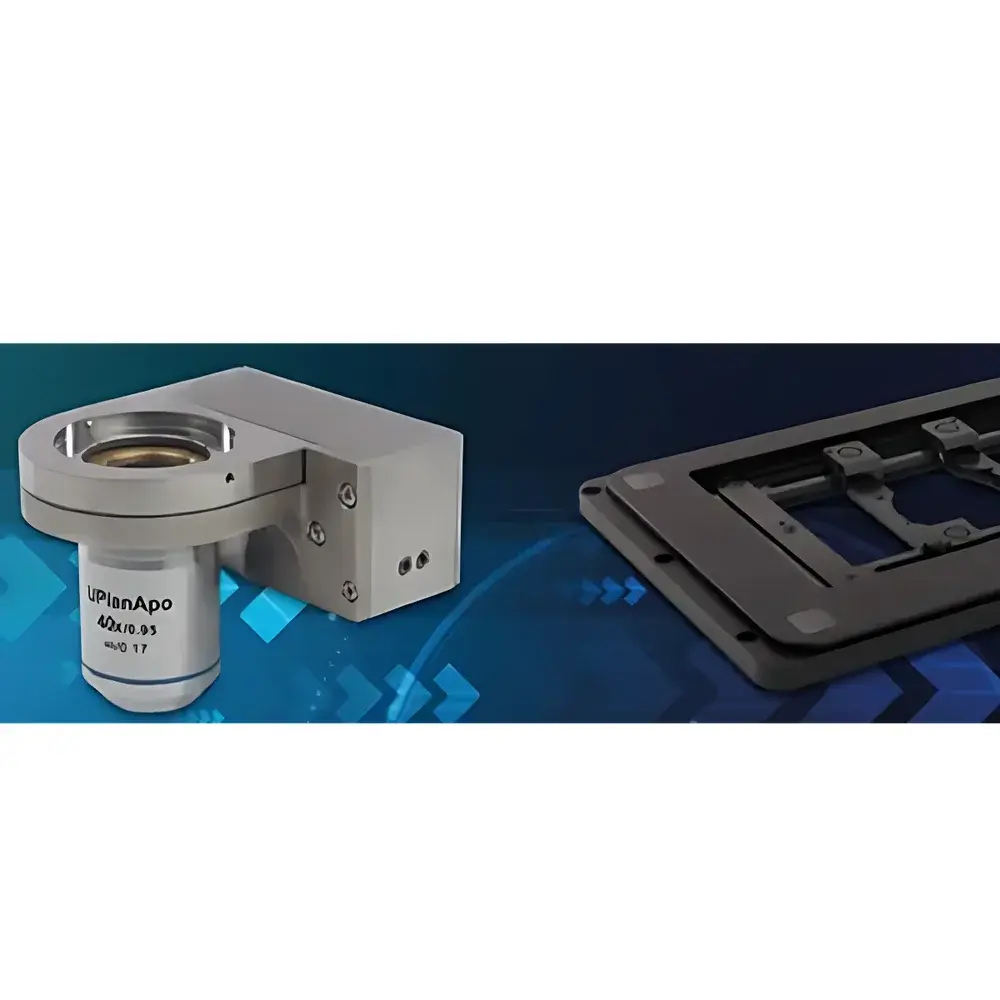
Queensgate OP400 & NanoScan SP High-Performance Piezoelectric Nanopositioning Systems for Microscopy
| Brand | Prior |
|---|---|
| Origin | UK |
| Manufacturer Type | Authorized Distributor |
| Origin Category | Imported |
| Model | Queensgate OP400 / NanoScan SP |
| Component Category | Optical Positioning Actuators |
| Travel Range | 400 nm / 600 nm |
| Resolution | Sub-nanometer (via integrated capacitive sensing) |
| Load Capacity | Up to 500 g |
| Settling Time | Optimized for high-speed z-stacking |
| Compatibility | Prior, Nikon, Olympus, Zeiss, Leica, Okolabs, Tokai Hit microscopes |
| Controller | Queensgate NPC Series |
Overview
The Queensgate OP400 Objective Positioner and NanoScan SP Nanopositioning Platform are engineered for ultra-precise, high-dynamics axial (z-axis) control in advanced optical microscopy. Built upon piezoelectric actuation and monolithic flexure mechanics, these systems deliver sub-nanometer resolution and exceptional linearity—enabled by integrated, drift-compensated capacitive position sensors. Unlike conventional piezoelectric stages relying on open-loop voltage control, Queensgate’s closed-loop architecture continuously measures actual displacement with picometer-level sensitivity, independent of temperature fluctuations, mechanical hysteresis, or load-induced creep. This ensures traceable, repeatable positioning critical for quantitative imaging modalities such as confocal z-stacking, structured illumination microscopy (SIM), stimulated emission depletion (STED), and atomic force microscopy (AFM)-correlative workflows. The OP400 is specifically designed for direct integration into the objective turret, enabling rapid, backlash-free focus modulation without moving the entire microscope stage—thereby preserving lateral stability and minimizing thermal drift during time-lapse acquisition.
Key Features
- Sub-nanometer closed-loop resolution (≤ 0.7 nm RMS) across full travel range, verified via capacitive sensor feedback—not interpolated or estimated
- High resonant frequency (> 2 kHz for OP400; > 1.8 kHz for SP600), enabling fast step-and-settle performance with minimal overshoot or ringing—critical for high-throughput z-stack acquisition
- Linearity error < 0.05% F.S. (OP400), more than twice the typical linearity of standard piezo objective scanners
- Load capacity up to 500 g—compatible with heavy apochromatic objectives, immersion lenses, and multi-filter turret assemblies
- Integrated NPC digital controller support: real-time PID tuning, waveform generation (sine, sawtooth, arbitrary), and synchronization via TTL/USB/Ethernet interfaces
- Zero-backlash, frictionless flexure guidance—no lubrication, no wear, no particle generation—suitable for cleanroom and live-cell imaging environments
Sample Compatibility & Compliance
The OP400 accommodates standard RMS (32 mm), M25×0.75, M26×0.75, and M32×0.75 objective threads, including wide-field and water-immersion configurations. The NanoScan SP series mounts directly to Prior Scientific ProScan III, Lumen 200, and other motorized inverted platforms via standardized kinematic interfaces; it also integrates natively with Nikon Ti-E, Olympus IX83, Zeiss Axio Observer, and Leica DMi8 systems through OEM-compatible mounting brackets. All mechanical and electronic components comply with CE, UKCA, and RoHS directives. Firmware and controller software support audit trails, user-access logging, and configurable parameter locking—aligning with GLP/GMP documentation requirements for regulated life science laboratories. While not FDA-cleared as a medical device, system performance data meets ASTM E2594–22 (Standard Practice for Calibration of Scanning Probe Microscopes) and ISO 10360-2 (Coordinate Measuring Machines) traceability principles.
Software & Data Management
Queensgate’s NPC Control Suite provides native drivers for MATLAB, Python (PyVISA), LabVIEW, and Micro-Manager 2.0+—enabling script-driven automation of multi-dimensional acquisitions, focus drift correction, and adaptive focus tracking. The controller logs all position commands, sensor readings, and environmental timestamps with microsecond precision. Export formats include CSV, HDF5, and TIFF metadata embedding (via custom ImageJ/Fiji plugins). For regulatory compliance, the NPC firmware supports 21 CFR Part 11–compliant electronic signatures, role-based access control, and immutable audit logs—configurable per laboratory SOPs. No third-party calibration certificates are required out-of-the-box; factory calibration data (including sensor gain, nonlinearity maps, and thermal coefficients) is embedded and accessible via API.
Applications
- Confocal and light-sheet z-stack acquisition at speeds exceeding 100 µm/s with < 50 µs settling time—enabling volumetric imaging of dynamic organelles without motion blur
- Super-resolution microscopy (STORM/PALM) requiring nanometer-precision focus stabilization over hours-long acquisitions
- Electrophysiology-coupled imaging: simultaneous patch-clamp recording and sub-diffraction-limit structural monitoring
- Topographic metrology of semiconductor wafers, MEMS devices, and thin-film coatings—where axial repeatability ≤ 1 nm is mandatory for defect classification
- Long-term timelapse with PureFocus 850 integration: sustained ±50 nm focus stability over 24+ hours under variable thermal and mechanical loading conditions
FAQ
What is the difference between OP400 and NanoScan SP platform designs?
The OP400 is an objective-mounted z-scanner optimized for direct focus modulation; the NanoScan SP is a sample-stage nanopositioner designed for high-stability lateral + axial scanning in inverted configurations.
Do these systems require recalibration after installation?
No—factory calibration is retained across power cycles and mechanical mounting; only optional secondary verification using a reference interferometer is recommended for ISO 17025-accredited labs.
Can the NPC controller synchronize with external hardware triggers?
Yes—TTL input/output ports support hardware triggering from cameras, lasers, or electrophysiology amplifiers with jitter < 100 ns.
Is thermal drift compensated in real time?
Capacitive sensors are inherently insensitive to temperature-induced expansion; additionally, NPC firmware applies real-time thermal coefficient compensation when ambient sensor data is provided.
Are custom travel ranges or mounting interfaces available?
Yes—Queensgate offers OEM engineering services for application-specific variants, including vacuum-compatible, cryogenic-rated, or magnetic-shielded configurations.




