
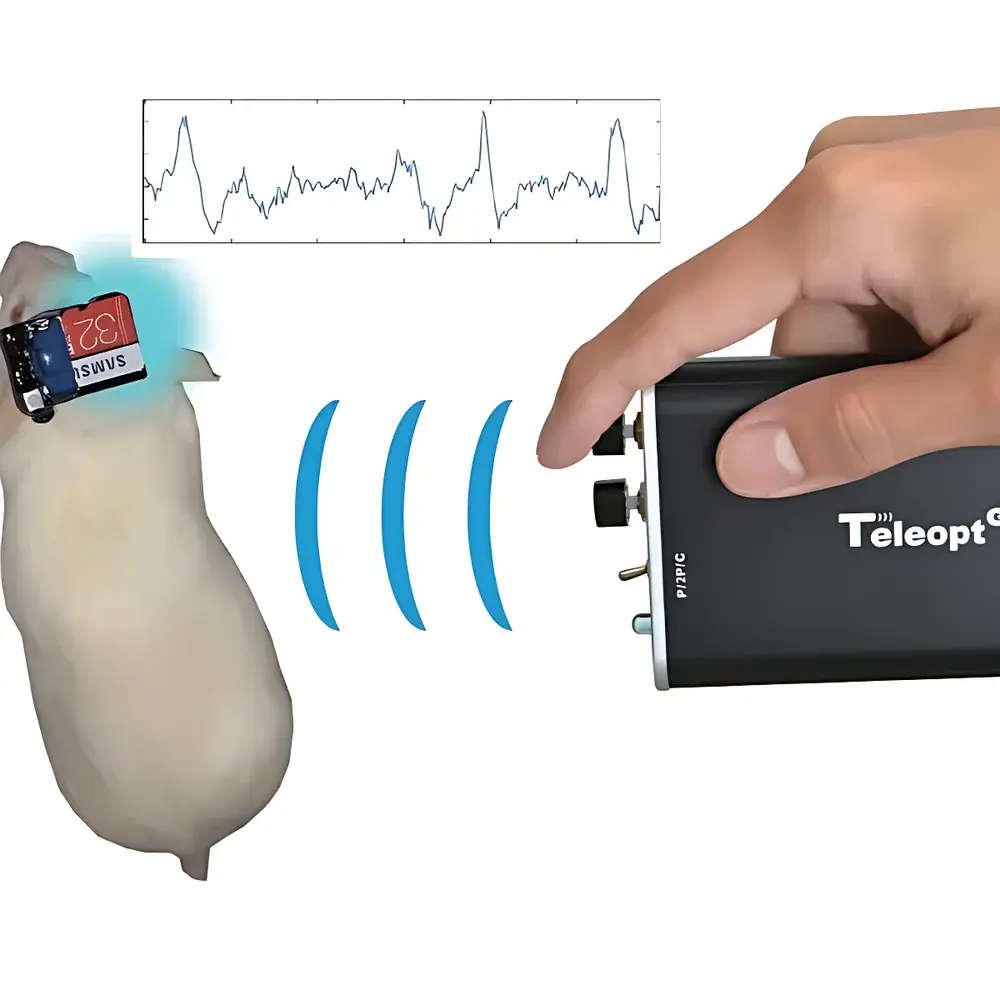
TeleoptoELG Wireless Integrated Electrophysiology and Optogenetic Stimulation System
| Brand | Teleopto |
|---|---|
| Origin | Japan |
| Model | TeleoptoELG |
| Weight (lightest variant) | 2 g |
| Battery Life | 12 h (2 g unit, no stimulation) / 25 h (3 g unit, no stimulation) |
| Channels | 2-channel differential bio-potential recording (EEG/EMG/LFP) |
| Data Storage | microSD card |
| Stimulation Control | Remote-triggered, dual-mode (pulsed & continuous) receiver |
| Optical Output | mW-level at fiber tip, wavelength-selectable via interchangeable LED cannula assemblies |
| LED Wavelength Flexibility | Dual-color (e.g., 470 nm / 590 nm) compatible with bi-stable opsins |
| Stimulation Configuration | Unilateral, bilateral, or sequential hemispheric stimulation via 1-channel or 2-channel receivers |
| Data Export Formats | TXT, EDF |
| Included Software | Dedicated viewer and export utilities |
Overview
The TeleoptoELG is a purpose-engineered wireless neurophysiology platform designed for concurrent high-fidelity electrophysiological recording and precisely timed optogenetic stimulation in freely behaving small animal models. It integrates two established technologies—Teleopto’s miniaturized optogenetic stimulation architecture and ELG-2’s low-noise, low-drift differential bio-potential acquisition circuitry—into a single cohesive system. The device operates on the principle of galvanically isolated, digitally encoded telemetry: neural signals are amplified, filtered (programmable analog bandpass: 0.1–500 Hz), and digitized onboard at 1 kHz sampling rate before being wirelessly transmitted to a base station receiver. Simultaneously, optical stimulation is delivered via implantable fiber-optic cannulas coupled to high-efficiency surface-mount LEDs, with output power calibrated to deliver mW-level irradiance at the target brain region. This co-localized, time-synchronized acquisition–stimulation paradigm enables causal interrogation of neural circuits with millisecond-scale temporal precision—critical for studies involving channelrhodopsin-2 activation, halorhodopsin inhibition, or bistable opsin kinetics.
Key Features
- Ultra-compact, ultra-lightweight design: lightest configuration weighs only 2 g, minimizing motion artifact and behavioral interference in mice and rats.
- Integrated rechargeable lithium-polymer battery: supports up to 12 hours of continuous EEG/EMG/LFP recording without stimulation (2 g unit); extends to 25 hours in the 3 g variant.
- Dual-channel differential input: configurable for EEG+EMG, EEG+LFP, or bipolar LFP recordings; input-referred noise < 2.5 µVRMS (1–100 Hz band).
- Fully wireless operation: no tethering during behavior; data stored locally on removable microSD card (up to 32 GB, FAT32 formatted) with timestamp-synchronized metadata.
- Modular optical stimulation architecture: interchangeable LED-cannula assemblies support discrete wavelengths (e.g., 470 nm blue, 590 nm amber) without hardware modification; peak irradiance tunable across 0.1–15 mW at fiber tip (200 µm core).
- Dual-mode stimulation receivers: pulsed-mode receiver delivers synchronous optical pulses aligned with external TTL triggers; continuous-mode receiver enables duty-cycle–modulated illumination for sustained inhibition protocols.
- Remote control interface: handheld IR remote supports dual independent trigger inputs, mode switching between receivers, and real-time selection of stimulation channel (left/right/hemispheric pair).
Sample Compatibility & Compliance
The TeleoptoELG is validated for chronic implantation and long-term recording in C57BL/6 mice, Sprague-Dawley rats, and prairie voles. Its mechanical footprint and mass distribution comply with NIH Office of Laboratory Animal Welfare (OLAW) guidelines for minimally invasive cranial instrumentation. Electrode configurations—including stainless-steel screws, microwire arrays, and custom photonic-electrode hybrids—are compatible with standard stereotaxic coordinates (Paxinos & Franklin atlas). All firmware and embedded software adhere to IEC 62304 Class B medical device software lifecycle requirements. Data files conform to EDF+ (European Data Format Plus) specification v1.10, ensuring interoperability with EEGLAB, FieldTrip, and Brainstorm. While not FDA-cleared for human use, the system meets ISO 13485-aligned manufacturing controls as implemented by the Japanese OEM.
Software & Data Management
The bundled TeleoptoELG Suite comprises two native applications: TeleoptoViewer (Windows/macOS) and TeleoptoExporter. TeleoptoViewer provides real-time visualization of raw and filtered channels, event marker overlay (stimulation onset/offset timestamps), spectral analysis (Welch’s method, 0.5–100 Hz), and epoch-based averaging. Exporter converts binary session files (.tel) into ASCII-delimited TXT (for MATLAB/Python ingestion) and EDF+ (for clinical-grade review systems). Both tools enforce audit-trail logging per GLP Annex 11 principles: every file open, export, and parameter change is timestamped and attributed to user ID. Metadata—including battery voltage, temperature sensor readings, and RF link quality index—is embedded in each EDF+ header, enabling retrospective quality control.
Applications
This system supports a broad spectrum of preclinical neuroscience investigations, including but not limited to: closed-loop seizure interruption via real-time EEG-triggered inhibition in kainic acid–induced epilepsy models; characterization of thalamocortical oscillations during sleep-wake transitions using dual-hemisphere stimulation; dissection of striatal direct/indirect pathway dynamics via temporally interleaved ChR2/NpHR stimulation; and validation of optogenetic fMRI coupling in awake, head-fixed rodents. Its dual-wavelength capability facilitates bidirectional control experiments—for instance, simultaneous excitation of PV+ interneurons (470 nm) and suppression of pyramidal neurons (590 nm) within the same cortical column.
FAQ
What is the maximum achievable optical power at the fiber tip?
Output is configurable up to 15 mW for standard 200 µm core fibers; precise calibration is performed per cannula assembly using an integrated NIST-traceable photodiode sensor.
Can the system be used for closed-loop experiments?
Yes—real-time TTL outputs from the base station receiver can feed back into external stimulus generators or behavioral control systems with sub-millisecond latency.
Is firmware upgrade supported in the field?
Firmware updates are delivered via encrypted .bin files and applied through TeleoptoExporter; all versions are digitally signed and version-locked to prevent unauthorized modification.
How is synchronization accuracy between recording and stimulation verified?
Each stimulation pulse generates a hardware-timestamped marker embedded in the EEG stream; jitter is measured at < ±50 µs RMS across 10,000 consecutive pulses (tested at 20 Hz repetition rate).
Are custom electrode or cannula designs available?
OEM-level customization—including multi-shank silicon probes with integrated waveguides—is supported under NDA; lead time typically 12–16 weeks.



