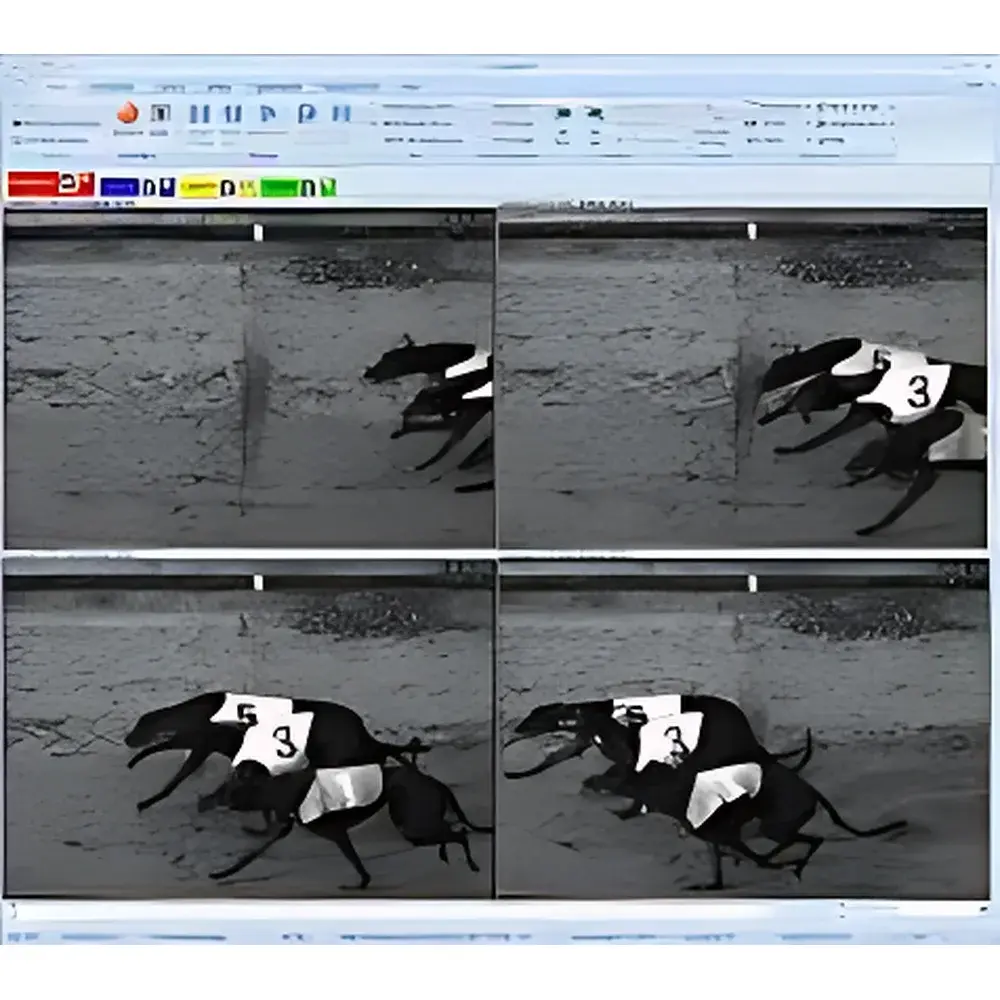
NorPix StreamPix 7 High-Speed Uncompressed Video Capture and Storage Software
| Brand | NorPix |
|---|---|
| Origin | Canada |
| Model | StreamPix 7 |
| Software Type | High-Speed Imaging Data Acquisition & Archiving Software |
| OS Support | Windows Vista/7/8 (32-bit & 64-bit) |
| Interface Compatibility | CameraLink (Base/Medium/Full), IEEE 1394 (FireWire), USB 3.0, GigE Vision |
| Max Synchronized Cameras | 48 |
| Output Formats | BMP, JPEG, TIFF, multi-TIFF, PNG, FITS, AVI (lossless & compressed), MOV |
| Timecode Support | LTC, IRIG-B, GPS |
| Real-Time Processing | White Balance, Histogram, Gamma Correction |
| Network Control | StreamNet Server |
| Customization | User-Defined Hotkeys, Full-Screen Display |
Overview
StreamPix 7 is a professional-grade, real-time high-speed video acquisition and archival software platform developed by NorPix Inc., a Canadian engineering software company specializing in deterministic digital imaging systems for scientific and industrial applications. Engineered for precision timing, zero-frame-loss data integrity, and hardware-agnostic interoperability, StreamPix 7 implements a proprietary disk-write optimization architecture that enables sustained uncompressed capture at multi-gigabyte-per-second throughput—provided the host system meets minimum I/O bandwidth and storage subsystem requirements (e.g., RAID-0 or NVMe-based storage arrays). Unlike general-purpose media recorders, StreamPix 7 operates at the kernel level to bypass Windows memory paging and filesystem latency, ensuring deterministic frame delivery from high-bandwidth sensors—including megapixel-resolution CMOS cameras running at >10,000 fps with pixel depths up to 16 bits. Its core function is not post-processing or analysis, but rather lossless, time-stamped, metadata-rich acquisition—making it foundational for quantitative motion studies, transient event documentation, and regulatory-compliant test data generation.
Key Features
- Deterministic Uncompressed Capture: Supports sustained write speeds exceeding 2 GB/s to local storage or network-attached storage (NAS) when configured with appropriate hardware; eliminates frame drops even during extended recordings of high-resolution, high-frame-rate sequences.
- Multi-Camera Synchronization: Coordinates up to 48 independent imaging devices via hardware triggers, PTP (IEEE 1588), or software-synchronized start commands—enabling stereo, multi-angle, or distributed sensor array deployments.
- Comprehensive Hardware Abstraction Layer (HAL): Native drivers for over 400 camera models across CameraLink, GigE Vision, USB3 Vision, and legacy IEEE 1394 interfaces; includes GenICam-compliant configuration and auto-discovery.
- Timecode Integration: Embeds precise temporal metadata using LTC (Linear Timecode), IRIG-B, or GPS-derived timestamps—critical for cross-instrument synchronization in automotive crash testing, aerospace telemetry, and ballistics validation.
- Real-Time Image Conditioning: On-the-fly white balance adjustment, histogram equalization, gamma correction, and ROI cropping without impacting recording fidelity or timing determinism.
- Flexible Export Pipeline: Exports raw frames as industry-standard formats (BMP, PNG, TIFF, multi-TIFF, FITS) and video containers (AVI with lossless codecs such as Lagarith or UT Video; MOV with Apple ProRes or DNxHD) — all preserving original bit depth and timestamp alignment.
Sample Compatibility & Compliance
StreamPix 7 is deployed in environments requiring audit-ready data provenance and long-term format stability. While the software itself does not perform analytical measurements, its output files are routinely used as primary evidence in ASTM E2912-compliant motion analysis workflows, ISO 13485-regulated medical device validation, and FAA/EASA-certified flight test instrumentation chains. The software supports GLP/GMP-aligned operational practices through optional logging modules that record user actions, system states, and hardware configuration changes—facilitating 21 CFR Part 11 compliance when paired with validated IT infrastructure and electronic signature protocols. All exported image and video files retain embedded EXIF/XMP metadata, including exposure parameters, sensor temperature, trigger edge polarity, and absolute UTC timestamps derived from synchronized time sources.
Software & Data Management
StreamPix 7 integrates with NorPix’s StreamNet Server architecture to enable centralized control of geographically distributed acquisition nodes—a capability widely adopted in large-scale test facilities where engineers manage dozens of synchronized cameras from a single console. The software provides hierarchical project management with versioned acquisition templates, automated folder structuring based on date/time/camera ID, and configurable pre- and post-trigger buffer policies. Raw data sets can be tagged with custom metadata fields (e.g., test ID, operator name, environmental conditions) and exported to LIMS or ELN platforms via CSV or XML schemas. For archival integrity, checksum generation (MD5/SHA-256) is available per session, and file naming conventions conform to ISO 8601 and NASA CDDIS standards to ensure long-term machine readability and cross-platform portability.
Applications
- Automotive crashworthiness testing and airbag deployment analysis
- Aerospace structural fatigue monitoring and UAV flight dynamics characterization
- Ballistics impact visualization and terminal effects modeling
- Biomechanics and sports science motion capture under natural lighting conditions
- Industrial process monitoring—e.g., injection molding, laser welding, powder metallurgy sintering
- Scientific research involving ultrafast phenomena: cavitation, plasma ignition, MEMS actuation
FAQ
Does StreamPix 7 support GPU-accelerated encoding or decoding?
No—StreamPix 7 deliberately avoids GPU-dependent processing to maintain deterministic timing and eliminate driver-level variability. Encoding (e.g., AVI compression) occurs post-capture via CPU-bound, multi-threaded libraries with fixed quantization tables and no adaptive bitrate logic.
Can StreamPix 7 be validated for use in FDA-regulated environments?
Yes—while NorPix does not provide out-of-the-box IQ/OQ/PQ documentation, the software’s deterministic behavior, audit log capabilities, and export traceability make it suitable for inclusion in a site-specific validation protocol aligned with GAMP 5 and 21 CFR Part 11 Annex 11 requirements.
Is there a runtime license limitation or dongle requirement?
StreamPix 7 uses node-locked licensing tied to the host machine’s MAC address and motherboard UUID; no physical dongle is required, and license transfers are managed via NorPix’s secure portal with engineering approval.
What is the maximum supported resolution and frame rate?
Theoretical limits depend entirely on host I/O bandwidth and storage subsystem performance—not software-imposed caps. Users have successfully recorded 4096×3072 @ 1,000 fps and 1920×1080 @ 15,000 fps using appropriately configured RAID-0 NVMe arrays and PCIe 4.0 x16 capture cards.
Does StreamPix 7 support third-party SDK integration?
Yes—via COM Automation interfaces and a documented C++ API supporting custom plugin development for real-time metadata injection, external trigger arbitration, and integration with MATLAB, Python (through pywin32), or LabVIEW via ActiveX wrappers.