
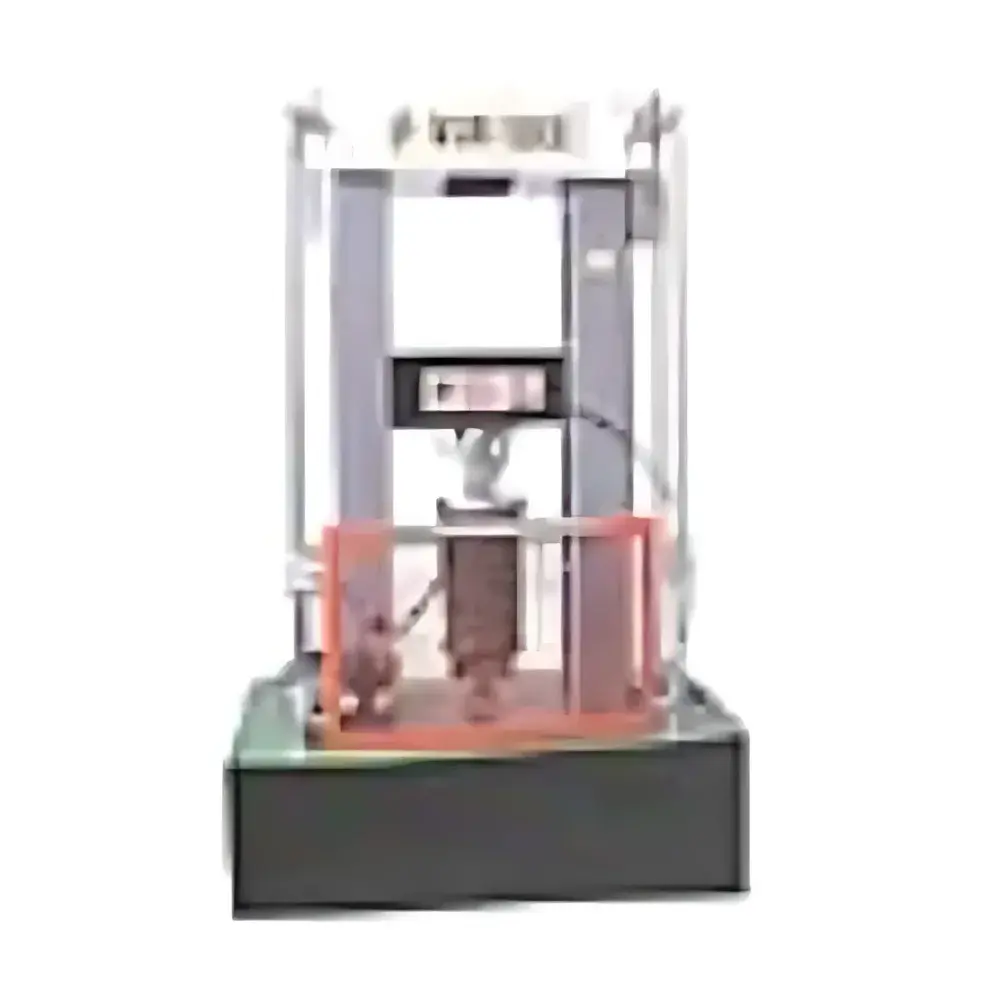
Air Spring Burst Test System PQH-3
| Origin | Jilin, China |
|---|---|
| Manufacturer Type | Authorized Distributor |
| Origin Category | Domestic (China) |
| Model | PQH-3 |
| Pricing | Upon Request |
| Max Pressure | 0–3 MPa |
| Burst Limit | 4 MPa |
| Pressurization Rate | ≤1.0 MPa/min |
| Max Assembly Height | 500 mm |
| Max Compressed Outer Diameter | 600 mm |
| Control System | Windows-based Industrial PC with Real-Time Data Acquisition & Safety Interlock Software |
| Safety Enclosure | Reinforced Sealed Chamber with Integrated Pressure Containment and Emergency Shutdown |
Overview
The Air Spring Burst Test System PQH-3 is an engineered solution for deterministic evaluation of structural integrity and failure pressure thresholds in pneumatic suspension components. Designed specifically for air springs used in commercial vehicles, rail systems, and industrial vibration isolation applications, this system implements controlled hydrostatic or pneumatic pressurization under ISO 8573-1-compliant clean air conditions (or deionized water, per user configuration), enabling precise capture of burst pressure—the maximum internal pressure at which the spring’s elastomeric bladder or metal end-plate assembly fails catastrophically. The system operates on a closed-loop pressure control principle, utilizing high-stability piezoresistive pressure transducers (class 0.25 accuracy per EN 61326-1) and servo-controlled positive-displacement test pumps to maintain programmable ramp rates within ±5% of setpoint. All test phases—including initialization, pressure ramping, dwell (optional), real-time pressure sampling at ≥1 kHz, instantaneous burst detection via derivative threshold triggering, and automatic emergency depressurization—are fully automated and synchronized through a deterministic real-time kernel embedded in the Windows-based industrial control platform.
Key Features
- Integrated reinforced safety enclosure: double-walled steel chamber with polycarbonate blast shield, rated for containment up to 4 MPa overpressure, compliant with OSHA 1910.147 lockout/tagout and EN 13857 mechanical hazard clearance standards
- Real-time burst detection algorithm: monitors dP/dt > 15 MPa/s for ≥2 consecutive samples to trigger millisecond-level solenoid dump valve activation, minimizing post-failure energy release
- Dual-mode pressurization: supports both compressed air (ISO 8573-1 Class 2) and hydraulic test media (deionized water, viscosity <1.5 cSt at 20°C) with dedicated quick-connect manifolds and media-specific seals
- Modular hardware architecture: includes industrial-grade IPC with 8 GB RAM, SSD storage, and PCI Express DAQ card (16-bit, 1 MS/s aggregate sampling); calibrated pressure sensor (0–3.5 MPa full scale, thermal drift <0.02%/°C)
- Predefined test templates: ASTM F2877-22 Annex A1 (air spring burst testing), SAE J2872 (heavy-duty vehicle suspension component validation), and custom user-defined profiles with multi-step ramp/hold sequences
- Hardware interlocks: redundant pressure switches, door position sensors, and emergency stop circuitry wired in series with SIL-2-rated safety relays (IEC 61508)
Sample Compatibility & Compliance
The PQH-3 accommodates air springs conforming to standard mounting geometries across Class 6–8 trucks, passenger rail bogies, and precision manufacturing platforms. Its 500 mm vertical stroke and 600 mm max compressed outer diameter envelope support bellows-type, sleeve-type, and rolling lobe configurations with nominal diameters from 120 mm to 550 mm. All test procedures are traceable to NIST-calibrated reference standards, and raw data files include embedded metadata compliant with 21 CFR Part 11 requirements (electronic signatures, audit trails, and immutable file hashing). The system meets CE marking requirements under the Machinery Directive 2006/42/EC and carries conformity documentation for electromagnetic compatibility (EN 61000-6-2/6-4) and low-voltage safety (EN 61000-6-3).
Software & Data Management
The proprietary Windows-based software provides role-based access control (administrator, operator, reviewer), GLP-compliant electronic lab notebook functionality, and automated report generation in PDF/A-1b format. Each test record stores synchronized time-series pressure, temperature (optional RTD input), and valve status data at user-selectable intervals (10 ms to 1 s). Statistical analysis modules compute mean burst pressure, standard deviation, Weibull shape parameter (for reliability modeling), and confidence intervals (95% CI, t-distribution). Export options include CSV (for MATLAB/Python post-processing), XML (for LIMS integration), and encrypted SQLite archives with SHA-256 checksums. Audit logs capture all user actions—including method edits, calibration events, and report approvals—with timestamps and Windows Active Directory credentials.
Applications
- Validation of air spring design margins against OEM specification limits (e.g., Volvo Bus B12B, Siemens Desiro ML, CRRC Type SW-220K)
- Production lot acceptance testing per ISO 3344:2021 (pneumatic elastic elements — acceptance tests)
- Material aging studies: accelerated life testing with sequential burst cycles at elevated temperatures (via optional environmental chamber interface)
- Root cause analysis of field failures: comparative burst morphology assessment using synchronized high-speed imaging (external camera trigger output available)
- Supplier qualification audits requiring documented test repeatability (R&R < 2.5% per AIAG MSA v4 guidelines)
FAQ
What media can be used for burst testing—air or water?
Both compressed air (filtered to ISO 8573-1 Class 2) and deionized water are supported; selection depends on application risk profile and regulatory requirements (e.g., water preferred for non-ignition-critical environments).
Is the system compatible with existing factory MES or QMS platforms?
Yes—via OPC UA server (compliant with IEC 62541), RESTful API endpoints, or direct database mirroring (SQL Server/PostgreSQL).
How is calibration traceability maintained?
Annual third-party calibration is performed against NIST-traceable deadweight testers; certificates include as-found/as-left data, uncertainty budgets, and compliance statements per ISO/IEC 17025.
Can the system perform cyclic fatigue testing in addition to burst?
No—the PQH-3 is purpose-built for single-event overpressure failure characterization. For fatigue evaluation, we recommend pairing with our complementary PFT-5000 series pneumatic fatigue tester.
What safety certifications does the enclosure hold?
The chamber complies with EN 14460:2016 (explosion-resistant enclosures) and has undergone independent rupture simulation using LS-DYNA finite element analysis, confirming containment integrity at 4 MPa static overpressure.



