
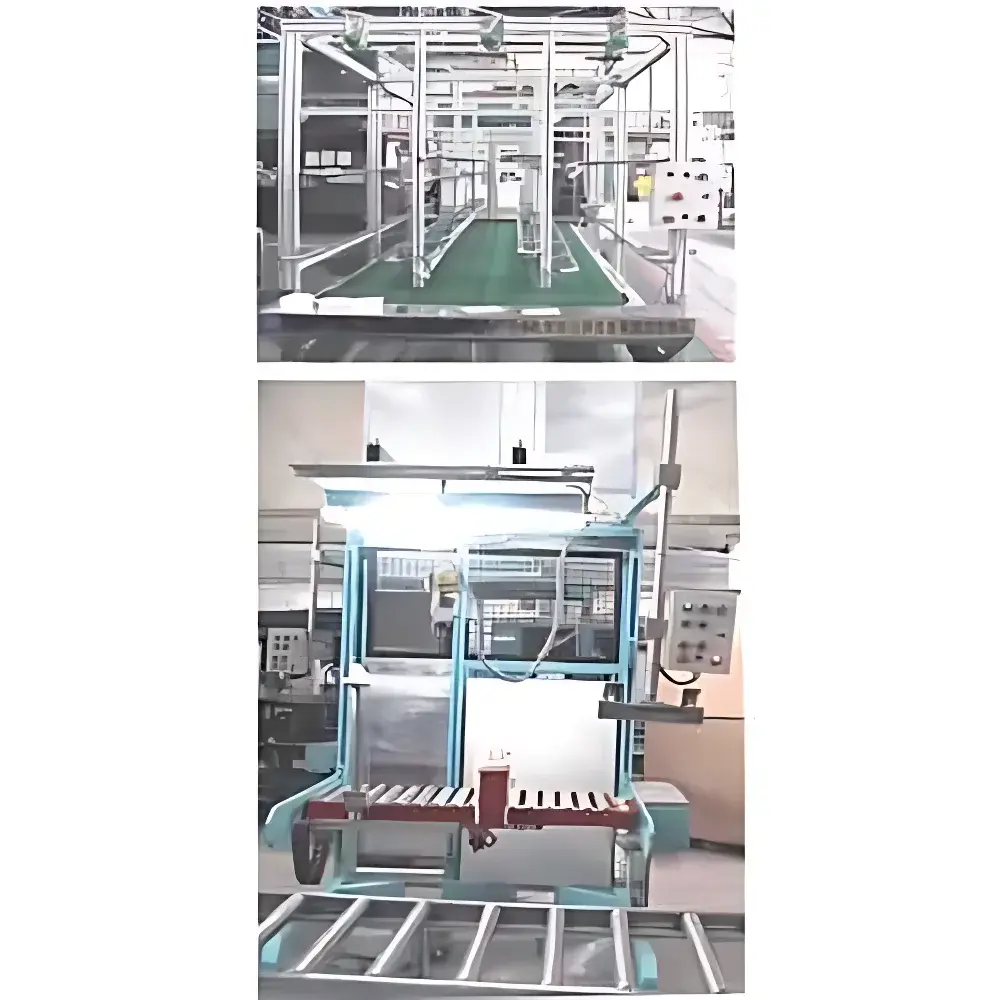
Automotive Fuel Tank Integrated Test Bench PQ35
| Origin | Jilin, China |
|---|---|
| Manufacturer Type | Authorized Distributor |
| Origin Category | Domestic (China) |
| Model | PQ35 |
| Pricing | Available Upon Request |
Overview
The Automotive Fuel Tank Integrated Test Bench PQ35 is an engineered assembly and functional verification platform designed for OEM-tier quality assurance and Tier-1 supplier production lines. It implements a modular, multi-station architecture aligned with DIN 70020, ISO 16750-4 (Environmental Testing – Fluid Systems), and GB/T 25985–2010 (Chinese National Standard for Automotive Fuel Tank Performance Requirements). The system integrates four synchronized workstations—Fuel Pump Assembly & Functional Test Station, Fuel Line Harness Assembly Station, Submerged Leak Detection Station, and Protective Shield Mounting Station—within a unified structural and control framework. Each station operates on the principle of constrained mechanical positioning, pneumatic actuation, and programmable electro-mechanical sequencing to replicate real-world assembly conditions while enabling repeatable, traceable verification of dimensional fit, sealing integrity, and functional performance of fuel system components.
Key Features
- Modular 4-station layout enables concurrent or sequential execution of pump integration, line routing, leak validation, and shield installation—all under a single control interface.
- Robust square-tube steel frame provides structural rigidity (±0.1 mm geometric tolerance over 2 m span) and supports dynamic loads up to 120 kg per station.
- Pneumatically actuated clamping system with foot-valve control ensures rapid, hands-free engagement/disengagement of stainless-steel roller conveyors (Ø32 mm, AISI 304), minimizing operator fatigue and cycle time variation.
- Motor-driven, belt-transmitted tilting mechanism enables precise ±90° rotation of the fuel tank platform with dual safety redundancy: electronic end-stop sensing and hardened mechanical limit stops compliant with EN ISO 13857.
- Integrated HMI touchscreen panel (IP65-rated) hosts station-specific operational sequences, emergency stop logic, and real-time status feedback—including clamp pressure monitoring (0–1.0 MPa range) and tilt angle verification.
- Dedicated submersion leak test station features calibrated water bath depth control (±2 mm), integrated air pressure decay measurement (0–100 kPa, resolution 0.1 kPa), and automated pass/fail logging per ISO 20484.
Sample Compatibility & Compliance
The PQ35 accommodates passenger vehicle fuel tanks ranging from 40 L to 85 L volume, with maximum dimensions of 1,200 mm (L) × 650 mm (W) × 320 mm (H) and nominal wall thicknesses between 2.0 mm and 4.5 mm (HDPE, multi-layer co-extruded, or stamped steel variants). All stations comply with automotive industry ergonomics guidelines (SAE J1116), electrical safety standards (IEC 60204-1), and environmental testing requirements per ISO 16750-4 Clause 4.3 (fluid system pressure cycling). The system supports GLP-aligned documentation protocols through optional audit trail export (CSV/Excel), including timestamped operator ID, station activation events, and test result metadata.
Software & Data Management
The embedded control software supports configurable test recipes per tank model (e.g., VW MQB, GM E2XX, BYD e-Platform 3.0 derivatives), with version-controlled parameter sets stored locally in non-volatile memory. Data logging includes cycle count, clamp actuation duration, tilt angle dwell time, leak test pressure decay slope (kPa/s), and pass/fail binary output. Export interfaces include USB 2.0 host port and RS-485 Modbus RTU for integration into MES platforms (e.g., Siemens Opcenter, Rockwell FactoryTalk). Optional FDA 21 CFR Part 11-compliant add-on module provides electronic signature capture, role-based access control, and immutable audit logs for regulated production environments.
Applications
- Pre-shipment functional validation of OEM-specified fuel pump modules (including flow rate, pressure delivery, and electrical continuity checks).
- Verification of fuel line routing clearance, connector torque sequence, and clip retention force compliance prior to final chassis integration.
- Quantitative leak rate assessment (≤0.5 mL/min at 35 kPa differential) via submerged pressure decay methodology per SAE J2705.
- Structural mounting verification of underbody protective shields—including bolt pattern alignment, bracket interference check, and fastener accessibility simulation.
- Operator training and process standardization across shift teams using repeatable, step-guided workflows with visual cue overlays.
FAQ
What tank materials are compatible with the PQ35 test bench?
The system supports HDPE blow-molded tanks, multi-layer co-extruded polymer tanks (e.g., EVOH barrier layers), and stamped steel tanks with painted or coated surfaces—provided dimensional and weight limits are observed.
Can the system be integrated with existing factory SCADA networks?
Yes—via RS-485 Modbus RTU or optional Ethernet/IP gateway; configuration files and data mapping templates are provided for seamless PLC-level integration.
Is calibration certification included with delivery?
A factory-issued calibration report (traceable to CNAS-accredited reference standards) is supplied for all pressure transducers, tilt encoders, and clamp force sensors.
What maintenance intervals are recommended for pneumatic components?
Daily visual inspection of air lines and filters; quarterly lubrication of cylinder rods and roller bearings; annual replacement of pneumatic seals per ISO 8573-1 Class 4 contamination limits.



