
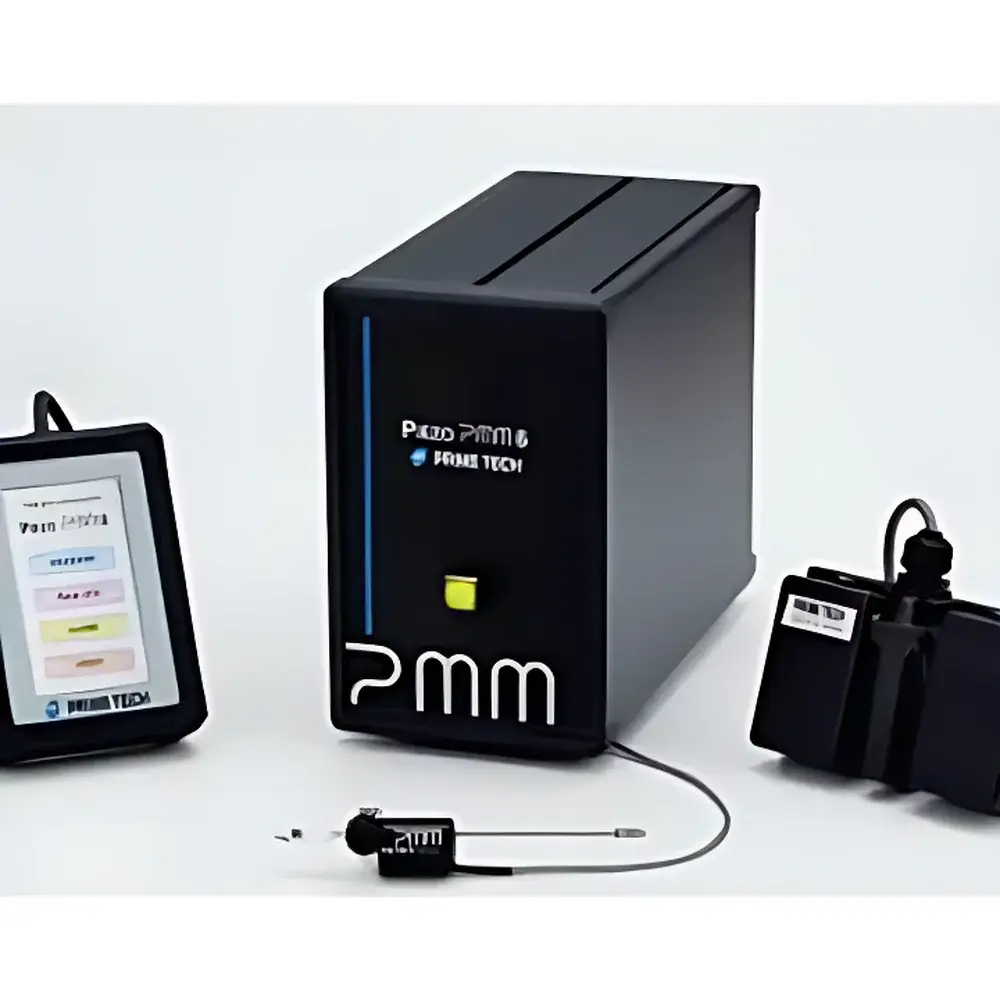
Prime Tech PIEZO PMM6 Piezoelectric Membrane Penetration Micromanipulator
| Brand | PRIME TECH |
|---|---|
| Origin | Japan |
| Model | PIEZO PMM6 |
| Drive Unit Options | MB-D-2 (Medium Output) / MB-U-2 (High Output) |
| Minimum Positioning Resolution | 0.1 µm |
| Touchscreen Modes | 3 (STANDARD, Piezo-ICSI, EXPART) |
| Operational States | 6 (3 modes × 2 states) |
| Piezo Intensity Levels | 16-step adjustable (1, 1/2, 2/3 increments) |
| Speed Settings | 16-step adjustable |
| Onboard Program Storage | 8 (EXPART mode only) |
| Cleaning Function | Enabled in Piezo-ICSI & EXPART modes |
| Footswitch Configuration | Dual-pedal (PMM actuation + mode/state toggle) |
| Controller Dimensions | 132.5(W) × 280(L) × 210(H) mm, 3.5 kg |
| PMM Drive Unit Weight | 110 g (MB-D-2) / 200 g (MB-U-2) |
| Touchscreen Unit Dimensions | 105(W) × 145(L) × 38(H) mm, 600 g |
| Footswitch Dimensions | 132.5(W) × 110(L) × 35(H) mm, 620 g |
| Power Supply | AC 100–240 V (±10%), 50/60 Hz, 30 VA |
| Operating Environment | 0–40 °C, ≤85% RH (non-condensing) |
Overview
The Prime Tech PIEZO PMM6 is a precision-engineered piezoelectric membrane penetration micromanipulator designed for high-fidelity, non-invasive intracellular microinjection and mechanical breaching of biological membranes under optical microscopy. Unlike conventional hydraulic or motorized manipulators, the PMM6 employs ceramic piezoelectric actuators to generate nanoscale-controlled, stepless displacement with sub-micrometer repeatability—enabling reliable puncture of delicate cellular structures without hydrodynamic disturbance, cytoplasmic aspiration, or mechanical deformation. Its operational principle relies on rapid, low-inertia piezoelectric expansion (typically <1 ms response time), delivering calibrated mechanical impulse rather than continuous force, making it uniquely suited for applications demanding transient, localized membrane disruption—such as intracytoplasmic sperm injection (ICSI), pronuclear transfer, blastomere biopsy, assisted hatching, and targeted nucleic acid or organelle delivery into oocytes and embryos.
Key Features
- Two interchangeable drive units: MB-D-2 (medium-output, 110 g) for routine ICSI and embryo handling; MB-U-2 (high-output, 200 g) for robust penetration of tougher membranes (e.g., zona pellucida of bovine or porcine oocytes, chorion of medaka or sea urchin eggs).
- 0.1 µm minimum positioning resolution across full travel range—ensuring consistent probe tip placement accuracy independent of load or thermal drift.
- Integrated 4.3-inch LCD touchscreen with three dedicated operational modes: STANDARD (manual fine control), Piezo-ICSI (optimized for sperm immobilization and injection timing), and EXPART (programmable multi-step protocols with up to eight stored sequences).
- Dual-footswitch interface: left pedal initiates piezo pulse actuation while maintaining hands-on microscope focus; right pedal toggles between active/inactive states or mode selection—eliminating visual interruption during critical manipulation phases.
- On-device cleaning function (activated in Piezo-ICSI and EXPART modes) applies controlled reverse piezo oscillation to dislodge adherent cellular debris from the injection pipette tip, reducing clogging and enhancing procedural reproducibility.
- Full parameter configurability: 16-step intensity scaling (with fractional increments: 1×, ½×, ⅔×, etc.) and 16-step speed modulation allow precise tailoring of pulse energy and rise/fall profile to match specimen elasticity and membrane tensile strength.
Sample Compatibility & Compliance
The PIEZO PMM6 demonstrates validated compatibility with a broad spectrum of developmental biology specimens, including murine, porcine, bovine, and human oocytes and preimplantation embryos; medaka (Oryzias latipes) and zebrafish embryos; sea urchin (Strongylocentrotus purpuratus) and ascidian (Ciona intestinalis) zygotes; and in utero mouse fetal tissues. All operational parameters adhere to internationally recognized standards for reproductive biotechnology instrumentation, including ISO 13485-compliant manufacturing processes and electromagnetic compatibility per IEC 61326-1. The device supports GLP/GMP-aligned workflows through audit-ready parameter logging (when integrated with compatible acquisition software) and complies with essential safety requirements outlined in IEC 61010-1 for laboratory electrical equipment.
Software & Data Management
While the PMM6 operates autonomously via its embedded controller and touchscreen interface, it features a standardized analog output port (BNC) for synchronization with external imaging systems, electrophysiology recorders, or time-stamped video capture devices. When used with Prime Tech’s optional PMM-Link software (Windows-based, USB-connected), users gain access to full protocol archiving, real-time pulse waveform visualization, session metadata tagging (operator ID, sample ID, date/time stamp), and export of CSV-formatted operation logs—including intensity setting, pulse count, mode activation timestamp, and footswitch event sequence. Data exports conform to FDA 21 CFR Part 11 readiness when deployed within validated network environments with appropriate user authentication and electronic signature controls.
Applications
- Intracytoplasmic Sperm Injection (ICSI): Precise, low-shear sperm immobilization and cytoplasmic deposition without vacuole formation or spindle displacement.
- Preimplantation Genetic Testing (PGT): Blastomere or trophectoderm biopsy with minimal cytolysis and preserved embryo viability.
- Nuclear Transfer: Enucleation and donor nucleus insertion in somatic cell nuclear transfer (SCNT) protocols.
- Assisted Hatching: Controlled zona pellucida thinning or opening in IVF clinics performing embryo transfer.
- Functional Genomics: Delivery of CRISPR-Cas9 ribonucleoprotein complexes, mRNA, siRNA, or fluorescent dyes into single cells with spatial and temporal fidelity.
- Developmental Physiology Studies: Mechanical stimulation of embryonic tissues (e.g., neural tube, heart field) to investigate mechanotransduction pathways.
FAQ
What is the difference between MB-D-2 and MB-U-2 drive units?
The MB-D-2 provides medium-force output optimized for standard ICSI and soft-membrane applications (e.g., mouse oocytes); the MB-U-2 delivers higher displacement amplitude and peak force, enabling reliable penetration of rigid extracellular matrices such as bovine zona pellucida or medaka chorion.
Can the PMM6 be integrated with inverted microscopes from Zeiss, Nikon, or Olympus?
Yes—the PMM6’s modular mechanical interface (standardized mounting plate with M4 threaded holes) and compact footprint allow seamless integration onto most commercial inverted microscope stages. Optional adapter kits are available for specific stage models.
Is firmware update capability supported?
Firmware updates are performed via USB connection using Prime Tech’s certified PMM-Update Utility; version history and release notes are provided in the technical documentation package supplied with each unit.
Does the device meet regulatory requirements for clinical use in ART laboratories?
The PIEZO PMM6 is CE-marked (Class I, Annex II) and registered with Japan’s PMDA as a Class II medical device for assisted reproductive technology. Clinical deployment requires local validation per national ART guidelines (e.g., ESHRE, ASRM, or JSGO standards).
How is calibration verified during routine operation?
Calibration is maintained via factory-trimmed piezo driver electronics and confirmed annually using traceable interferometric displacement verification (NIST-traceable laser Doppler vibrometer), with results documented in the instrument’s service log.






