
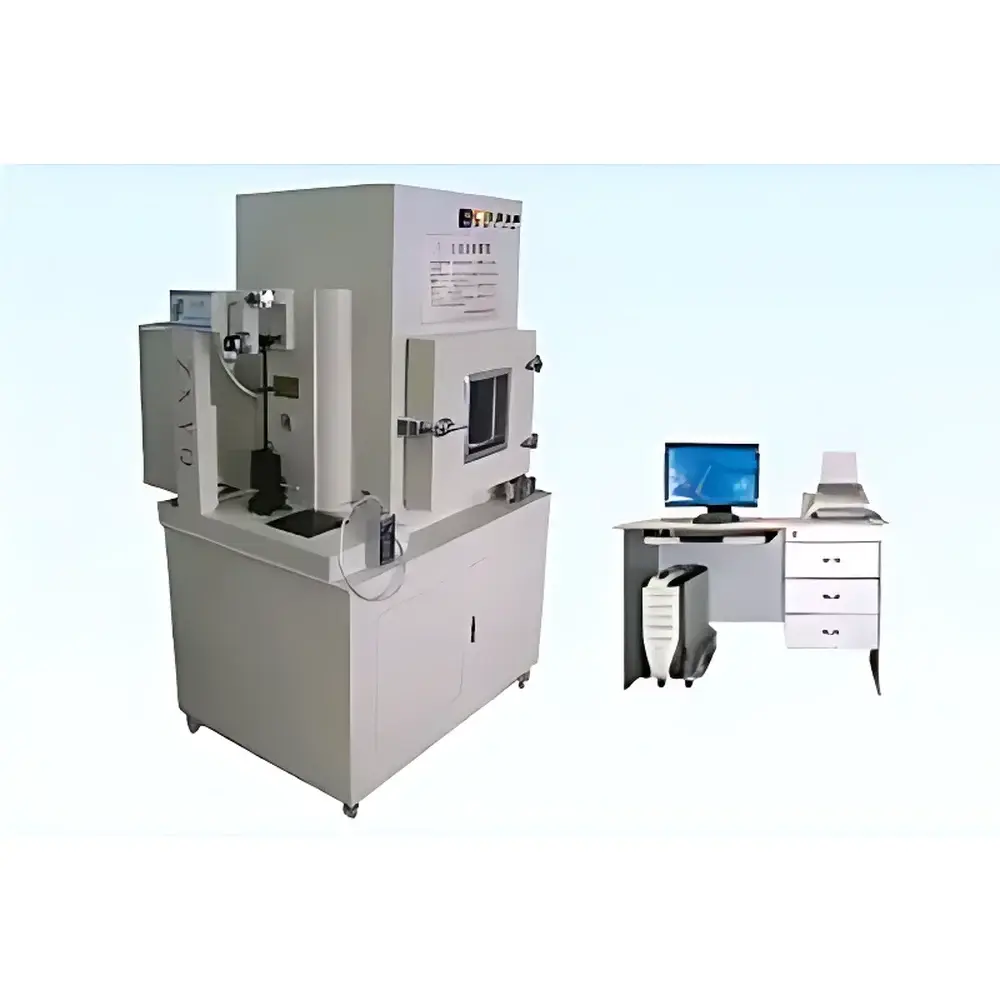
English Product Name
| Origin | Jilin, China |
|---|---|
| Manufacturer Type | Authorized Distributor |
| Origin Category | Domestic (China-made) |
| Model | JJ-20W |
| Quotation | Available Upon Request |
| Impact Energy Range | 0.5 J, 1 J, 2 J, 4 J, 7.5 J |
| Sampling Rate | 1.2 µs |
| A/D Resolution | 1/65536 |
| Load Measurement Accuracy | ≤2% |
| Span Options | 60 mm, 62 mm |
| Specimen Thickness | 4 mm, 10 mm, 13 mm |
| Specimen Width | 6 mm, 10 mm, 13 mm, 15 mm |
| Pendulum Impact Velocity (0.5–4 J) | 2.9 m/s |
| Low-Temperature Range | –60 °C (cascade refrigeration), –120 °C (liquid nitrogen injection) |
| High-Temperature Range | up to +200 °C (electric heating) |
| Temperature Control Accuracy | ±1 °C |
| Compliance | GB/T 1043.1–1993 (Charpy & Izod impact testing of rigid plastics) |
Overview
The JJ-20W High-Low Temperature Impact Testing Machine is a precision-engineered instrument designed for dynamic mechanical characterization of polymeric and composite materials under controlled thermal conditions. It operates on the principle of pendulum-based impact energy absorption measurement—specifically configured for both Charpy and Izod configurations per GB/T 1043.1–1993—and integrates real-time high-speed data acquisition of force and angular displacement during impact events. Unlike conventional impact testers, the JJ-20W couples a calibrated pendulum system with dual-mode thermal conditioning: electric resistance heating for elevated temperature testing up to +200 °C, and a hybrid cooling architecture combining cascade mechanical refrigeration (–60 °C) and liquid nitrogen injection (–120 °C). This enables standardized impact evaluation across a broad operational temperature spectrum, supporting structure–property correlation studies in automotive engineering, aerospace composites development, and thermoplastic formulation optimization.
Key Features
- High-fidelity dual-sensor acquisition: Simultaneous capture of load-time (N–t) and energy-time (J–t) profiles via piezoelectric force transducer and high-resolution rotary encoder
- Ultra-fast signal processing: 1.2 µs sampling interval with 16-bit A/D conversion (1/65536 resolution) ensures accurate transient response capture during brittle fracture or ductile yielding
- Thermally isolated test chamber: Integrated low-temperature cryostat and high-temperature furnace maintain stable setpoints within ±1 °C over full test duration
- Semi-automated specimen handling: Motorized positioning stage minimizes operator-induced variability and supports repeatable alignment of notched/unnotched specimens
- Full-process digital replay: All acquired waveforms are time-stamped, stored, and reconstructible—including slow-motion playback of impact dynamics for failure mode analysis
- Modular energy calibration: Interchangeable pendulum hammers support five discrete impact energies (0.5 J to 7.5 J), each traceable to national metrological standards
Sample Compatibility & Compliance
The JJ-20W accommodates standardized rectangular specimens per GB/T 1043.1–1993, with configurable span lengths (60 mm / 62 mm), thicknesses (4 mm / 10 mm / 13 mm), and widths (6–15 mm). Its mechanical design permits testing of rigid thermoplastics (e.g., PC, ABS, PBT), fiber-reinforced composites, and engineering elastomers. The system meets essential requirements for laboratory accreditation under ISO/IEC 17025:2017, including documented calibration procedures, environmental monitoring logs, and uncertainty budgets for impact energy reporting. While not certified to ASTM D6110 or ISO 179-1 out-of-the-box, its hardware architecture allows method adaptation to those standards through validated parameter mapping and third-party verification protocols.
Software & Data Management
The embedded Windows-based control software provides real-time visualization of force–displacement curves, automatic notch depth compensation, and batch-wise statistical reporting (mean, SD, CV%). Raw binary data files (.bin) are exportable in ASCII CSV format for post-processing in MATLAB, Python (NumPy/Pandas), or commercial CAE tools. Audit trails record user login, test parameters, calibration history, and environmental chamber logs—supporting GLP-compliant documentation workflows. Though not natively compliant with FDA 21 CFR Part 11, the software architecture supports integration with external electronic lab notebook (ELN) systems via OPC UA or REST API for secure, version-controlled data archiving.
Applications
- Evaluation of low-temperature embrittlement thresholds in automotive interior polymers (e.g., PP/EPDM blends at –40 °C)
- High-temperature impact resilience assessment of flame-retardant polycarbonate used in electrical enclosures (+120 °C)
- Quality assurance of injection-molded parts subjected to thermal cycling prior to impact validation
- Research into cryogenic toughness of carbon-fiber epoxy laminates for space-grade components (–120 °C)
- Correlation of impact performance with DSC-measured Tg, DMA storage modulus, and FTIR degradation signatures
FAQ
Does the JJ-20W comply with international standards such as ASTM D6110 or ISO 179-1?
The base configuration conforms to GB/T 1043.1–1993. Adaptation to ASTM D6110 or ISO 179-1 requires verification of specimen geometry tolerances, anvil radius specifications, and energy calibration traceability—services available through authorized application support.
Can the system perform instrumented impact testing per ISO 148-2?
Yes—the integrated force sensor and angular encoder satisfy the core instrumentation requirements of ISO 148-2; however, full compliance necessitates validation against reference specimens and certification by an accredited body.
What maintenance is required for the liquid nitrogen subsystem?
Routine checks include dewar level monitoring, nozzle clearance inspection, and purge gas flow verification. Annual calibration of pressure regulators and thermal mass flow controllers is recommended.
Is remote operation supported?
Local Ethernet connectivity enables remote desktop access for supervision and data retrieval. Full unattended operation requires integration with a facility-wide LIMS or MES platform.



