
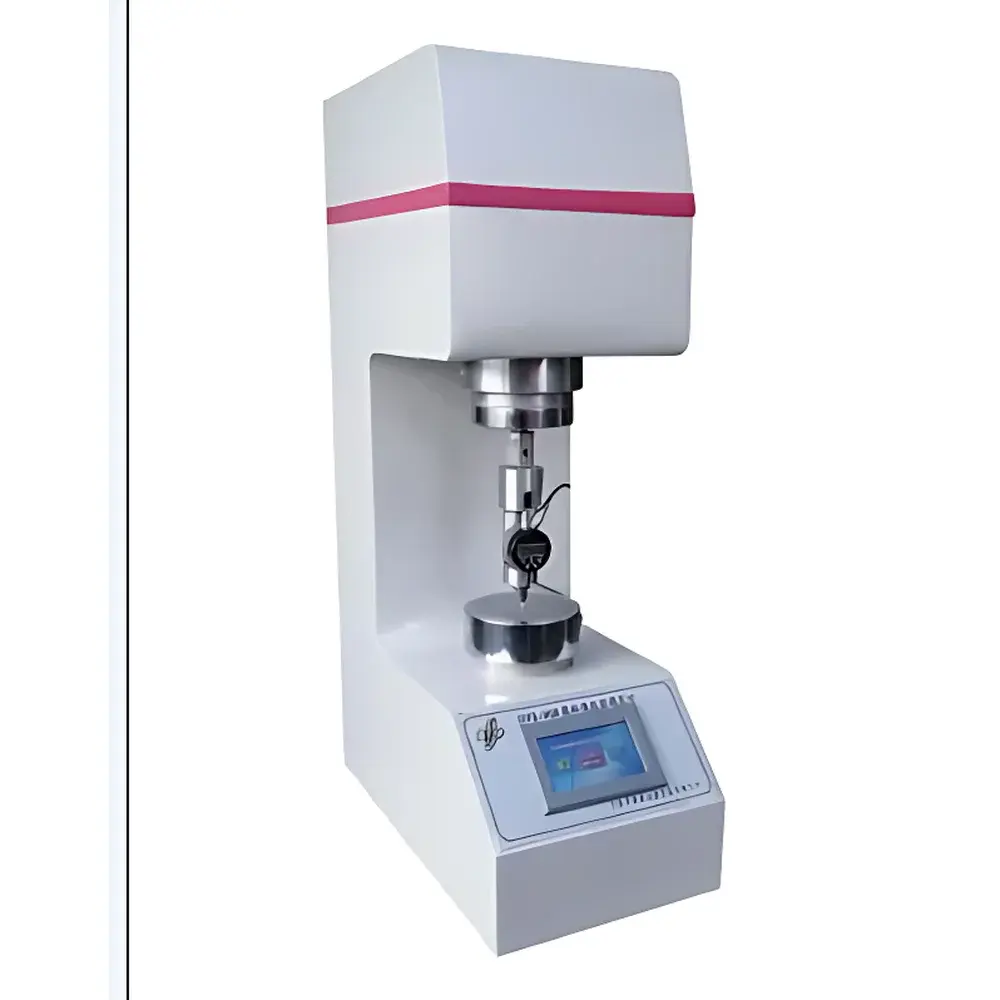
QYS-96 Advanced Electronic Servo-Controlled Ball Indentation Hardness Tester
| Origin | Jilin, China |
|---|---|
| Manufacturer Type | Authorized Distributor |
| Origin Category | Domestic (PRC) |
| Model | QYS-96 |
| Pricing | Available Upon Request |
| Test Principle | Ball Indentation Hardness (ISO 2039-1 / GB/T 3398.1–2008) |
| Load Range | 9.8 N (pre-load), 49 N, 132 N, 358 N, 612 N, 961 N |
| Indenter Options | Φ5 mm & Φ10 mm hardened steel ball |
| Depth Resolution | 0.001 mm |
| Max Sample Height | 30 mm |
| Indenter-to-Column Distance | 100 mm |
| Depth Measurement Accuracy | ±4% |
| Dwell Time Range | 10–90 s (±0.5% timing accuracy) |
| Valid Indentation Depth Range | 0.150–0.350 mm |
| Frame Deflection | ≤0.05 mm |
| Net Weight | 70 kg |
| Dimensions (W×D×H) | 420 × 240 × 640 mm |
Overview
The QYS-96 is an electronically servo-controlled ball indentation hardness tester engineered for precise, repeatable quantification of the resistance of polymeric materials to localized plastic deformation under standardized spherical indentation. It operates in strict accordance with the fundamental principles defined in ISO 2039-1 (Plastics — Determination of indentation hardness by means of a spherical indenter) and its national equivalents, including GB/T 3398.1–2008 and DIN 53456. Unlike scratch or rebound-based methods, this instrument measures the depth of permanent indentation produced by a hardened steel sphere under controlled, time-stabilized load conditions—yielding a dimensionless hardness value inversely proportional to the measured penetration depth. The system employs closed-loop electronic servo actuation to ensure high reproducibility in load application, dwell maintenance, and unloading sequences, minimizing mechanical hysteresis and operator-induced variability.
Key Features
- Electronically regulated servo mechanism enabling fully automated loading, dwell holding, and unloading with programmable force profiles and real-time feedback control.
- Six discrete test load levels (9.8 N pre-load, followed by 49 N, 132 N, 358 N, 612 N, and 961 N), supporting broad material coverage—from soft thermoplastic elastomers to semi-crystalline engineering polymers.
- Interchangeable hardened steel spherical indenters (Φ5 mm and Φ10 mm) compliant with ISO 2039-1 geometric specifications and surface roughness requirements.
- Digital linear position transducer with 1 µm resolution and traceable calibration path, delivering direct depth measurement within the validated operational range of 0.150–0.350 mm.
- Robust cast-iron frame design with measured structural deflection ≤0.05 mm under maximum load, ensuring mechanical stability and metrological integrity across repeated cycles.
- Integrated thermal-compensated timer with ±0.5% accuracy over 10–90 s dwell intervals, supporting compliance with standardized conditioning and relaxation protocols.
- Onboard thermal-printed data output for immediate hard-copy documentation of test parameters, depth readings, calculated hardness values, and timestamp metadata.
Sample Compatibility & Compliance
The QYS-96 is validated for testing rigid and semi-rigid polymeric specimens meeting ISO 2039-1 dimensional criteria: minimum thickness ≥10× indentation depth, surface flatness ≤0.02 mm, and lateral dimensions sufficient to maintain ≥2× indenter radius distance from edges. It accommodates specimens up to 30 mm in height and supports positioning with ≥100 mm clearance between indenter axis and machine column—facilitating integration into production-line QA workflows. The instrument satisfies essential requirements of GB 3398–1982 (superseded by GB/T 3398.1–2008), DIN 53456:1982, and ASTM D785 (for comparative Rockwell-scale correlation where applicable). Its design and verification protocol align with GLP-compliant laboratory practices, and raw data outputs—including load-time-depth traces—support audit-ready documentation for automotive Tier-1 suppliers adhering to Volkswagen Group’s PV 3.10.7 and VW 60330 material approval standards.
Software & Data Management
While the base configuration features embedded firmware and thermal printing, optional PC-based software (QYS-Link v3.2) enables USB-connected acquisition of full force–depth curves, statistical batch reporting (mean, SD, CV%), pass/fail threshold mapping per ASTM D785 Annex A1, and export to CSV, PDF, or XML formats. All digital records include immutable timestamps, operator ID fields, and instrument serial number tagging. The software architecture supports 21 CFR Part 11–compliant user access controls, electronic signatures, and audit trail logging when deployed in regulated environments requiring FDA or IATF 16949-aligned quality systems.
Applications
- Quality assurance of injection-molded automotive interior trim, bumpers, and under-hood components supplied to OEMs including Volkswagen AG and its certified Tier-1 partners.
- Routine hardness screening of polypropylene (PP), acrylonitrile-butadiene-styrene (ABS), polycarbonate (PC), and polyamide (PA6/PA66) formulations during incoming raw material inspection.
- Correlation studies between ball indentation hardness and tensile modulus, impact strength, or heat deflection temperature (HDT) in R&D laboratories.
- Process validation of annealing, moisture conditioning, or post-molding aging effects on surface mechanical behavior.
- Supporting technical documentation for PPAP submissions and IMDS material declarations in global automotive supply chains.
FAQ
What international standards does the QYS-96 directly support?
It conforms to ISO 2039-1:2015, GB/T 3398.1–2008, DIN 53456:1982, and provides traceable correlation pathways to ASTM D785 for Rockwell-scale referencing.
Can the QYS-96 be used for rubber or elastomeric compounds?
No—it is calibrated and validated exclusively for rigid and semi-rigid thermoplastics and thermosets with indentation depths falling within 0.150–0.350 mm; softer elastomers require durometer or Shore hardness instrumentation.
Is third-party calibration certification available?
Yes—NIST-traceable calibration certificates (including load cell, depth sensor, and timer verification) are provided upon request, compliant with ISO/IEC 17025 requirements through accredited partner labs.
Does the system meet automotive industry cybersecurity requirements for shop-floor instruments?
The standalone unit contains no network interface; optional QYS-Link software supports air-gapped deployment and may be configured to comply with TISAX AL3 requirements when integrated into secured corporate IT infrastructure.
What maintenance intervals are recommended for long-term metrological reliability?
Annual verification of indenter sphericity (per ISO 6506-2), load cell linearity, and depth transducer drift is advised; preventative servicing includes lubrication of guide columns and verification of servo motor torque response every 12 months or 2,000 test cycles.



