
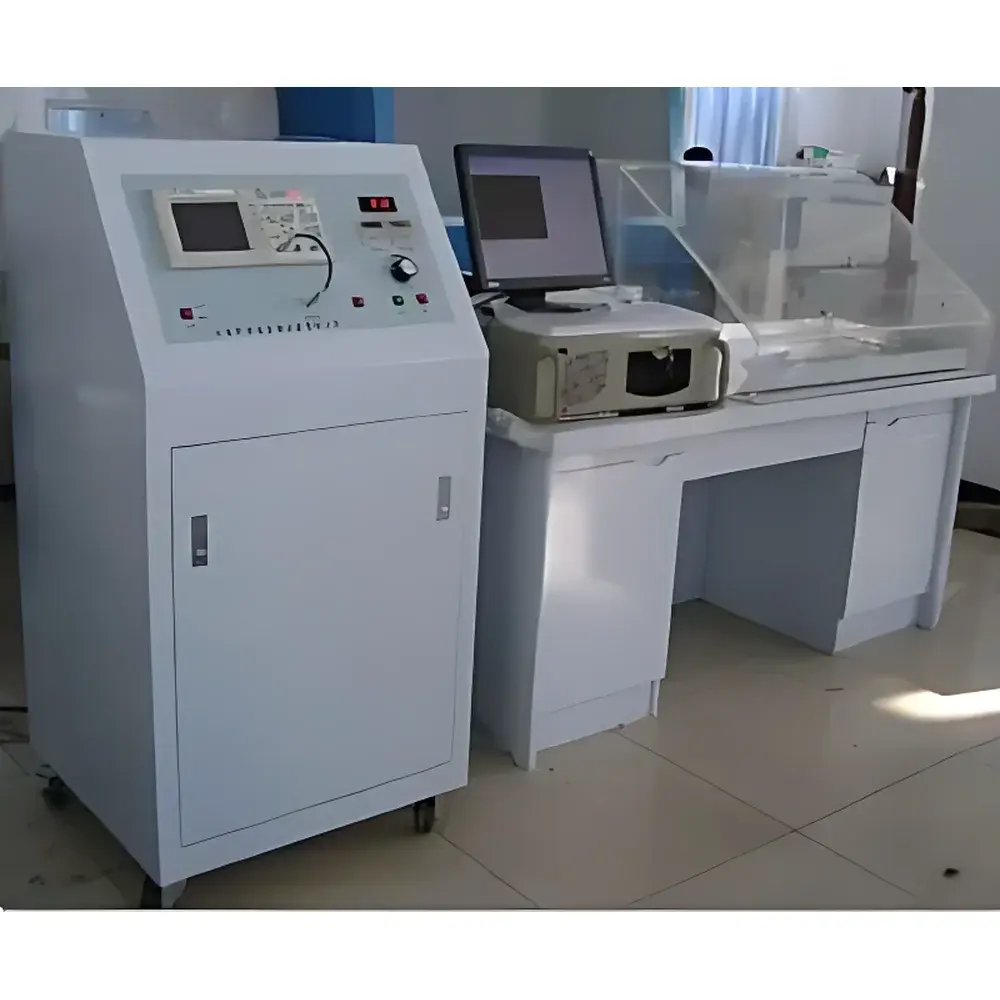
Changchun Intelligent CJE-30 High-Voltage Impulse Generator
| Brand | Changchun Intelligent |
|---|---|
| Origin | Jilin, China |
| Model | CJE-30 |
| Maximum Output Voltage | 30 kV |
| Lightning Impulse Waveform | 1.2/50 µs |
| Switching Impulse Waveform | 250/2500 µs or damped oscillatory wave with front time 2000–3000 µs |
| Front Time (T₁) | 0.5–10 µs (T₁ = 1.67T) |
| Apparent Origin | 0.15–3 µs (0.3T₁) |
| Time to Half-Peak (T₂) | 10–100 µs |
Overview
The Changchun Intelligent CJE-30 High-Voltage Impulse Generator is a computer-controlled impulse voltage test system engineered for dielectric strength evaluation and transient overvoltage simulation in electrical insulation materials, components, and complete apparatus. It operates on the principle of capacitor bank discharge through controlled resistive-inductive networks to generate standardized lightning and switching impulse voltages—critical for assessing insulation coordination and transient response under realistic stress conditions. Designed to comply with GB/T 17627.1–1998 (equivalent to IEC 61000-4-5 Ed. 3.0 for surge immunity testing framework), the system delivers repeatable, traceable, and waveform-accurate impulses up to 30 kV peak. Unlike basic low-energy impulse testers (typically limited to ≤6 kV), the CJE-30 supports full-scale lightning impulse (1.2/50 µs) and operational impulse (250/2500 µs or damped oscillatory waves with front times of 2000–3000 µs), enabling rigorous qualification per national and industrial standards for power equipment, transformers, insulators, and high-voltage connectors.
Key Features
- Integrated computer-based control architecture with real-time waveform acquisition via high-speed analog-to-digital converter (≥100 MS/s sampling rate, 12-bit resolution)
- Shielded mid-frequency rectified high-voltage generation within an interlocked safety enclosure compliant with IEC 61010-1 Class II requirements
- Adjustable impulse shaping network supporting precise tuning of front time (T₁ = 0.5–10 µs; T₁ = 1.67T), apparent origin (0.15–3 µs), and half-peak time (T₂ = 10–100 µs)
- Automated waveform validation against tolerance bands defined in GB/T 17627.1–1998 and IEC 60060-1:2010
- Full digital data capture, storage, and post-processing—including array-based waveform retrieval, comparative overlay, localized zoom, derivative analysis, and report generation
- Hardware-enforced safety interlocks, ground-fault detection, and automatic discharge sequencing prior to chamber access
Sample Compatibility & Compliance
The CJE-30 accommodates solid, liquid, and gaseous dielectrics—including polymeric insulators, transformer oil samples, ceramic bushings, printed circuit board substrates, and composite high-voltage housings. Electrode configurations support rod-plane, sphere-gap, and custom fixtures per IEC 60270 and ASTM D149. All impulse waveforms are validated against GB/T 17627.1–1998 (identical to IEC 61000-4-5 Annex A methodology for open-circuit voltage calibration). The system’s measurement chain—including divider ratio calibration, A/D timing jitter compensation, and trigger synchronization—is documented per ISO/IEC 17025 requirements for accredited laboratories. It supports GLP-compliant audit trails when integrated with validated laboratory information management systems (LIMS).
Software & Data Management
Control and analysis are executed via proprietary Windows-based software featuring deterministic real-time acquisition scheduling, dual-channel synchronized sampling (impulse voltage + current monitor), and IEEE 1588-2008 timestamping for multi-instrument correlation. Raw waveform data is stored in HDF5 format with embedded metadata (test ID, operator, date/time, environmental conditions, calibration certificate IDs). Software modules include automated pass/fail assessment per waveform deviation thresholds, statistical trending across batches, export to CSV/PDF/IEEE C37.90.2-compliant XML, and configurable electronic signatures meeting FDA 21 CFR Part 11 requirements for regulated environments. Audit logs record all parameter changes, data exports, and user actions with immutable timestamps.
Applications
- Determination of impulse breakdown voltage and flashover characteristics of insulating materials and assemblies
- Verification of surge arrester and varistor energy absorption capability under lightning and switching transients
- Qualification testing of medium- and high-voltage switchgear, cable terminations, and busbar supports
- Research into partial discharge inception under fast-rising voltage stress (complementary to IEC 60270 measurements)
- Evaluation of electromagnetic compatibility (EMC) resilience in power electronics enclosures and control cabinets
- Support for academic coursework and thesis research in high-voltage engineering, insulation physics, and transient phenomena
FAQ
What standards does the CJE-30 comply with for impulse waveform generation?
It conforms to GB/T 17627.1–1998, which aligns with IEC 61000-4-5 for surge immunity testing methodology and references IEC 60060-1:2010 for impulse voltage definitions and tolerances.
Can the system generate both lightning and switching impulses without hardware reconfiguration?
Yes—the front- and tail-time shaping network is electronically reconfigurable via software-selectable resistor-capacitor combinations, enabling seamless transition between 1.2/50 µs and 250/2500 µs waveforms.
Is waveform calibration traceable to national metrology institutes?
Calibration certificates for the resistive divider and timing modules are issued by CNAS-accredited labs with traceability to NIM (National Institute of Metrology, China) and include uncertainty budgets per GUM (JCGM 100:2008).
How is operator safety ensured during high-voltage operation?
The system incorporates redundant safety layers: interlocked chamber door switches, automatic grounding rods activated upon door opening, real-time leakage current monitoring, and emergency stop circuits meeting SIL-2 per IEC 61508.
Does the software support automated reporting for quality audits?
Yes—reports include waveform plots, pass/fail status, measurement uncertainty, calibration validity dates, and digitally signed operator verification, fully compatible with ISO 9001 and IATF 16949 documentation workflows.



