
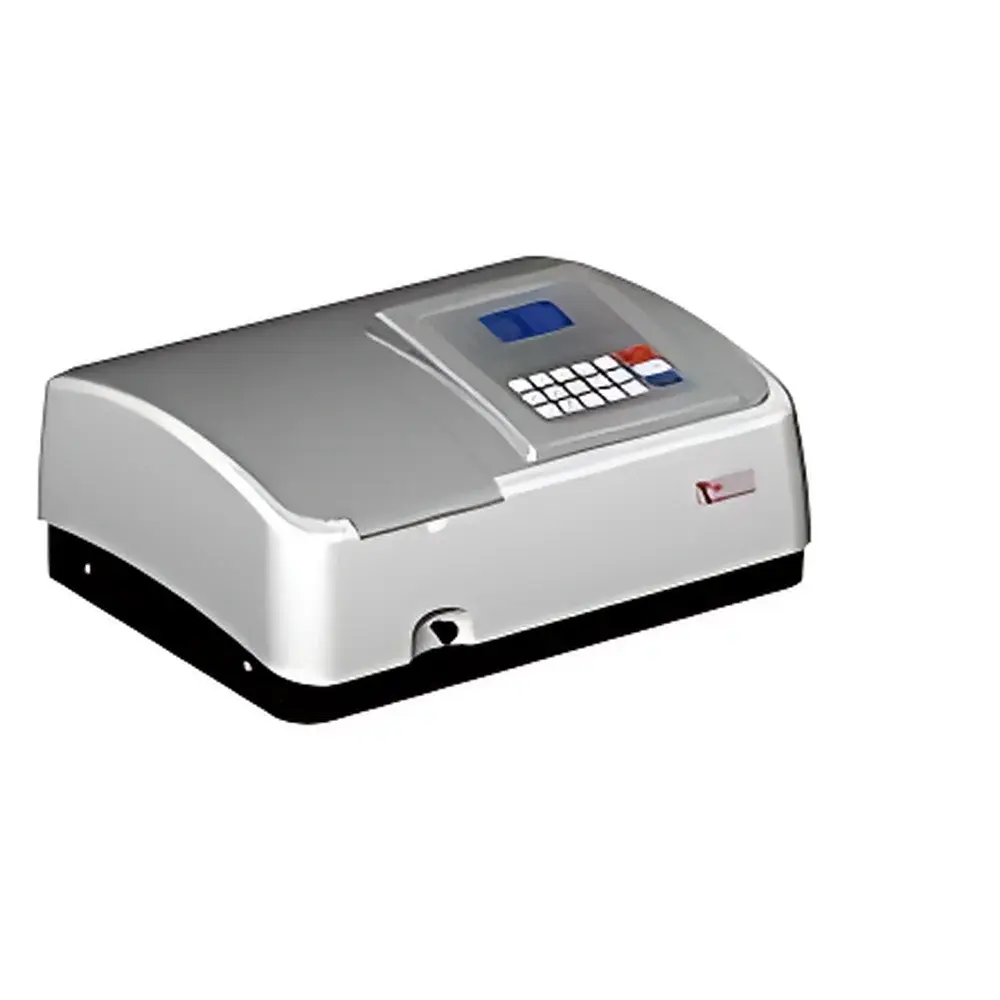
Mapada UV-1800 Ultraviolet-Visible Spectrophotometer
| Brand | Mapada |
|---|---|
| Model | UV-1800 |
| Optical System | Single-beam |
| Detector | Photodiode Array |
| Wavelength Range | 190–1100 nm |
| Spectral Bandwidth | 2 nm |
| Wavelength Accuracy | ±0.5 nm |
| Wavelength Repeatability | ≤0.2 nm |
| Stray Light | ≤0.05% T (at 220 nm and 360 nm) |
| Photometric Accuracy | ±0.002 A (0–0.5 A), ±0.004 A (0.5–1 A), ±0.3% T (0–100% T) |
| Photometric Repeatability | ≤0.001 A (0–0.5 A), ≤0.002 A (0.5–1 A), ≤0.15% T (0–100% T) |
| Baseline Drift | ±0.001 A/h (at 500 nm, after warm-up) |
| Baseline Flatness | ±0.002 A (200–1000 nm) |
| Noise Level | 0.0005 Abs (at 500 nm) |
| Photometric Range | –0.3 to 3 A, 0–200% T, 0–9999 C |
| Light Sources | Imported long-life deuterium lamp and tungsten-halogen lamp |
| Display | 128 × 64 dot-matrix LCD |
| Data Interface | USB port + parallel printer port |
| Dimensions | 490 × 360 × 240 mm |
| Weight | 14 kg |
Overview
The Mapada UV-1800 Ultraviolet-Visible Spectrophotometer is a precision single-beam optical instrument engineered for routine and research-grade quantitative and qualitative analysis in chemistry, biochemistry, pharmaceuticals, and environmental laboratories. It operates on the principle of Beer–Lambert law-based absorbance measurement across a broad spectral range (190–1100 nm), enabling reliable characterization of analytes from nucleic acids and proteins to organic dyes and transition metal complexes. Its high-stability optical architecture—featuring a 1200 lines/mm holographic grating, sealed optical compartment, and thermally stabilized light path—ensures minimal environmental interference and long-term signal integrity. Designed for compliance with international analytical standards, the UV-1800 supports method validation workflows aligned with ISO/IEC 17025, USP , and CLSI EP10-A3 guidelines for spectrophotometric performance verification.
Key Features
- Single-beam optical design with automatic wavelength scanning, source switching (D2/W), and dark-current correction—optimized for reproducibility in regulated environments.
- High-resolution 2 nm spectral bandwidth, delivering sufficient resolution for overlapping peaks in complex mixtures without compromising throughput.
- Imported long-life deuterium and tungsten-halogen lamps with real-time usage monitoring and socket-type modular replacement—eliminating post-installation optical alignment.
- Ultra-low stray light (≤0.05% T at 220 nm and 360 nm), critical for accurate low-transmittance measurements in UV-sensitive applications such as DNA quantification.
- Integrated GLP self-diagnostic function: enables on-demand verification of wavelength accuracy, photometric linearity, and baseline stability—supporting audit-ready documentation.
- Large sample compartment accommodating cuvettes from 5 mm to 100 mm pathlength, plus optional accessories including 8-cell auto-positioning holders and micro-volume adapters (e.g., 50 µL capillary cells).
Sample Compatibility & Compliance
The UV-1800 accommodates standard quartz, glass, and plastic cuvettes (10 mm default), as well as specialized formats including microcuvettes, flow cells, and solid-sample reflectance accessories. Its wide dynamic range (–0.3 to 3 A) and low noise floor (0.0005 Abs at 500 nm) ensure robust performance across diverse sample matrices—from highly diluted protein solutions (e.g., BSA at 0.02 mg/mL) to concentrated colored dyes. The instrument meets essential regulatory requirements for laboratory instrumentation: its photometric accuracy and repeatability conform to ASTM E275–22 (Standard Practices for Describing and Measuring Performance of UV-Vis Spectrophotometers); its data handling architecture supports traceable calibration logs required under FDA 21 CFR Part 11 when paired with validated PC software. Optional audit trail and electronic signature modules are available for GMP/GLP-compliant deployments.
Software & Data Management
The UV-1800 is supplied with PC-based scanning software compatible with Windows 10/11, offering full control over acquisition parameters—including scan speed, data interval, delay time, and peak integration settings. Core modules include:
- Photometric mode: direct readout of Absorbance (A), Transmittance (%T), Concentration (C), or Energy (E) at fixed wavelengths.
- Quantitative analysis: dual-method calibration—standard curve generation (up to 10-point linear/nonlinear regression) and coefficient-based calculation (C = kA + b or A = kC + b).
- Kinetic assay: time-resolved monitoring of absorbance changes at user-defined intervals; calculates reaction rates (ΔA/t) and endpoint kinetics.
- Biomolecular analysis: pre-configured methods for DNA (260 nm), protein (280 nm), and A260/A280 purity ratios per standard protocols.
- Data export: CSV, TXT, and image (BMP/PNG) formats; direct printing via parallel port (optional thermal or laser printer).
All raw spectra and method files are timestamped and stored with instrument ID and operator metadata—enabling full traceability per ISO/IEC 17025 clause 7.5.2.
Applications
The UV-1800 delivers consistent performance across multiple analytical domains:
- Pharmaceutical QC: assay of active pharmaceutical ingredients (APIs), dissolution testing, and excipient compatibility screening per USP .
- Life sciences: nucleic acid quantification (dsDNA, ssDNA, RNA), Bradford/Lowry protein assays, enzyme kinetics (e.g., NADH oxidation at 340 nm), and cell culture density estimation.
- Environmental analysis: nitrate/nitrite detection (via diazotization), COD determination, and heavy metal chelate quantification (e.g., Fe-phenanthroline at 510 nm).
- Academic research: teaching spectroscopy fundamentals, polymer degradation studies, and ligand-binding stoichiometry via titration scans.
FAQ
Does the UV-1800 support 21 CFR Part 11 compliance?
The base instrument does not include electronic signatures or audit trails; however, validated software packages with full Part 11 functionality—including role-based access control, immutable audit logs, and digital signature capture—are available as certified add-ons.
Can I perform kinetic measurements without a PC connection?
Yes—the embedded firmware supports standalone kinetic mode with up to 200 time points, real-time curve display on the LCD, and internal storage of up to 200 standard curves.
What is the recommended recalibration interval?
Per ISO/IEC 17025 and manufacturer recommendations, wavelength and photometric calibration should be verified before each analytical session when used in regulated environments; annual full metrological verification by an accredited service provider is advised.
Is the deuterium lamp ozone-free?
Yes—the imported D2 lamp features an integrated ozone-suppression window, reducing ambient ozone concentration below OSHA PEL limits (0.1 ppm) during continuous operation.
How is baseline flatness validated?
Baseline flatness (±0.002 A over 200–1000 nm) is verified using a certified neutral-density reference filter set traceable to NIST SRM 930e, following procedures outlined in ASTM E275–22 Annex A3.




