
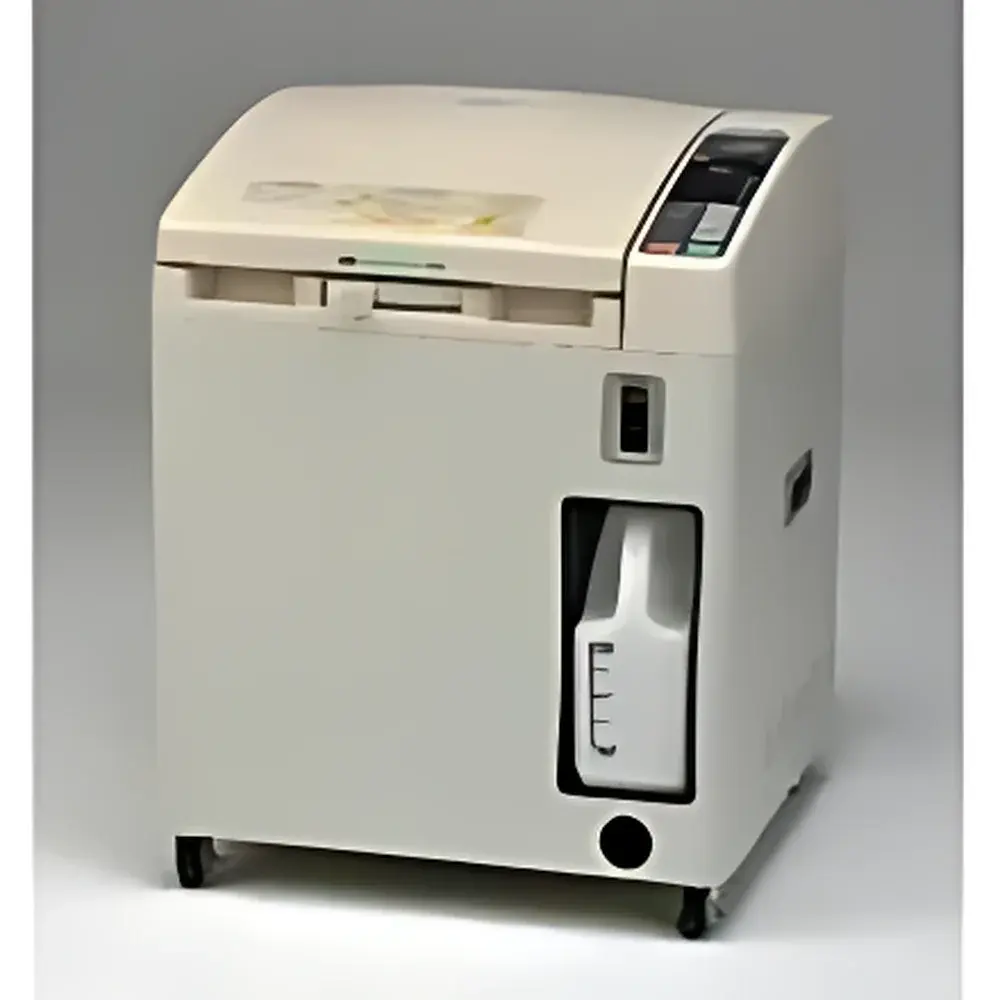
Panasonic MVS50 & MVS80 Vertical High-Pressure Steam Sterilizers
| Brand | Panasonic |
|---|---|
| Origin | Liaoning, China |
| Manufacturer Type | Authorized Distributor |
| Product Category | Domestic |
| Model | MVS50, MVS80 |
| Price Range | USD 7,000–11,200 (FOB) |
| Instrument Type | Vertical Sterilizer |
| Max Temperature | 135°C |
| Max Pressure | 0.235 MPa |
| Chamber Dimensions | Ø370 × 415 mm (MVS50), Ø370 × 640 mm (MVS80) |
| External Dimensions | 600 × 754 × 560 mm (MVS50), 600 × 979 × 560 mm (MVS80) |
| Chamber Volume | 50 L (MVS50), 75 L (MVS80) |
| Power Supply | 220 V, 50/60 Hz |
| Power Consumption | 2000 W (MVS50), 4000 W (MVS80) |
| Chamber Material | SUS304 Stainless Steel |
| Temperature Control Range | 105–135°C (sterilization), 60–100°C (media melting), 45–60°C (keep-warm) |
| Timer Range | Sterilization 1–250 min (up to 72 h via program logic), Media Melting 0–250 min (up to 72 h), Keep-Warm Duration: up to 72 h with auto-shutdown |
| Exhaust Control | Programmable temperature-triggered exhaust valve activation |
| Safety Systems | Dual-pressure relief valves, overtemperature limiter, dry-run protection, interlocked door mechanism, overpressure limiter, current overload fuse |
| Standard Accessories | 2 stainless steel baskets (MVS50), 3 stainless steel baskets (MVS80), drain hose, large steam collection bottle, small steam collection bottle |
Overview
The Panasonic MVS50 and MVS80 are vertically oriented, microprocessor-controlled high-pressure steam sterilizers engineered for reliable, repeatable terminal sterilization in academic laboratories, pharmaceutical QC environments, and clinical research facilities. Operating on the fundamental principle of saturated steam under controlled pressure—per ASTM F1337 and ISO 17665-1—the units achieve microbial lethality through thermal denaturation of proteins and nucleic acids. At 0.235 MPa (2.35 bar gauge), the chamber reaches a validated 135°C saturation temperature, delivering a minimum F0 value of ≥15 min for standard biological indicator challenge (e.g., Geobacillus stearothermophilus spores). Unlike gravity-displacement or pre-vacuum systems, these models utilize a steam-in-place (SIP) internal exhaust configuration, minimizing ambient humidity rise and eliminating need for external venting infrastructure—a critical advantage in shared lab spaces or ISO Class 7 cleanrooms.
Key Features
- Interlocked safety door system: Mechanically and electrically inhibited from opening during pressurized cycles; prevents inadvertent access during sterilization or cooling phases per EN 61010-1 and IEC 61010-2-040 requirements.
- Dual redundant pressure protection: Primary spring-loaded safety valve + secondary overpressure limiter calibrated to release at ≤0.25 MPa, ensuring ASME BPVC Section VIII compliance in operational envelope.
- Ergonomic low-platform design: Chamber bottom positioned at 754 mm (MVS50) / 979 mm (MVS80) height—optimized for anthropometric reach of users 150–170 cm tall, reducing repetitive strain during loading/unloading.
- Large-diameter chamber geometry: Ø370 mm internal diameter enables horizontal placement of four 1000 mL Erlenmeyer flasks per shelf layer—maximizing volumetric throughput versus narrow-tall alternatives without compromising steam penetration uniformity.
- Programmable multi-stage cycle logic: Integrated timer supports delayed start (up to 99 h), independent control of sterilization/melting/keep-warm durations, and automatic termination with audible/visual alert upon completion.
- Thermal insulation architecture: Resin-coated steel lid and fully rounded “egg-shaped” cabinet minimize surface temperature rise (<45°C at ambient 25°C), meeting IEC 60529 IP2X touch-safety criteria.
- Steam management system: Internal condensate recovery with dual-capacity collection bottles (large + small) prevents overflow during extended media-melting protocols and simplifies maintenance documentation.
Sample Compatibility & Compliance
The MVS50/MVS80 accommodate glassware (flasks, Petri dishes, pipettes), stainless steel instruments, liquid culture media (agar, broth), and wrapped surgical packs—provided load configurations maintain ≥10 mm inter-vessel spacing for unimpeded steam circulation. Chamber geometry and jacketed heating ensure ±0.5°C temperature uniformity across all zones (validated per ISO 17665-2 Annex C). Units comply with GLP/GMP documentation requirements via non-volatile cycle log storage (date/time stamp, setpoints, actuals, alarms) and support audit-ready data export. Optional RS-232 interface enables integration with LIMS and satisfies FDA 21 CFR Part 11 requirements when paired with validated electronic signature software.
Software & Data Management
A dedicated 4.3-inch TFT LCD display presents real-time graphical cycle progress using intuitive iconography—not text-only prompts—reducing operator training time. Each phase (heat-up, sterilize, exhaust, dry, keep-warm) is visually segmented with color-coded status bars and synchronized audio tones (distinct frequencies per stage). All executed cycles—including parameter deviations and safety interventions—are timestamped and stored in internal memory (≥1000 records). Data export via USB port generates CSV files compatible with Excel-based trend analysis or statistical process control (SPC) platforms. Firmware supports field-upgradable protocols aligned with evolving ISO 13485:2016 and EU MDR Annex I §10.2 validation expectations.
Applications
- Routine sterilization of microbiological media (LB agar, nutrient broth) with programmable melt-hold-cool sequences to prevent caramelization.
- Terminal sterilization of reusable labware prior to aseptic cell culture operations (ISO 13408-1 compliant).
- Preparation of sterile saline solutions and buffer stocks under GxP conditions with full traceability.
- Validation support for autoclave qualification (IQ/OQ/PQ) using thermocouple mapping and biological indicator placement per PDA TR1.
- High-throughput processing in teaching labs where ergonomic loading and rapid cooldown reduce turnaround time between classes.
FAQ
What is the maximum allowable load weight per cycle?
The chamber supports up to 25 kg of stainless steel load or 15 kg of glassware (including water content) without compromising steam penetration or cycle repeatability.
Does the unit meet international regulatory requirements for pharmaceutical use?
Yes—when operated within specified parameters and maintained per Panasonic’s Service Manual Rev. 4.2, it satisfies core elements of EU Annex 1, USP , and JP 17 Chapter 7 requirements for steam sterilization processes.
Can the sterilizer be validated for use with porous loads?
Validation is possible using Bowie-Dick test packs and vacuum leak testing; however, these models are optimized for solid and liquid loads—not wrapped textiles or hollow devices requiring pre-vacuum cycles.
Is remote monitoring supported?
Standard configuration includes local display only; Ethernet or Wi-Fi modules are available as factory-installed options for centralized facility monitoring systems.
What maintenance intervals are recommended?
Daily: Chamber wipe-down and drain line inspection. Quarterly: Safety valve functional test and gasket integrity check. Annually: Full calibration of temperature/pressure sensors by authorized service technician with NIST-traceable equipment.



