
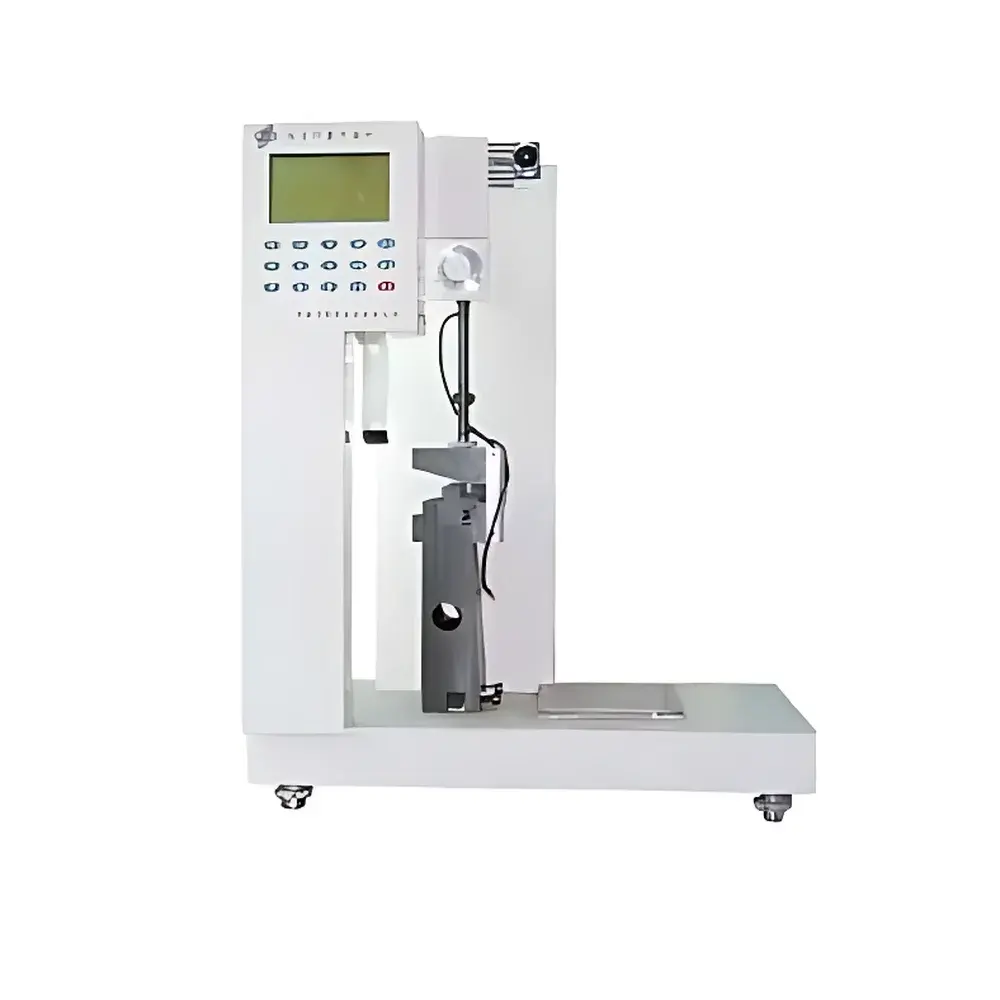
JJ-20-cczn Impact Testing Machine (Cantilever & Simply-Supported Beam Configuration)
| Brand | Changchun Intelligent |
|---|---|
| Origin | Jilin, China |
| Model | JJ-20-cczn |
| Sample Span Options | 40 mm, 60 mm, 62 mm, 70 mm, 95 mm |
| Specimen Width Range | 4–15 mm |
| Specimen Thickness Range | 3–10 mm |
| Pendulum Impact Velocity | 3.8 m/s |
| Display | LCD Digital Interface |
Overview
The JJ-20-cczn Impact Testing Machine is a precision-engineered physical property testing instrument designed for standardized determination of impact resistance in thermoplastic and thermosetting engineering polymers. It operates on the principle of pendulum impact energy absorption, conforming to fundamental mechanical test methodologies defined in ASTM D256 (Standard Test Methods for Determining the Izod and Charpy Impact Resistance of Plastics) and ISO 180/ISO 179 (Plastics — Determination of Izod Impact Strength and Charpy Impact Strength). The system supports both cantilever-beam (Izod) and simply-supported beam (Charpy) configurations through interchangeable anvil and clamp assemblies, enabling dual-mode evaluation within a single platform. Its rigid cast-iron base, calibrated pendulum arm with precision-machined striker, and low-friction bearing system ensure high reproducibility and minimal energy loss during impact events.
Key Features
- LCD digital display panel providing real-time readout of impact energy (J), absorbed energy (J), and pendulum angle (°) with automatic zero-reset and unit toggle (J/m or kJ/m²)
- Modular anvil and specimen holder design accommodating five standardized span lengths: 40 mm, 60 mm, 62 mm, 70 mm, and 95 mm — compliant with ASTM D256 Type A (Izod) and Type B (Charpy) fixtures
- Adjustable specimen clamping mechanism supporting rectangular cross-sections from 4 mm to 15 mm in width and 3 mm to 10 mm in thickness
- Pendulum with nominal impact velocity of 3.8 m/s at the point of contact, calibrated per ISO 13802 requirements for verification of kinetic energy accuracy
- Integrated safety guard with interlocked door switch to halt pendulum release unless fully closed — meeting CE machinery directive (2006/42/EC) basic health and safety requirements
- Stainless-steel striker tip with certified radius (1 mm ± 0.1 mm) and hardness (HRC 58–62), traceable to NIST-traceable calibration standards
Sample Compatibility & Compliance
The JJ-20-cczn accommodates standard ASTM and ISO-compliant test specimens cut from injection-molded plaques, extruded sheets, or machined bars. It is routinely employed for quality control of polyamide (PA6, PA66), polycarbonate (PC), acrylonitrile butadiene styrene (ABS), polybutylene terephthalate (PBT), and glass-fiber-reinforced composites. All mechanical components are manufactured to ISO 2768-mK general tolerances, and energy calibration is validated using certified reference specimens (e.g., PMMA calibration bars with known impact strength values). The instrument meets essential requirements for GLP-compliant laboratories when operated with documented calibration records, maintenance logs, and operator training verification.
Software & Data Management
While the JJ-20-cczn operates as a stand-alone analog-digital hybrid instrument, its LCD interface supports manual data logging with timestamped energy readings. For integration into networked QA/QC environments, optional RS-232 or USB-to-serial adapters enable connection to external PCs running validated laboratory data management systems (LIMS). Exported data conforms to CSV format with columns for test ID, specimen ID, span length, width/thickness measurements, impact energy (J), and pass/fail flag relative to specification limits. Audit trail functionality—including user login, parameter changes, and calibration event timestamps—is available when paired with FDA 21 CFR Part 11–compliant software modules.
Applications
- Verification of batch-to-batch consistency in polymer compound formulations prior to extrusion or molding
- Evaluation of embrittlement effects following thermal aging, UV exposure, or chemical immersion per ASTM G154 or ISO 4892
- Comparative assessment of toughening agent efficacy (e.g., elastomer modifiers, nano-fillers) in R&D laboratories
- Supporting technical documentation for automotive PP/EPDM blends per SAE J2334 or aerospace-grade PEEK composites per AMS 3675
- Teaching impact mechanics principles in university materials science laboratories under controlled pedagogical protocols
FAQ
What standards does the JJ-20-cczn comply with for impact testing?
It supports test execution per ASTM D256 (Izod), ASTM D6110 (Charpy), ISO 180, ISO 179-1, and GB/T 1043.1—subject to correct fixture selection and specimen preparation.
Can the machine be calibrated in-house?
Yes, routine verification uses certified reference specimens; full calibration requires traceable pendulum energy calibration kits and should be performed annually by an accredited metrology provider.
Is the LCD display programmable for custom units or thresholds?
No—the display shows fixed parameters (energy, angle); threshold-based pass/fail logic must be implemented externally via LIMS or spreadsheet-based QC rules.
Does the system support notched and unnotched specimen testing?
Yes, both notched (ASTM D256 Type I or II) and unnotched (ISO 179-1 UR) configurations are supported using interchangeable notch guides and clamps.
What maintenance intervals are recommended for long-term accuracy?
Lubrication of pivot bearings every 6 months, visual inspection of striker tip wear before each shift, and annual verification of pendulum axis alignment and energy loss coefficient (≤ 0.5% deviation).



