
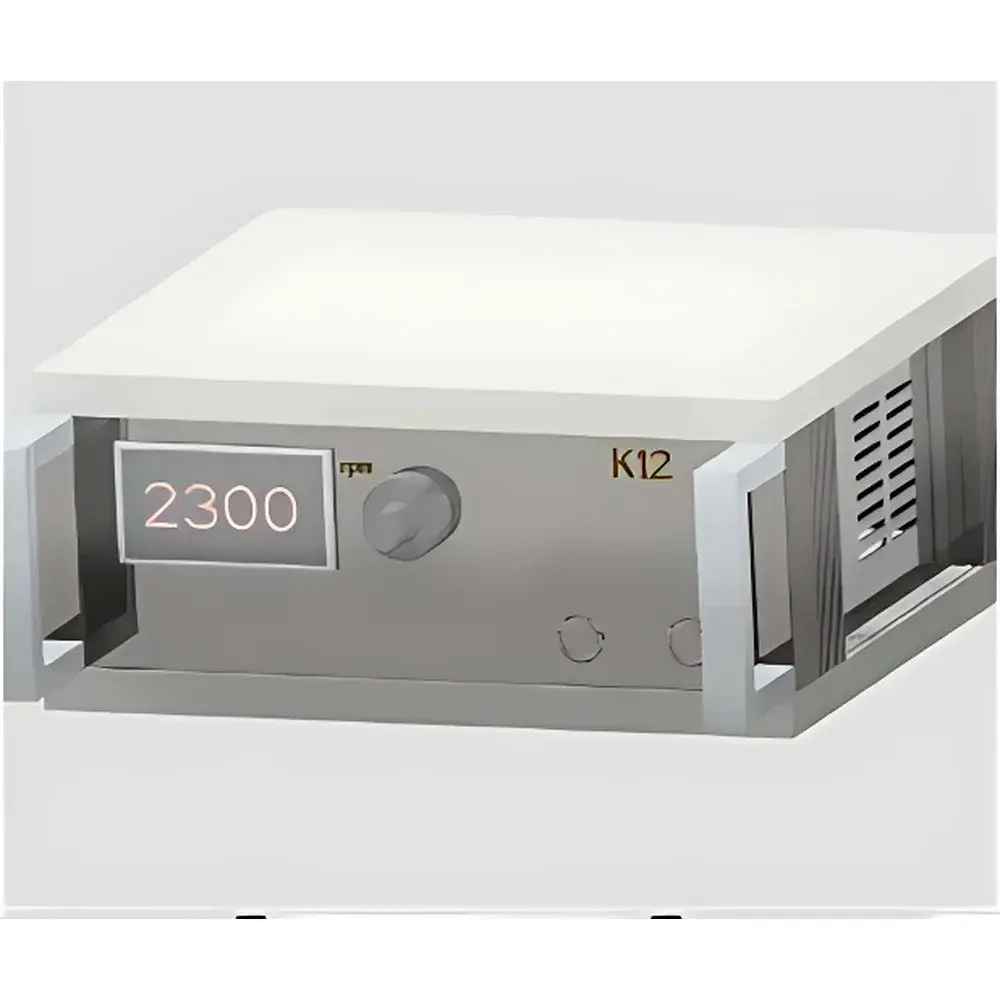
Truelab K12 Single-Channel Electrospinning Collector Controller
| Brand | Truelab |
|---|---|
| Origin | Shanghai, China |
| Model | K12 |
| Speed Range | 300–3600 ±20 rpm |
| Dimensions (W×D×H) | 275 × 250 × 110 mm |
| Weight | 3.5 kg |
| Power Supply | AC 220 V, 50 Hz |
| Motor Type | Hall-effect-sensored Brushless DC (BLDC) |
| Direction Control | Forward/Reverse Toggle Switch |
| Safety | Emergency Stop Button, Dedicated Motor Grounding Terminal |
| Expandability | Compatible with K22 Dual-Channel Controller Upgrade |
| Enclosure | Industrial-grade ABS+PC housing |
Overview
The Truelab K12 Single-Channel Electrospinning Collector Controller is an engineered precision interface designed specifically for rotational electrospinning collectors driven by Hall-effect-sensored brushless DC (BLDC) motors. It delivers stable, low-ripple speed regulation across a calibrated range of 300–3600 ±20 rpm—optimized to support uniform nanofiber deposition on cylindrical mandrels, rotating drums, or custom collector geometries. Unlike generic motor controllers, the K12 integrates hardware-level current limiting, thermal monitoring, and closed-loop speed feedback via integrated Hall sensors—ensuring consistent angular velocity under variable mechanical load conditions typical during polymer jet impingement and fiber accumulation. Its compact form factor (275 × 250 × 110 mm) and 3.5 kg mass enable seamless integration into benchtop electrospinning workstations, fume hoods, or ISO-classified cleanroom environments without compromising structural stability or electromagnetic compatibility (EMC). The controller operates exclusively on standard AC 220 V / 50 Hz mains power, eliminating the need for external DC power supplies or signal conditioning modules.
Key Features
- Precision BLDC motor control with real-time Hall-sensor feedback for ±20 rpm speed accuracy across the full 300–3600 rpm operating range
- Dedicated forward/reverse direction toggle switch enabling rapid polarity reversal without software reconfiguration or parameter reset
- Integrated emergency stop button compliant with IEC 60204-1 Category 0 shutdown requirements—physically interrupting motor power at the drive stage
- Isolated motor grounding terminal supporting low-impedance earth connection (<1 Ω) to suppress bearing current erosion and extend motor service life beyond 10,000 operational hours
- Industrial-grade enclosure fabricated from UL94 V-0 rated ABS+PC blend, providing IP20 ingress protection and flame-retardant operation in laboratory settings
- Modular architecture supporting field upgrade to the Truelab K22 dual-channel controller via firmware update and optional expansion board installation
Sample Compatibility & Compliance
The K12 controller is compatible with all electrospinning collector systems utilizing Hall-equipped BLDC motors rated for continuous operation at ≤250 W input power and ≤48 V nominal bus voltage. It supports standard 3-phase BLDC configurations with 120° commutation timing and accepts common encoder resolutions (e.g., 2-pole-pair, 4-pole-pair). While not a medical device or process-critical GMP system, its design adheres to key laboratory equipment standards including IEC 61000-6-3 (EMI emission limits), IEC 61000-6-2 (immunity to electrostatic discharge and fast transients), and GB/T 14710–2009 (Chinese environmental testing for electrical equipment). For regulated applications involving pharmaceutical nanofiber scaffolds or ISO 13485-aligned R&D workflows, the K12’s deterministic speed control and mechanical safety features support alignment with GLP documentation requirements when paired with validated collector hardware.
Software & Data Management
The K12 operates as a standalone hardware controller with no embedded microprocessor-based UI or data logging capability. All operational parameters—including setpoint rpm, direction state, and fault status—are managed locally via front-panel potentiometer and tactile switches. No proprietary software, drivers, or USB/RS-232 interfaces are included, minimizing cybersecurity attack surface and ensuring long-term interoperability across evolving OS platforms. For laboratories requiring audit trails or electronic records, the K12 may be integrated into higher-level supervisory systems (e.g., LabVIEW, MATLAB, or SCADA) via optional analog 0–10 V speed command input and 0–10 V tachometer feedback output (available upon request with K12-AN variant). Such configurations support 21 CFR Part 11-compliant electronic signatures when deployed with validated acquisition software and access-controlled user accounts.
Applications
- Controlled fabrication of aligned polymeric nanofibers (e.g., PCL, PLA, PAN) on rotating drum collectors for tissue engineering scaffold development
- High-speed fiber collection in solvent-free or low-volatility electrospinning processes where precise rotational shear minimizes fiber entanglement
- Process optimization studies requiring repeatable rpm sweeps (e.g., 500 → 1500 → 3000 rpm) to correlate collector speed with fiber diameter distribution (measured via SEM or AFM)
- Integration into multi-nozzle electrospinning platforms where independent collector speed tuning enables differential fiber orientation across parallel deposition zones
- Teaching laboratories conducting fundamental experiments on jet stretching dynamics, whipping instability suppression, and collector-induced fiber alignment mechanisms
FAQ
Does the K12 support analog or digital speed setpoint input?
Yes—the standard K12 uses manual potentiometer control, but the K12-AN variant provides 0–10 V analog input for remote speed command and 0–10 V tachometer output for closed-loop verification.
Can the K12 be used with non-Hall BLDC motors?
No—it requires Hall-effect sensor signals for commutation timing and speed feedback; sensorless or encoder-only motors are incompatible.
What is the maximum continuous torque the K12 can deliver?
It supports BLDC motors with peak torque ≤1.2 N·m and continuous torque ≤0.6 N·m at rated speed, assuming adequate heat dissipation from the motor housing.
Is CE or UL certification available for the K12?
The unit complies with applicable IEC/GB safety and EMC standards; formal CE marking is available upon request for EU-market shipments subject to technical file review.
How is firmware updated during a K12-to-K22 upgrade?
Upgrade requires physical installation of the K22 expansion board and flashing of new firmware via UART interface using Truelab-provided configuration utility—no end-user programming required.



