
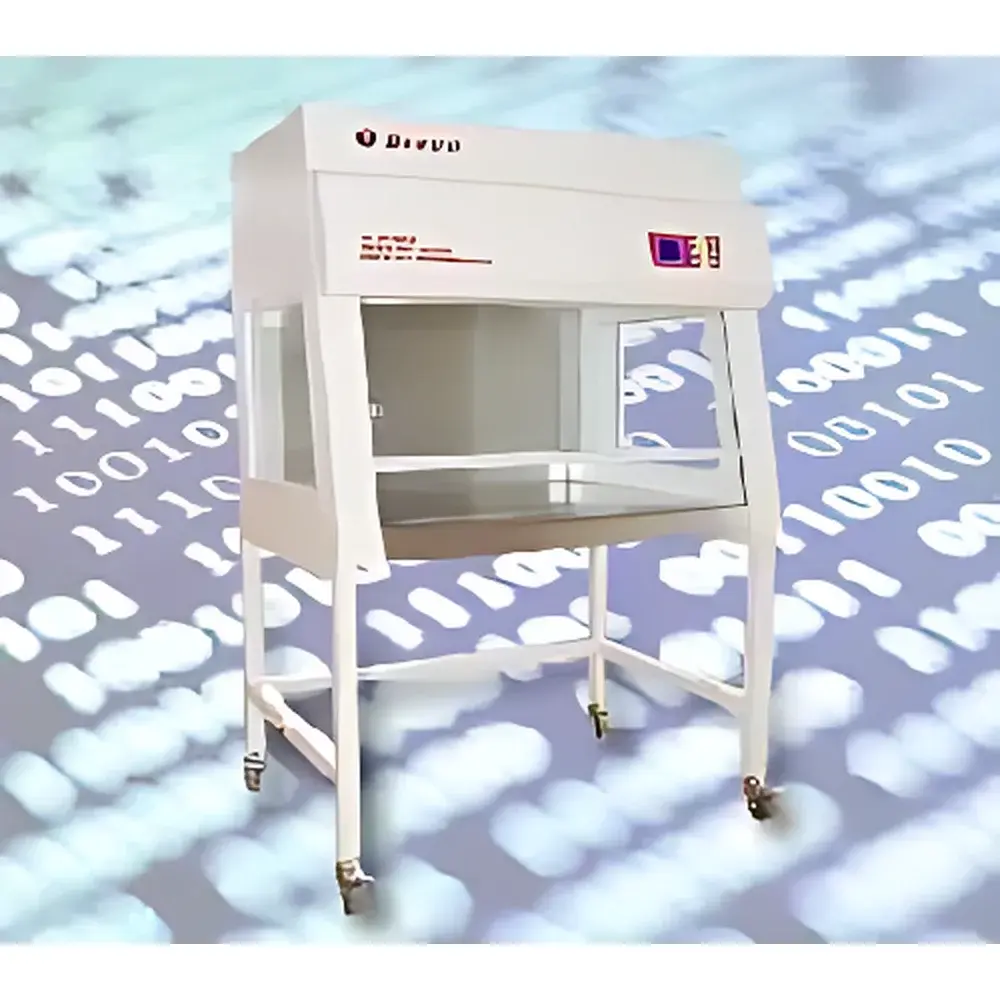
Truelab BJ-1CD Vertical Laminar Flow Clean Bench (Single-Person, Single-Face)
| Brand | Truelab |
|---|---|
| Origin | Shanghai, China |
| Instrument Type | Vertical Laminar Flow Clean Bench |
| Cleanliness Class | ISO Class 5 (equivalent to Fed. Std. 209E Class 100 @ ≥0.5 µm) |
| Airflow Pattern | Vertical Downward Laminar Flow |
| User Capacity | Single-Person, Single-Face |
| Average Air Velocity | 0.1–0.6 m/s (infinitely adjustable) |
| Microbial Contamination | ≤0.5 CFU/plate·hr (φ90 mm Petri dish) |
| Noise Level | ≤62 dB(A) |
| Illumination | ≥300 lux |
| Vibration Half-Peak Amplitude | ≤0.3 µm (X/Y/Z axes) |
| Power Supply | AC 220 V / 50 Hz |
| Power Consumption | 0.3 kW |
| Net Weight | 200 kg |
| Work Area Dimensions | 1570 × 480 × 570 mm (W×D×H) |
| Overall Dimensions | 1570 × 790 × 1380 mm (W×D×H) |
| HEPA Filter Specification | 549 × 1236 × 50 mm (1 unit) |
| Lighting | 30 W Fluorescent Lamp ×1 |
| UV Lamp | 40 W ×1 |
| Control Interface | LCD Display with Real-Time Parameter Monitoring (air velocity, filter status, timer, differential pressure) |
Overview
The Truelab BJ-1CD is a single-person, single-face vertical laminar flow clean bench engineered for ISO Class 5 (Fed. Std. 209E Class 100) particulate control in non-hazardous laboratory applications. It operates on the principle of unidirectional vertical airflow: ambient air is drawn through a pre-filter and conditioned via a high-efficiency particulate air (HEPA) filter (rated at ≥99.99% efficiency for particles ≥0.3 µm), then delivered downward across the work surface at a controlled, uniform velocity. This laminar flow establishes a sterile barrier that sweeps airborne contaminants—including viable microorganisms and non-viable particulates—away from the operator and out of the work zone, protecting samples during aseptic procedures such as media preparation, cell culture handling, pharmaceutical weighing, and microbiological plating. Unlike biological safety cabinets, the BJ-1CD does not recirculate air nor provide personnel or environmental protection against biohazards; it is strictly intended for use with non-pathogenic, non-toxic, and non-volatile materials compliant with ISO 14644-1 and USP guidance for low-risk compounding environments.
Key Features
- Vertical laminar airflow architecture with infinitely adjustable velocity (0.1–0.6 m/s), digitally monitored and stabilized via closed-loop feedback control
- Integrated LCD interface displaying real-time operational parameters: airflow velocity, HEPA filter differential pressure, UV lamp runtime, and programmable sterilization timer
- Robust structural design: cold-rolled steel outer casing with electrostatic epoxy coating; mirror-finish 304 stainless steel work surface resistant to corrosion and compatible with common disinfectants (e.g., 70% ethanol, 10% sodium hypochlorite)
- Dual independent lighting system: 30 W fluorescent lamp for task illumination (≥300 lux at work surface) and 40 W germicidal UV-C lamp (254 nm) with interlocked safety cutoff when sash is opened
- Counterbalanced vertical sliding sash with frictionless movement and infinite positional locking—optimized for ergonomic access and consistent containment geometry
- Acoustically damped centrifugal blower assembly achieving ≤62 dB(A) at 1 m distance, meeting ISO 7779 and ANSI S12.55 noise compliance thresholds for routine lab environments
- Pre-filter + HEPA filtration train (549 × 1236 × 50 mm, EN 1822-1 H14 grade) with visual and audible alarm triggered upon filter saturation or integrity loss
Sample Compatibility & Compliance
The BJ-1CD is validated for use with non-infectious, non-toxic, and non-aerosol-generating materials. It complies with international standards governing cleanroom equipment performance, including ISO 14644-1 (Class 5 airborne particle limits), ISO 14644-3 (test methods for cleanbench airflow uniformity and turbulence), and EN 12464-1 (lighting requirements for laboratory workplaces). While not certified to NSF/ANSI 49 or EN 12469 (biological safety cabinet standards), its design aligns with USP Annex A recommendations for low-risk sterile compounding and CLSI GP26-A4 guidelines for microbiology laboratory ventilation. The unit supports GLP-compliant documentation through timestamped event logging (UV activation, filter runtime, door position changes) and retains configuration memory after power interruption per IEC 61000-4-11 immunity testing.
Software & Data Management
The embedded microcontroller firmware provides audit-ready operational logging without external software dependency. All critical events—including UV cycle initiation/completion, sash position changes, filter pressure drop exceeding 70% of initial baseline, and power-loss recovery—are time-stamped and stored in non-volatile memory for ≥12 months. Data export is supported via RS-232 serial interface (optional USB-to-serial adapter) for integration into laboratory information management systems (LIMS). The interface meets FDA 21 CFR Part 11 requirements for electronic records: user authentication (password-protected access levels), electronic signatures for maintenance logs, and immutable audit trails with tamper-evident timestamps.
Applications
- Aseptic preparation of microbial growth media and agar plates in clinical and research microbiology labs
- Handling of primary cell cultures, hybridoma lines, and non-pathogenic recombinant strains under GMP-aligned conditions
- Weighing and dispensing of non-hazardous pharmaceutical actives and excipients in ISO Class 5 buffer rooms
- Assembly and inspection of precision optical components and semiconductor prototypes requiring particle-free environments
- Electronics prototyping involving solder paste application and reflow staging where flux residue must remain uncontaminated
- Forensic trace evidence examination where fiber or particulate cross-contamination must be minimized
FAQ
What is the difference between a vertical laminar flow clean bench and a biological safety cabinet?
A vertical laminar flow clean bench protects only the sample—not the operator or environment—by directing filtered air downward over the work surface. A biological safety cabinet (BSC) provides simultaneous protection for personnel, product, and environment using inward airflow, recirculation, and exhaust filtration, and is required for work with Risk Group 2+ agents per WHO Biosafety Manual.
Does the BJ-1CD meet ISO Class 5 certification requirements?
Yes—the unit achieves and maintains ≤3,520 particles/m³ ≥0.5 µm under steady-state operation, verified per ISO 14644-1:2015 Annex B test protocols including particle counting, airflow visualization, and recovery testing.
Can the HEPA filter be replaced in-house?
Yes—filter replacement requires standard tools and takes <15 minutes. Replacement HEPA units (EN 1822-1 H14, 549 × 1236 × 50 mm) are supplied with integrity test certificates and pre-installed gasketing to ensure leak-tight mounting per ISO 14644-3 Annex D.
Is the UV lamp intensity monitored?
No—intensity is not actively measured, but cumulative UV runtime is tracked and displayed. Per IEC 62471, the 40 W low-pressure mercury lamp delivers ≥100 µW/cm² at 1 m distance, sufficient for surface decontamination per CLSI M29-A4 guidelines when operated for ≥15 minutes post-use.
What electrical safety certifications does the unit hold?
It conforms to IEC 61010-1 (Safety Requirements for Electrical Equipment for Measurement, Control, and Laboratory Use) and carries CE marking under the EU Low Voltage Directive 2014/35/EU and EMC Directive 2014/30/EU.



