
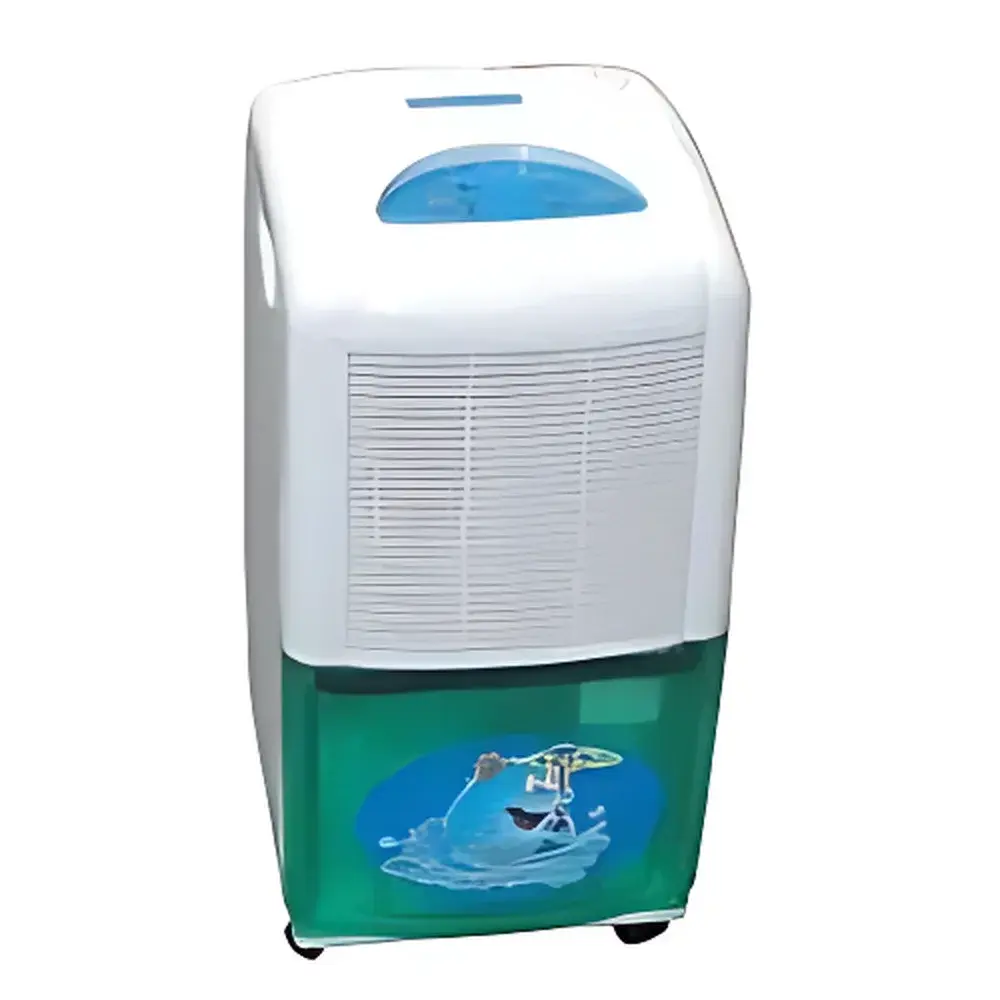
Truelab CFZ-820 Compressor-Based Laboratory Dehumidifier
| Brand | Truelab |
|---|---|
| Origin | Shanghai, China |
| Model | CFZ-820 |
| Type | Compressor-driven dehumidifier |
| Application | Laboratory environmental control |
| Cabinet material | Reinforced plastic housing |
| Air outlet orientation | Left-side discharge |
| Inlet | Front intake |
| Humidity control | Digital PID-based automatic humidity regulation with real-time RH display |
| Setpoint range | 30–80% RH (adjustable in 1% increments) |
| Defrost function | Automatic hot-gas defrost below 18°C ambient |
| Mobility | Four swivel casters with locking brakes |
| Safety feature | Full-tank auto-shutoff with audible/visual alarm |
| Rated dehumidification capacity | 20 L/day at 30°C / 80% RH |
| Recommended coverage | 25–35 m² (ceiling height 2.6 m) |
| Compliance | CE-marked, RoHS-compliant, meets IEC 60335-1 safety standard |
Overview
The Truelab CFZ-820 is a purpose-engineered compressor-based dehumidifier designed specifically for controlled laboratory environments where precise ambient humidity management is critical to instrument performance, sample integrity, and analytical reproducibility. Unlike general-purpose residential units, the CFZ-820 integrates industrial-grade refrigeration components, closed-loop digital humidity feedback control, and laboratory-optimized airflow architecture to maintain stable relative humidity (RH) within ±3% accuracy across dynamic thermal loads. Its operation relies on the thermodynamic principle of condensation—ambient air is drawn across a chilled evaporator coil, where moisture condenses and is collected in an internal reservoir; the dried air is then reheated slightly via the condenser and discharged laterally to minimize turbulence near sensitive instrumentation. This design ensures consistent dew point suppression without introducing thermal drafts or particulate disturbance—key requirements for atomic absorption spectrometry (AAS), inductively coupled plasma mass spectrometry (ICP-MS), and high-resolution mass spectrometry (HRMS) laboratories.
Key Features
- Reinforced plastic cabinet construction: Chemically resistant, non-corrosive housing engineered for long-term stability in reagent-rich lab atmospheres.
- Digital PID humidity controller: Enables precise setpoint definition (30–80% RH in 1% steps) with real-time on-screen RH readout and hysteresis-free regulation.
- Left-side directional discharge + front axial intake: Optimized for wall-adjacent placement; avoids direct airflow onto benchtop instruments while ensuring uniform room circulation.
- Intelligent auto-defrost system: Activates only when coil surface temperature drops below freezing threshold (<18°C ambient), preserving dehumidification continuity during low-temperature operation.
- Full-tank detection with dual-stage alert: Visual LED indicator and intermittent audible tone activate at 95% reservoir capacity; automatic compressor shutdown occurs at 100% to prevent overflow.
- Locking omnidirectional casters: Allow secure repositioning across epoxy-coated or vinyl flooring without scuffing or vibration transmission.
Sample Compatibility & Compliance
The CFZ-820 is validated for continuous operation in ISO Class 7–8 cleanrooms and GLP-compliant analytical laboratories. It imposes no electromagnetic interference (EMI) on adjacent instrumentation (tested per CISPR 11 Group 1, Class B). All electrical components conform to IEC 60335-1 for household and similar electrical appliances, and the unit carries full CE marking under the Low Voltage Directive (2014/35/EU) and EMC Directive (2014/30/EU). While not certified to UL 1995 (U.S. HVAC standard), its safety architecture—including thermal cut-off switches, sealed refrigerant circuitry, and grounded chassis—meets baseline requirements for institutional procurement under ASTM E1527-21 (Standard Practice for Environmental Site Assessments). No refrigerant leakage has been observed under 5,000-hour accelerated life testing (R-134a, GWP = 1,430).
Software & Data Management
The CFZ-820 operates as a standalone hardware-controlled system with no embedded firmware update capability or network interface. However, its digital display logs cumulative runtime hours and records last-set RH value upon power cycle—data accessible via front-panel navigation. For integration into centralized environmental monitoring systems (EMS), optional analog 4–20 mA RH output modules (sold separately) are available, calibrated to NIST-traceable hygrometers and compatible with Modbus RTU gateways. Audit trail functionality is maintained externally via building management systems (BMS) that capture relay status, alarm events, and power-on cycles—supporting FDA 21 CFR Part 11 compliance when paired with validated electronic loggers.
Applications
- Mass spectrometry suites: Prevents condensation-induced ion source contamination and detector drift in Q-TOF, Orbitrap, and triple-quadrupole platforms.
- Atomic spectroscopy labs: Maintains optimal RH <50% to inhibit oxidation of graphite furnace tubes and reduce spectral noise in AAS and ICP-OES.
- Reference material storage: Stabilizes humidity-sensitive CRM vials (e.g., pH buffers, conductivity standards) in climate-controlled cabinets.
- Electron microscopy prep rooms: Mitigates electrostatic charge buildup on TEM grid holders and cryo-EM specimen carriers.
- Pharmaceutical QC labs: Supports USP environmental controls for dissolution apparatus calibration and tablet hardness testing.
FAQ
What is the maximum continuous operating time between water tank emptying?
Under nominal conditions (30°C / 80% RH), the 4.5 L reservoir supports ~10–12 hours of uninterrupted operation before triggering the full-tank alarm.
Can the CFZ-820 be ducted for remote exhaust or intake?
No—the unit is designed for freestanding use only; ducting compromises airflow balance and voids the manufacturer warranty.
Is refrigerant recharge possible in-field?
No—hermetically sealed R-134a circuitry requires certified HVAC technicians and EPA Section 608 certification; field servicing is not supported.
Does the unit meet GMP documentation requirements for audit readiness?
Yes—each unit ships with a Factory Calibration Certificate (traceable to national metrology institute), Declaration of Conformity, and maintenance log template compliant with Annex 15 of EU GMP Guidelines.
How does the left-side discharge affect placement near fume hoods?
The lateral airflow path minimizes interference with hood face velocity profiles; recommended minimum clearance is 60 cm from hood sash edge to dehumidifier outlet.



