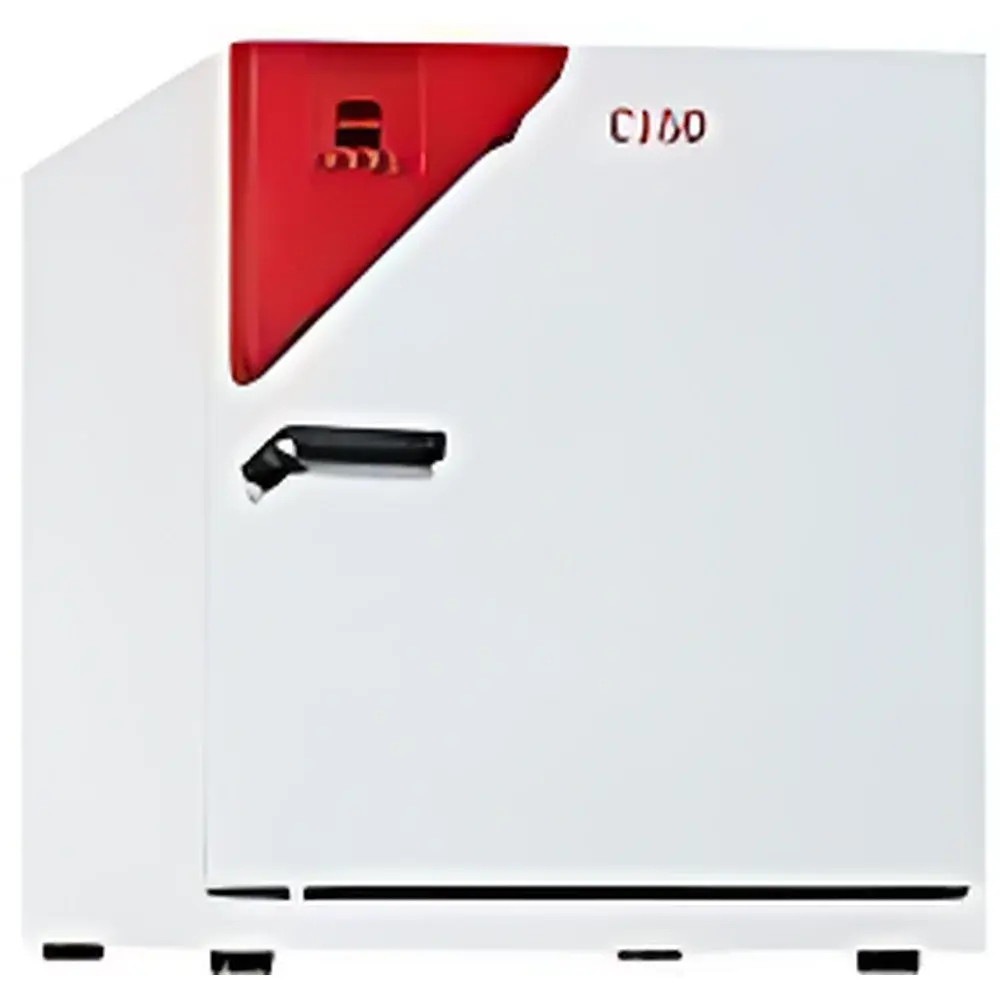
BINDER CB53/CB150/CB210 CO₂ Incubator Series
| Brand | BINDER |
|---|---|
| Origin | Germany |
| Model | CB53 / CB150 / CB210 |
| Temperature Range | Ambient +7 °C to 60 °C |
| Temperature Uniformity | ±0.1 °C (at 37 °C) |
| CO₂ Range | 0–20 vol.% |
| O₂ Range (Tri-gas models) | 0.2–95 vol.% |
| Humidity | ≥95 % RH (Permadry® dual-disk system) |
| Chamber Volume | 53 L / 150 L / 210 L |
| Sterilization | 180 °C hot-air (DIN 58947) |
| CO₂ Sensing | Non-drift IR sensor |
| O₂ Sensing | Zirconia (ZrO₂) sensor |
| Control System | MCS microprocessor controller with LCD interface, real-time clock, and electronic chart recorder |
| Communication | RS 422 (APT-COM® compatible) |
| Construction | Seamless deep-drawn stainless steel chamber (1.4301 / AISI 304) |
| Safety | Independent temperature safety device (DIN 12880 Class 3.1), visual/audible alarms, self-diagnostic system |
Overview
The BINDER CB53, CB150, and CB210 CO₂ incubators are precision-engineered life science instruments designed for reliable, contamination-free cell culture under tightly controlled environmental conditions. Built in Tuttlingen, Germany, these incubators employ a convection-free APT.Line® air-jacketed heating system—eliminating internal fans to prevent airborne particle dispersion and mechanical stress on sensitive cultures. Temperature regulation is achieved via independent, PID-controlled heating elements embedded within the insulated air jacket, ensuring exceptional thermal stability (±0.1 °C uniformity at 37 °C) and rapid recovery (<3 min after 30-sec door opening). The core measurement architecture integrates non-drift infrared (IR) CO₂ sensing and zirconia (ZrO₂)-based O₂ detection—enabling accurate, long-term gas concentration control without recalibration drift or cross-sensitivity. All models comply with DIN 58947 for 180 °C hot-air sterilization—a validated, GLP/GMP-aligned decontamination protocol essential for primary cell work and biosafety Level 2 (BSL-2) applications.
Key Features
- APT.Line® air-jacket technology: Fanless, uniform thermal distribution with minimized turbulence and vibration—critical for stem cell differentiation and low-adhesion culture protocols.
- Seamless deep-drawn stainless steel inner chamber (1.4301 / AISI 304): No weld seams or crevices; smooth, large-radius corners facilitate ISO 14644-compliant cleaning and reduce microbial retention.
- Permadry® dual-disk humidification system: Maintains ≥95 % RH without condensation across the full chamber volume—even during repeated door openings—via passive capillary water transfer and heated evaporation surfaces.
- MCS microcontroller with full-featured LCD interface: Intuitive menu navigation, real-time parameter visualization, programmable alarm thresholds, and built-in electronic chart recorder with timestamped event logging.
- Independent Class 3.1 temperature safety device (DIN 12880): Redundant hardware-level monitoring with optical and acoustic alerting—operational even if main controller fails.
- Gas mixing head with laminar flow design: Delivers homogeneous CO₂/O₂/N₂ distribution without forced convection—minimizing shear stress and preventing localized desiccation or hypoxia artifacts.
- RS 422 serial interface compatible with APT-COM® software: Enables remote monitoring, data export (CSV/Excel), audit-trail generation, and integration into centralized lab management systems compliant with FDA 21 CFR Part 11 requirements.
Sample Compatibility & Compliance
The CB series accommodates standard tissue culture flasks (T25–T225), multiwell plates (6–96-well), roller bottles (optional modular rack system), and specialized vessels including hypoxia chambers and bioreactor adapters. Internal glass doors (standard on CB150/CB210) provide physical compartmentalization—reducing cross-contamination risk and enabling concurrent maintenance of multiple atmospheric setpoints. All models meet DIN EN 61000-6-2 (immunity) and DIN EN 61000-6-4 (emissions) for electromagnetic compatibility. Hot-air sterilization at 180 °C satisfies DIN 58947 and supports validation per ISO 13485 and EU Annex 1 for pharmaceutical cell banking. Gas control accuracy (±0.1 vol.% CO₂/O₂ setpoint resolution) aligns with USP and ASTM E2927-22 for environmental simulation in regenerative medicine workflows.
Software & Data Management
APT-COM® software provides secure, role-based access to incubator parameters, historical trend graphs, and alarm logs. Data integrity is preserved through time-stamped entries, user ID tagging, and tamper-evident audit trails—fully traceable for GLP/GMP inspections. Export functions support CSV, PDF, and XML formats; raw data files include metadata such as calibration dates, firmware versions, and sterilization cycle records. Optional Ethernet gateway modules enable SNMP-based network integration and SNMP trap alerts for facility-wide environmental monitoring platforms. All controllers store ≥30 days of continuous parameter history internally—ensuring continuity during temporary network outages.
Applications
These incubators serve high-integrity applications including: human embryonic and induced pluripotent stem cell (iPSC) expansion; primary neuronal and endothelial cell culture; tumor spheroid and organoid development; monoclonal antibody production in CHO and HEK293 lines; infectious disease modeling requiring precise O₂ modulation (e.g., HIF-1α pathway studies); and GMP-compliant cell therapy manufacturing where environmental consistency directly impacts product potency and release testing outcomes. Tri-gas variants (CB150-TG, CB210-TG) support physioxia research (1–5 % O₂), hyperoxia exposure (up to 95 % O₂), and nitrogen-based inerting for anaerobic co-cultures.
FAQ
What sterilization method is certified for the CB series?
The CB incubators support validated 180 °C hot-air sterilization per DIN 58947—providing complete microbial inactivation without chemical residues or chamber corrosion.
How does the Permadry® system prevent condensation?
It uses two independently heated stainless steel water reservoirs with capillary wicks and optimized surface-area-to-volume geometry—maintaining vapor pressure equilibrium without active misting or ultrasonic components.
Is O₂ control available on all CB models?
O₂ capability is exclusive to tri-gas configurations (CB150-TG and CB210-TG); standard CO₂-only models (CB53, CB150, CB210) do not include zirconia sensors or N₂ supply ports.
Can multiple CB units be monitored centrally?
Yes—via RS 422 daisy-chaining or optional Ethernet gateways, up to 32 units can be managed through APT-COM® Enterprise Edition with configurable dashboard views and automated report scheduling.
What regulatory standards does the MCS controller satisfy?
The controller’s electronic log, user authentication, and change-tracking features meet FDA 21 CFR Part 11 requirements for electronic records and signatures when deployed with appropriate IT infrastructure controls.
Related Products