
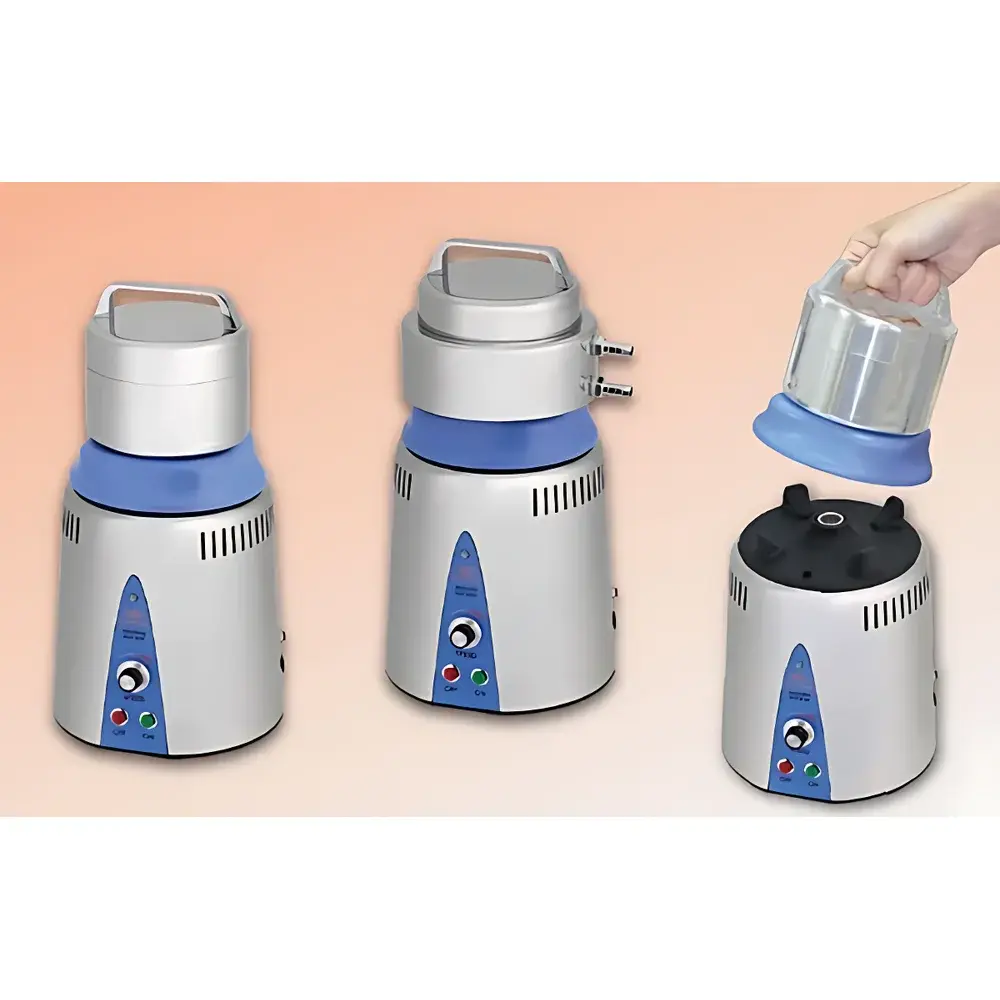
HsiangTai SM-3/L Benchtop Cryogenic Grinder
| Brand | HsiangTai (HSIANGTAI) |
|---|---|
| Origin | Shanghai, China |
| Model | SM-3/L |
| Motor Power | 700 W |
| Speed Range | 0–30,000 rpm |
| Grinding Capacity | 200 mL |
| Feed Size | ≤10 mm (standard) |
| Final Particle Size | 0.01–0.5 mm |
| Cup Material | High-Strength Polycarbonate |
| Dimensions (Ø × H) | 170 × 335 mm |
| Net Weight | 5.6 kg |
| Input Voltage | AC 220 V, 50/60 Hz |
| Safety Features | Overload & Overheat Protection, Automatic Motor Cut-off Upon Cup Detachment |
| Optional Accessory | Micro-Cap Lid for Sub-10 µm Pulverization |
Overview
The HsiangTai SM-3/L is a compact, high-speed benchtop cryogenic grinder engineered for reproducible, controlled size reduction of dry, brittle, and moderately hard solid samples in research, quality control, and analytical laboratories. It operates on the principle of high-shear impact grinding—utilizing a rapidly rotating stainless-steel blade assembly within a sealed polycarbonate grinding cup to fracture material through mechanical collision and attrition. Unlike planetary ball mills or jaw crushers, the SM-3/L delivers rapid throughput with minimal thermal accumulation, especially when used with optional pre-chilled cups or ambient-temperature operation for thermolabile substances such as pharmaceutical excipients, herbal powders, or mineral standards. Its design prioritizes operator safety, regulatory traceability, and compatibility with routine laboratory workflows—making it suitable for ISO/IEC 17025-accredited testing environments and GLP-compliant sample preparation protocols.
Key Features
- Variable speed control (0–30,000 rpm) enables precise optimization of particle size distribution across diverse sample matrices—from friable soil aggregates to dense ceramic granules.
- Integrated dual-protection circuitry provides automatic motor shutdown during overload conditions or temperature excursions exceeding safe operational thresholds (≥65°C).
- Modular cup-and-base architecture ensures full mechanical decoupling: if the grinding cup is lifted or disengaged mid-cycle, power to the motor is instantly interrupted—meeting IEC 61000-4-11 electrical safety requirements.
- Polycarbonate grinding cup (200 mL capacity) features chemical resistance to common solvents and autoclavable construction for cross-contamination prevention between batches.
- Cryogenic-ready configuration supports optional liquid nitrogen pre-cooling of samples and cups—critical for preserving crystallinity in polymorphic drug substances or preventing amorphization during milling.
- Micro-cap lid accessory reduces effective grinding volume to <5 mL, enabling ultra-rapid pulverization (<30 s) of small-volume samples down to median particle sizes below 10 µm (D50), verified by laser diffraction analysis per ISO 13320.
Sample Compatibility & Compliance
The SM-3/L accepts dry, non-fibrous, non-sticky materials with Mohs hardness ≤6.5—including but not limited to pharmaceutical tablets and APIs, agricultural grains, powdered clays, sintered oxides, geological core fragments, and botanical extracts. It is unsuitable for wet, oily, fibrous, or highly elastic samples (e.g., rubber, polymers above Tg). All mechanical components comply with RoHS Directive 2011/65/EU and CE marking requirements for laboratory equipment (EN 61000-6-2, EN 61000-6-4). The unit meets basic electrical safety criteria outlined in UL 61010-1 and is routinely validated for use in USP sieve analysis preparation and ASTM D5630-22 standard test methods for plastic ash content determination where homogenized feedstock is required.
Software & Data Management
As a manually operated, analog-controlled instrument, the SM-3/L does not incorporate embedded firmware or digital connectivity. However, its consistent mechanical performance supports integration into electronic lab notebook (ELN) systems via documented SOPs. Users may record speed setting, run duration, cup temperature (with external IR thermometer), and post-grind sieve analysis results in structured templates compliant with FDA 21 CFR Part 11 when paired with audit-trail-enabled ELN platforms (e.g., LabArchives, IDBS E-WorkBook). Routine preventive maintenance logs—including blade wear inspection, cup integrity checks, and calibration of tachometer accuracy using handheld optical sensors—are recommended quarterly per ISO/IEC 17025 Clause 6.4.8.
Applications
- Preparation of homogeneous sub-samples for X-ray fluorescence (XRF) and inductively coupled plasma (ICP-OES/MS) analysis of geological and metallurgical specimens.
- Routine comminution of herbal raw materials prior to HPLC assay or microbial limit testing per USP and .
- Particle size standardization of reference materials used in laser diffraction validation studies (ISO 13320 Annex B).
- Homogenization of dried food products (e.g., spices, cereals) for nutritional labeling compliance under EU Regulation (EU) No 1169/2011.
- Generation of fine ceramic precursors for sintering trials in materials science R&D labs.
FAQ
Can the SM-3/L process wet or frozen samples?
No. The instrument is designed exclusively for dry, room-temperature or pre-chilled solid materials. Introducing moisture may cause blade corrosion, cup clouding, or electrical hazards.
Is the grinding cup autoclavable?
Yes—the polycarbonate cup is rated for steam sterilization at 121°C for 15 minutes; however, repeated autoclaving may reduce long-term impact resistance. Visual inspection for microcracks is advised before each use.
What is the expected service life of the stainless-steel blade assembly?
Under typical usage (≤5 cycles/day), the blade maintains dimensional integrity for ≥12 months. Replacement is recommended when observed edge rounding exceeds 50 µm under 10× magnification.
Does the SM-3/L meet GMP documentation requirements?
While the device itself lacks digital logging, its mechanical repeatability and modular design support IQ/OQ documentation per ASTM E2500-22. Full validation packages—including performance qualification with certified reference materials—are available upon request from authorized distributors.
Can I use the SM-3/L for nanomaterial synthesis?
No. This is a macro-scale comminution tool. It does not achieve nano-range particle sizes (≤100 nm) nor provide the energy input necessary for top-down nanoparticle generation.



