
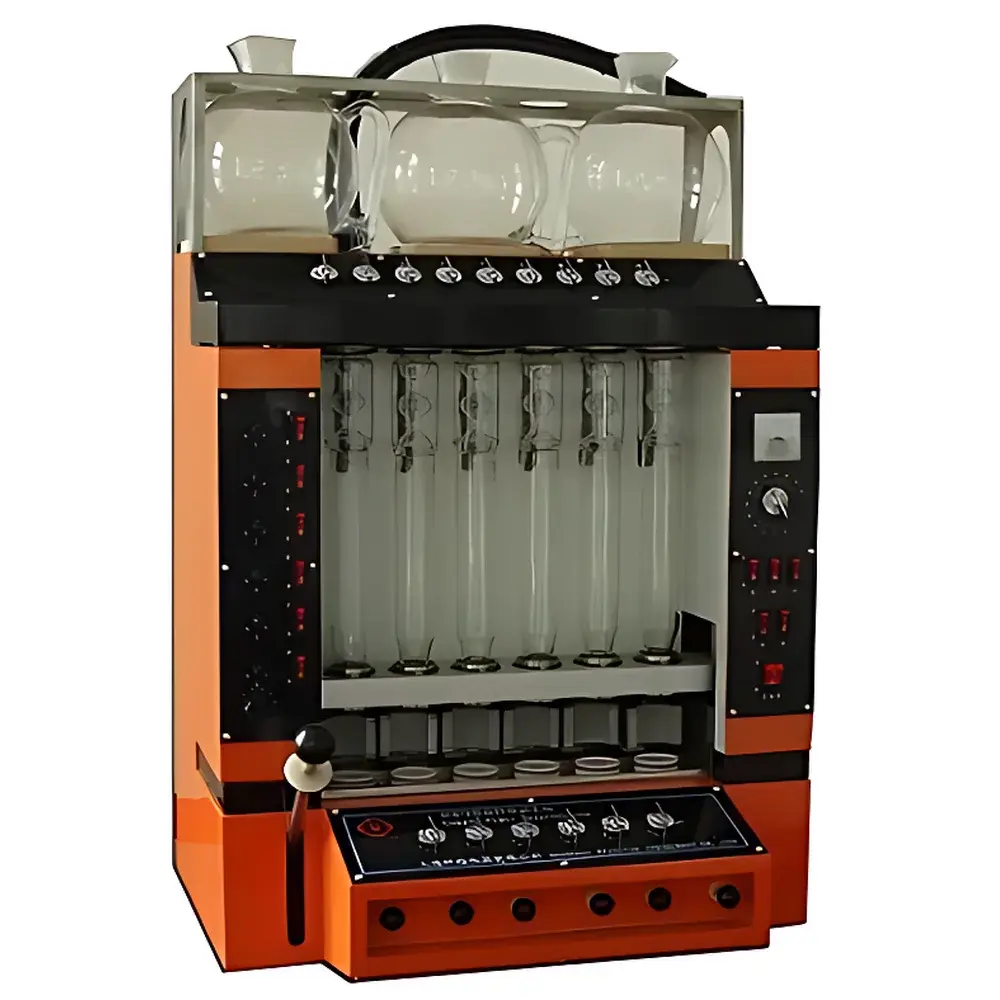
Truelab SLQ-6 Acid-Base Digestion Fiber Analyzer
| Brand | Truelab |
|---|---|
| Origin | Shanghai, China |
| Model | SLQ-6 |
| Sample Capacity | 6 positions |
| Sample Mass Range | 0.5–3 g |
| Measurement Range | 0–100% (w/w) |
| Accuracy | Relative deviation ≤4%, Parallel deviation ≤0.4% |
| Total Cycle Time | ≤90 min (acid digestion: 30 min, alkaline digestion: 30 min, filtration & rinsing: ~30 min) |
| Heating System | Six independent semi-spherical ceramic heating elements with individual temperature control per crucible |
| Temperature Range | Ambient to 400 °C |
| Sealing Mechanism | Dual-layer PTFE isolation gasket (top and bottom) |
| Rated Power | 2 kW |
| Power Supply | 220 V ±10%, 50–60 Hz |
| Dimensions (W×D×H) | 570 × 470 × 750 mm |
| Weight | 30 kg |
Overview
The Truelab SLQ-6 Acid-Base Digestion Fiber Analyzer is a dedicated benchtop instrument engineered for the standardized determination of crude fiber content in agricultural and food matrices according to classical acid-base detergent fiber methodology—aligned with AOAC Official Method 962.09, ISO 6865:2000, and GB/T 6434–2006. It implements a fully enclosed, automated digestion workflow comprising sequential sulfuric acid hydrolysis, sodium hydroxide solubilization, vacuum-assisted filtration, and thorough solvent rinsing—all conducted within sealed crucibles without manual sample transfer. This closed-system architecture minimizes analyst exposure to corrosive reagents, reduces procedural variability, and ensures high reproducibility across replicate analyses. The instrument operates on the principle that crude fiber represents the residue remaining after exhaustive removal of starches, sugars, pectins, and hemicelluloses via controlled acid and alkali treatments, followed by ash correction. Its design prioritizes operational robustness, thermal uniformity, and methodological fidelity for routine quality control laboratories in feed mills, grain processing facilities, dairy nutrition centers, and food regulatory testing units.
Key Features
- Six independent semi-spherical ceramic heating modules—each thermally isolated and individually adjustable from ambient to 400 °C—enable precise, position-specific temperature optimization for heterogeneous sample types.
- PTFE dual-gasket sealing system (top and bottom) ensures leak-tight containment during high-temperature acid/alkali digestion, preventing vapor loss and cross-contamination between samples.
- Integrated peristaltic reagent delivery and vacuum filtration manifold eliminates manual pipetting and gravity-based rinsing, reducing operator error and improving inter-batch consistency.
- No sample transfer requirement: digestion, neutralization, filtration, and washing occur sequentially in the same crucible, preserving mass integrity and minimizing analytical bias.
- Compliant electrical architecture with over-temperature cutoff, grounded chassis, and CE-marked safety interlocks meets IEC 61010-1 requirements for laboratory equipment.
Sample Compatibility & Compliance
The SLQ-6 accommodates solid, granular, or powdered samples from cereals (corn, wheat, barley), compound feeds (poultry, swine, ruminant formulations), forage materials (alfalfa hay, silage), bakery by-products, and plant-based food ingredients. Sample mass (0.5–3 g) is selected based on expected fiber concentration and matrix density to ensure complete digestion without overflow or incomplete extraction. The instrument supports full traceability in regulated environments: all digestion parameters—including set temperatures, dwell times, reagent volumes, and filtration duration—are manually logged per run in accordance with GLP documentation practices. While the SLQ-6 itself does not include electronic audit trails or user authentication, its mechanical repeatability and deterministic protocol execution make it suitable for use in FDA-regulated feed safety programs where method validation (per AOAC 2012.01) and equipment qualification (IQ/OQ) are performed externally.
Software & Data Management
The SLQ-6 is a hardware-only platform with no embedded microprocessor, touchscreen interface, or data export capability. All operational parameters are set via analog dials and mechanical timers. Users maintain analytical records manually using standardized lab notebooks or LIMS-integrated worksheets. This architecture intentionally avoids software validation burdens while ensuring long-term reliability, minimal maintenance, and immunity to firmware obsolescence—making it particularly suited for resource-constrained QC labs, teaching institutions, and contract testing facilities requiring ISO/IEC 17025-compliant fiber analysis without digital complexity.
Applications
- Crude fiber quantification in commercial livestock feed formulations to verify compliance with nutritional labeling standards (e.g., AAFCO, EU Regulation No. 767/2009).
- Quality assessment of forage crops during harvest and storage to guide ration balancing for dairy and beef operations.
- Raw material screening in flour milling and cereal processing to detect adulteration or inconsistent milling fractions.
- Method verification and reference analysis in accreditation audits where gravimetric fiber determination serves as the benchmark for NIR calibration models.
- Academic research in animal nutrition, plant biochemistry, and food science where standardized detergent fiber protocols remain the method of record.
FAQ
What standard methods does the SLQ-6 support?
It is validated for AOAC 962.09, ISO 6865:2000, and Chinese national standard GB/T 6434–2006.
Can the SLQ-6 be used for neutral detergent fiber (NDF) or acid detergent fiber (ADF) analysis?
No—it is configured exclusively for crude fiber (CF) per acid-alkali digestion; NDF/ADF require different reagents (e.g., α-amylase, CTAB) and filtration protocols not supported by this platform.
Is ash correction included in the procedure?
Yes—residue after digestion is ignited at 550 °C in a muffle furnace (external equipment), and ash weight is subtracted to report crude fiber on ash-free basis.
What maintenance is required?
Routine cleaning of PTFE gaskets, crucibles, and filtration manifolds with dilute nitric acid; annual calibration of temperature dials against NIST-traceable thermocouples.
Does the unit comply with electrical safety standards for export to the EU or North America?
It meets IEC 61010-1:2010 and carries CE marking; UL/CSA certification requires local third-party evaluation due to regional wiring and grounding specifications.






