
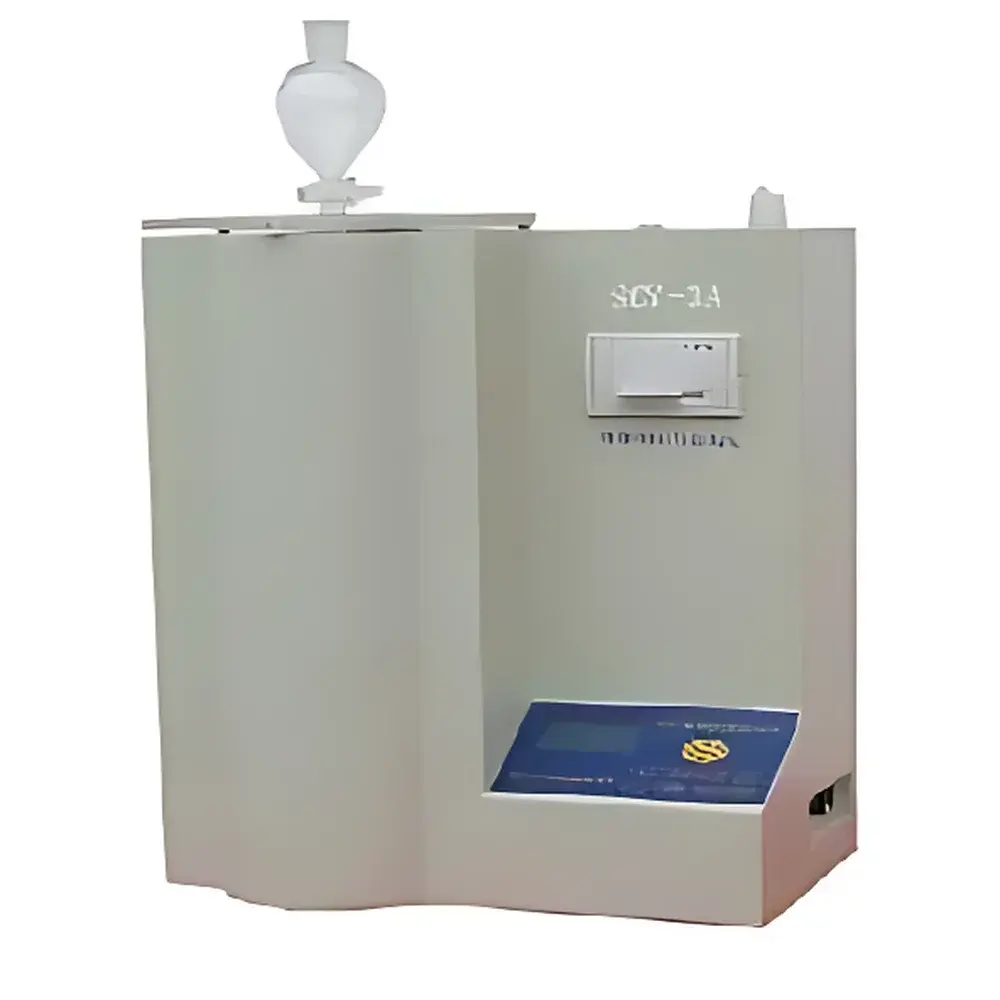
Truelab SCY-3A Carbon Dioxide Analyzer for Beer and Soft Drinks
| Brand | Truelab |
|---|---|
| Origin | Shanghai, China |
| Model | SCY-3A |
| Measurement Range | 0–1.5% (w/w) |
| Accuracy | ±2.5% |
| Display | Chinese LCD interface |
| Power Supply | AC 220 V / 50 Hz |
| Power Consumption | ≤15 W |
| Dimensions | 450 mm × 305 mm × 550 mm (H) |
| Weight | 15 kg |
| Data Storage Capacity | 63 entries per sample type (beer + soft drinks) |
Overview
The Truelab SCY-3A Carbon Dioxide Analyzer is a dedicated benchtop instrument engineered for the quantitative determination of dissolved CO₂ concentration in carbonated beverages—including beer, sparkling water, sodas, and flavored effervescent drinks. It operates on a well-established acid liberation–gas quantification principle: a precisely metered sample is mixed with phosphoric acid in a sealed reaction vessel, liberating dissolved CO₂ as gaseous CO₂; the evolved gas volume is then measured volumetrically under controlled temperature and atmospheric pressure conditions. This method aligns with classical wet-chemical approaches referenced in ISO 21730-1:2019 (Carbonated beverages — Determination of carbon dioxide content — Part 1: Volumetric method) and serves as a practical alternative to more complex instrumental techniques such as headspace GC or infrared absorption when routine QC-level accuracy suffices. Designed for use in brewery QC labs, beverage R&D facilities, and contract testing laboratories, the SCY-3A delivers repeatable, operator-independent results without requiring chromatographic expertise or high-purity carrier gases.
Key Features
- Integrated electrochemical sensor module calibrated for CO₂-specific response in the 0–1.5% (w/w) range, ensuring linearity and minimal cross-sensitivity to O₂ or ethanol vapors.
- Automated assay sequence: auto-initiated upon vessel placement, including reagent dispensing (pre-loaded phosphoric acid), mixing, gas evolution, pressure-stabilized volume measurement, and calculation—reducing manual intervention and inter-operator variability.
- Chinese-language LCD display with real-time graphical feedback: shows CO₂ concentration (% m/m), elapsed assay time, ambient temperature (°C), and system status indicators.
- Onboard non-volatile memory stores up to 63 test records each for beer and soft drink matrices, with timestamp, sample ID (user-entered), and measured value—supporting basic traceability requirements.
- Dedicated thermal printer provides immediate hard-copy output compliant with internal lab documentation standards; printouts include date/time stamp, model number, and measured CO₂ value.
- Built-in real-time clock (RTC) and ambient temperature sensor enable environmental condition logging—critical for identifying potential drift correlated with laboratory thermal fluctuations.
- Compact footprint (450 × 305 × 550 mm) and low power draw (≤15 W) allow deployment in space-constrained QC stations or mobile lab environments without dedicated HVAC or high-capacity circuits.
Sample Compatibility & Compliance
The SCY-3A accommodates standard 300 mL glass or PET reaction vessels conforming to ISO 21730-1 geometry specifications. It supports both filtered and unfiltered beer samples (including hazy craft styles), provided turbidity does not impede acid–sample homogenization. Carbonated soft drinks with pH < 4.5 (e.g., colas, lemon-lime sodas) yield reliable results; highly viscous or pulpy beverages (e.g., fruit nectars) require pre-filtration or dilution validation per internal SOP. While not certified to ISO/IEC 17025 or FDA 21 CFR Part 11 out-of-the-box, the device’s deterministic measurement logic, audit-ready printouts, and timestamped data storage support GLP-aligned workflows. Users may incorporate it into validated methods under ASTM D6178 (Standard Test Method for Carbon Dioxide Content of Carbonated Beverages) with documented system suitability checks.
Software & Data Management
The SCY-3A operates via embedded firmware with no external PC dependency. All data reside locally in EEPROM with write-protection against accidental overwrite. Export functionality is limited to printed reports; however, users may manually transcribe records into LIMS or Excel using the timestamped printout format. The interface supports user-defined sample naming (up to 8 alphanumeric characters) and toggles between beer/soft drink assay modes—each maintaining independent calibration offsets and record counters. Firmware updates are performed via USB port using vendor-supplied utility software (available under NDA); version history and calibration logs are accessible through service menu (password-protected).
Applications
- Routine quality control of finished beer batches prior to packaging—verifying compliance with target carbonation levels (e.g., 0.45–0.65% w/w for lagers, 0.70–0.85% for wheat beers).
- Process monitoring during forced carbonation in bright tanks—enabling rapid feedback for CO₂ injection rate adjustments.
- Stability testing of shelf-life studies: tracking CO₂ loss over time under accelerated storage conditions (e.g., 30°C/75% RH).
- Supplier qualification of CO₂ cylinders and blending gases—cross-verifying supplier certificates of analysis.
- Educational use in food science laboratories to demonstrate gas solubility principles, Henry’s law applications, and volumetric analytical methodology.
FAQ
What standards does the SCY-3A comply with?
It implements methodology consistent with ISO 21730-1:2019 and ASTM D6178, though formal accreditation requires lab-specific validation per ISO/IEC 17025.
Can the instrument measure CO₂ in pasteurized vs. unpasteurized beer interchangeably?
Yes—provided sample temperature is stabilized to 20 ± 0.5°C prior to analysis, as viscosity and gas solubility differ minimally across typical pasteurization profiles.
Is calibration traceable to NIST or other national standards?
Factory calibration uses gravimetrically prepared CO₂-in-water reference solutions; end users should perform periodic verification using certified reference materials (CRM) traceable to NIST SRM 2045 or equivalent.
Does the device require annual recalibration?
Recommended recalibration interval is 12 months or after 500 assays—whichever occurs first—using Truelab-certified service centers or qualified in-house metrology personnel.
How is temperature compensation handled during measurement?
The built-in sensor monitors ambient cabinet temperature and applies empirically derived correction coefficients to the gas volume reading, compensating for thermal expansion effects within the reaction chamber.



