
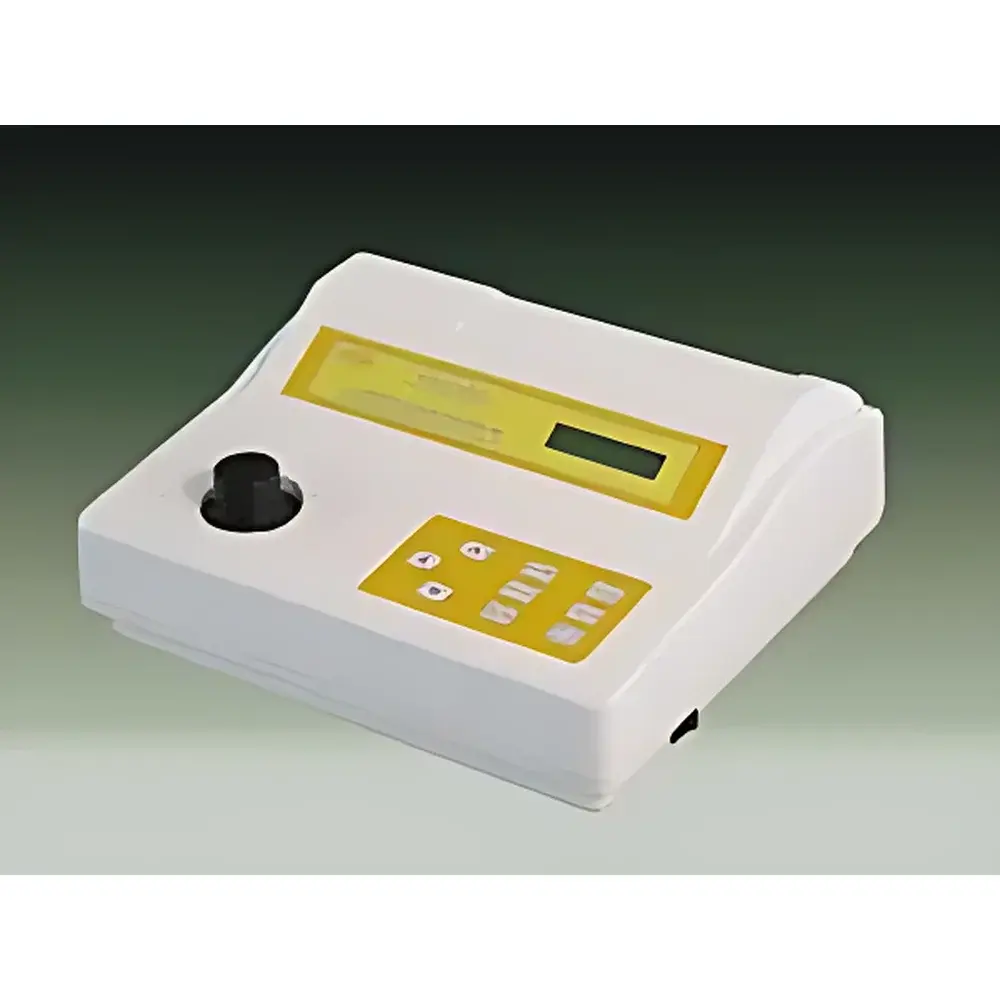
Truelab WGZ-2-XJ Bacterial Turbidimeter
| Brand | Truelab |
|---|---|
| Origin | Shanghai, China |
| Model | WGZ-2-XJ |
| Minimum Readout | 0.01 MCF |
| Measuring Range | 0–6 MCF |
| Basic Error | ±5% F.S. (McFarland Units) |
| Repeatability | ≤1.5% |
| Display | Backlit LCD with Microprocessor Control |
| Interface | RS232 Serial Port |
| Light Source | High-Intensity Stable LED (Rated Lifetime: 100,000 hours) |
| Data Storage | Internal Clock-Synchronized Memory for Calibration Values and Measurement Logs |
| Measurement Modes | Auto-Balanced Reading, Timed-Acquisition, Averaging Mode for Unstable Samples |
| Optical System | Precision Aligned Path with Chromatic Compensation |
| Compliance | Designed to support GLP-compliant workflows in microbiological water testing |
Overview
The Truelab WGZ-2-XJ Bacterial Turbidimeter is a dedicated optical instrument engineered for rapid, field-deployable quantification of bacterial suspension density in liquid media using McFarland turbidity standards (MCF). It operates on the principle of nephelometric light scattering—measuring the intensity of light scattered at a fixed angle (typically 90°) by suspended bacterial cells in a standardized cuvette. Unlike general-purpose turbidimeters calibrated in NTU or FNU, the WGZ-2-XJ is specifically scaled and validated for McFarland units (MCF), enabling direct correlation with established microbial concentration benchmarks used in clinical microbiology, pharmaceutical water system validation, and drinking water safety protocols. Its optical architecture features a precisely aligned LED light source and detector pair, integrated chromatic compensation to minimize interference from sample coloration, and a thermally stabilized measurement path—ensuring consistent performance across ambient laboratory or on-site environmental monitoring conditions.
Key Features
- Microprocessor-controlled operation with touch-sensitive keypad and backlit LCD display for clear visibility under variable lighting conditions
- Auto-balancing readout mode that dynamically stabilizes signal acquisition, reducing operator dependency and minimizing drift during extended measurements
- Configurable timed data capture—users can define sampling intervals (e.g., 2 s, 5 s, 10 s) to accommodate transient turbidity fluctuations in unstable samples such as raw wastewater or freshly inoculated broth
- Integrated averaging algorithm that computes and displays mean turbidity over user-defined cycles (2–10 readings), improving statistical reliability for heterogeneous suspensions
- Non-volatile internal memory with real-time clock stamping—stores up to 500 calibration events and measurement records with timestamps, supporting traceability requirements under ISO/IEC 17025 and CLIA-aligned quality systems
- Dedicated McFarland-scale firmware with factory pre-calibration against NIST-traceable McFarland standard suspensions (0.5, 1.0, 2.0, 4.0, 6.0 MCF)
- RS232 serial interface compliant with ANSI/TIA-232-F specifications, enabling bidirectional communication with LIMS or custom data acquisition software
Sample Compatibility & Compliance
The WGZ-2-XJ accepts standard 12 mm round glass or disposable plastic cuvettes (10 mm path length) and is optimized for aqueous bacterial suspensions—including Escherichia coli, Enterococcus faecalis, Pseudomonas aeruginosa, and other Gram-negative and Gram-positive species commonly enumerated in water quality assessment. It complies with methodological expectations outlined in ASTM D6508 (Standard Guide for Quantitative Determination of Microbial Concentration by Turbidimetric Measurement) and supports verification procedures referenced in USP <1231> (Water for Pharmaceutical Purposes) and ISO 9308-1 (Enumeration of E. coli and coliform bacteria). While not an automated enumeration system, its output serves as a validated proxy for colony-forming unit (CFU/mL) estimation when correlated via strain-specific calibration curves per CLSI M07-A11 guidelines.
Software & Data Management
No proprietary software is bundled; however, the RS232 interface enables integration with third-party platforms including LabVIEW, Python-based PySerial scripts, or Excel via terminal emulation (e.g., Tera Term). All stored data—including calibration date/time, reference MCF value, measured MCF, and operator ID (manually entered)—are exportable as CSV. Audit trail functionality meets minimum GLP documentation requirements: each record includes immutable timestamp, firmware version, and sensor status flag. Firmware updates are delivered via UART bootloader and require physical connection—not cloud-dependent.
Applications
- Routine verification of E. coli suspension density prior to membrane filtration or MPN assay setup in drinking water laboratories
- Monitoring bioburden trends in pharmaceutical purified water (PW) and water-for-injection (WFI) distribution loops during periodic system qualification
- Calibration validation of automated microbial detection platforms (e.g., ATP luminometers, flow cytometers) using standardized turbidimetric references
- Educational use in undergraduate microbiology labs for teaching McFarland standard preparation and turbidity–CFU correlation principles
- Field-based preliminary screening of recreational water bodies where rapid (<60 s) semi-quantitative assessment is prioritized over absolute enumeration
FAQ
What McFarland standards is the WGZ-2-XJ calibrated against?
The instrument is factory-calibrated using NIST-traceable McFarland standard suspensions (0.5, 1.0, 2.0, 4.0, and 6.0 MCF) prepared according to ISO 846:2019 Annex C protocols.
Can it measure samples with high background coloration, such as humic-rich surface water?
Yes—the built-in chromatic compensation algorithm corrects for absorbance contributions below 600 nm, maintaining accuracy within ±5% F.S. for samples with apparent color up to 50 PCU (Platinum-Cobalt Units).
Is the device suitable for GMP-regulated environments?
It supports GMP-aligned operations through secure calibration logging, time-stamped data storage, and RS232 audit trail export—but requires supplementary procedural controls (e.g., documented SOPs, periodic inter-device verification) to satisfy FDA 21 CFR Part 11 electronic record requirements.
Does it comply with EPA Method 180.1 for turbidity measurement?
No—EPA Method 180.1 specifies NTU calibration using Formazin standards; the WGZ-2-XJ is exclusively MCF-scaled and intended for microbiological suspension quantification, not regulatory drinking water turbidity reporting.
What is the recommended recalibration frequency?
Truelab recommends annual verification against certified McFarland standards or after 10,000 measurement cycles—whichever occurs first—as defined in the instrument’s maintenance logbook per ISO/IEC 17025 Clause 6.4.6.
Related Products







