
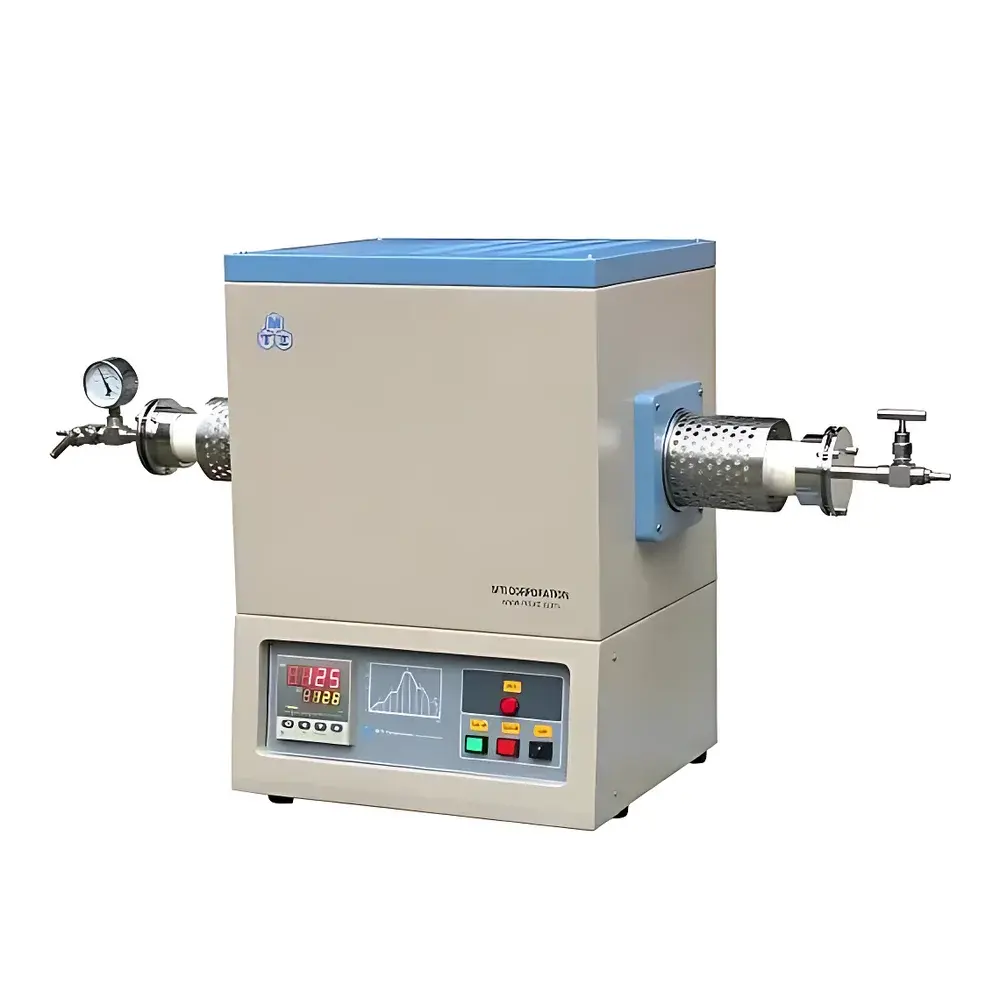
KJ GROUP GSL-1700X-S High-Temperature Vacuum Tube Furnace
| Brand | KJ GROUP |
|---|---|
| Origin | Liaoning, China |
| Manufacturer Type | Authorized Distributor |
| Country of Origin | China |
| Model | GSL-1700X-S |
| Price | Upon Request |
| Temperature Range | Up to 1700 °C |
| Heating Element | 1800 °C-rated Molybdenum Disilicide (MoSi₂) Rods |
| Tube Dimensions | Ø60 mm OD × Ø54 mm ID × 1000 mm L |
| Heating Zone Length | 300 mm |
| Uniformity Zone | 80 mm |
| Max. Ramp/Cool Rate | 10 °C/min |
| Temperature Control Accuracy | ±1 °C |
| Vacuum Performance | 10⁻³ torr (with dual-stage rotary vane pump), 10⁻⁵ torr (with optional turbomolecular pump) |
| Power Supply | AC 220 V, 50/60 Hz, 3 kW (30 A circuit breaker required) |
| Enclosure | Dual-layer steel housing with forced-air cooling |
| Surface Temperature | <60 °C at ambient |
| Insulation | High-purity alumina fiber |
| Controller | 30-segment programmable PID |
| Certifications | CE-compliant |
| Dimensions (W×D×H) | 445 mm × 380 mm × 615 mm |
| Net Weight | 150 kg |
| Standard Accessories | One high-purity alumina tube, two alumina end plugs, one stainless-steel flange set |
Overview
The KJ GROUP GSL-1700X-S is a precision-engineered high-temperature vacuum tube furnace designed for controlled thermal processing under reduced-pressure or inert-atmosphere conditions. Utilizing molybdenum disilicide (MoSi₂) heating elements rated to 1800 °C and a high-density alumina fiber insulation system, the furnace achieves stable, repeatable operation up to 1700 °C within a defined 300 mm heating zone—80 mm of which maintains ±1 °C uniformity. Its dual-layer air-cooled enclosure ensures surface temperatures remain below 60 °C during continuous operation, enhancing laboratory safety and reducing ambient heat load. The furnace is optimized for applications requiring precise thermal profiles—including sintering of advanced ceramics, annealing of semiconductor substrates, synthesis of nanomaterials via CVD/PVD, and controlled oxidation/reduction studies. It operates as a core component in materials science laboratories where reproducibility, thermal stability, and vacuum integrity are critical to experimental validity.
Key Features
- 30-segment programmable PID temperature controller enabling complex multi-step ramp-hold-cool protocols with user-defined rate limits and soak durations.
- Dual-layer stainless-steel housing integrated with axial fan-assisted air cooling—engineered to maintain outer shell temperature below 60 °C even at maximum operating temperature.
- High-efficiency thermal insulation using ultra-low-conductivity, high-purity alumina fiber (Al₂O₃ ≥ 99.8%), minimizing radial heat loss and improving energy efficiency.
- Standard high-purity α-alumina tube (Ø60 mm OD / Ø54 mm ID / 1000 mm L) compatible with aggressive chemical environments and rapid thermal cycling.
- CE-marked design compliant with EN 61000-6-3 (EMC emission) and EN 61000-6-2 (immunity), ensuring safe integration into regulated research and production environments.
- Modular vacuum interface: standard Swagelok-compatible compression fittings (Bellingham-type) allow straightforward adaptation to UHV-compatible double-ferrule or KF25 configurations.
Sample Compatibility & Compliance
The GSL-1700X-S accommodates cylindrical samples up to Ø52 mm in diameter and 300 mm in length within its uniform heating zone. Compatible sample forms include powders, pellets, thin films on substrates, fibers, and monolithic ceramics. The furnace supports atmospheric control via inert gas purging (Ar, N₂) or dynamic vacuum processing down to 10⁻⁵ torr when paired with an optional turbomolecular pumping station. All wetted components—including the alumina tube, end plugs, and stainless-steel flanges—are chemically inert to common precursors used in solid-state synthesis and thin-film deposition. The system meets baseline requirements for GLP-compliant thermal treatment workflows and supports audit-ready documentation when operated with optional PC-based control software (sold separately), including timestamped temperature logs and parameter change tracking aligned with FDA 21 CFR Part 11 data integrity principles.
Software & Data Management
While the standard unit features a front-panel 30-segment PID controller with real-time temperature display and manual override capability, optional PC connectivity enables full remote supervision and data archiving. The companion Windows-based software provides graphical profile editing, live thermal mapping, automated CSV export, and configurable alarm triggers (e.g., over-temperature, vacuum breach, power interruption). All logged data includes ISO 8601 timestamps, operator ID fields, and digital signatures—facilitating traceability in quality-controlled environments governed by ISO/IEC 17025 or ICH Q5D. Software updates and firmware patches are distributed through KJ GROUP’s secure customer portal, with version history and validation reports available upon request.
Applications
- Sintering of oxide and non-oxide ceramics (e.g., Al₂O₃, ZrO₂, SiC, Si₃N₄) under vacuum or flowing Ar/N₂.
- Thermal annealing of Li-ion battery cathode materials (NMC, LFP) and solid electrolytes to optimize crystallinity and ionic conductivity.
- Controlled pyrolysis of polymer-derived ceramics and carbonization of MOF-based precursors.
- Gas-phase synthesis of 2D materials (e.g., MoS₂, WS₂) via sulfurization/selenization under precisely timed temperature ramps.
- Calibration and aging studies of thermocouples and reference materials per ASTM E230/E220 protocols.
- Pre-oxidation treatments of refractory metals (Nb, Ta, Mo) prior to high-temperature mechanical testing.
FAQ
What vacuum level can be achieved with the base configuration?
The standard package includes a dual-stage rotary vane pump capable of reaching ≤10⁻³ torr. For ultra-high vacuum applications (≤10⁻⁵ torr), a turbomolecular pump station is available as an optional upgrade.
Is the furnace suitable for hydrogen atmosphere processing?
Yes—when equipped with appropriate H₂-compatible seals, leak-tested flanges, and explosion-proof electrical components (available upon specification), the system may be configured for Class A hydrogen service per ISO 10156 and CGA P-21 guidelines.
Can the heating zone be extended beyond 300 mm?
No—the 300 mm heating zone is fixed by the physical arrangement and wattage distribution of the MoSi₂ rod array. Custom-length tubes may be used, but uniformity and max temperature ratings apply only to the specified 80 mm central zone.
Does the controller support Ethernet or RS-485 communication?
The base PID controller features RS-232 output; RS-485 and Ethernet modules are available as field-installable options for integration into SCADA or LabVIEW-controlled environments.
What maintenance intervals are recommended for the heating elements and insulation?
MoSi₂ rods typically exhibit >2000 hours of service life at 1700 °C in clean vacuum or inert gas. Annual visual inspection of insulation integrity and thermocouple calibration is advised per ISO/IEC 17025 Clause 6.4.2.



