
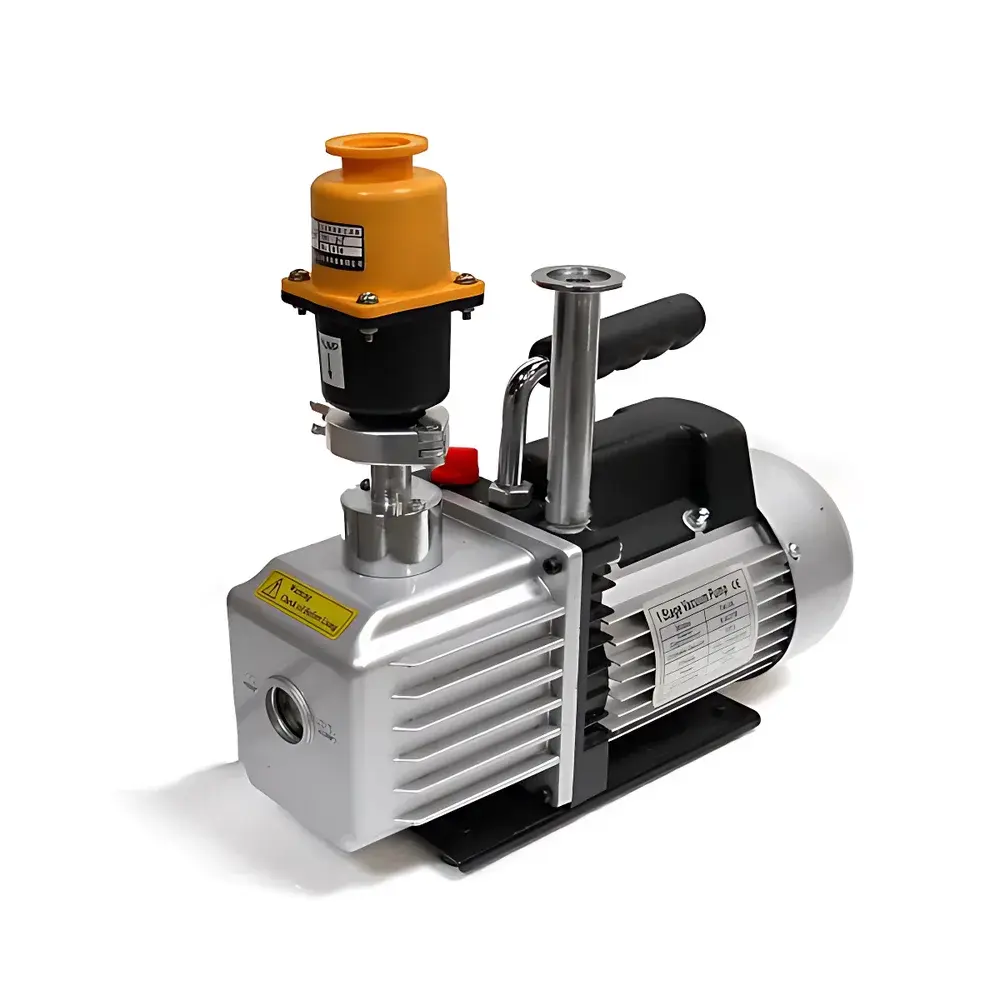
KJ GROUP TW-3A Single-Stage Rotary Vane Vacuum Pump
| Brand | KJ GROUP |
|---|---|
| Origin | Liaoning, China |
| Manufacturer Type | Authorized Distributor |
| Country of Origin | China |
| Model | TW-3A |
| Pricing | Available Upon Request |
| Power Supply | 110 V / 220 V AC, 360 W |
| Pumping Speed | 6.6 CFM (187 L/min) |
| Ultimate Vacuum | 0.075 Torr (10 Pa) |
| Motor Speed | 1720 rpm |
| Oil Reservoir Capacity | 20 mL |
| Operating Temperature Range | –5 °C to 40 °C |
| Inlet Port Diameter | 6.35 mm (¼″ NPT compatible) |
| Inlet Thread | M12 × 1.25 mm |
| Dimensions (L × W × H) | 340 × 135 × 260 mm |
| Net Weight | 9.8 kg |
| Optional Accessory | Oil Mist Filter (KJ-FIL-OMF) |
Overview
The KJ GROUP TW-3A is a compact, single-stage rotary vane vacuum pump engineered for reliable low-to-medium vacuum generation in laboratory and light industrial applications. Based on the proven Couette-flow principle of rotary vane displacement, the pump utilizes precision-machined vanes rotating eccentrically within a cylindrical stator chamber to continuously trap, compress, and exhaust gas from the inlet to the outlet. Its design emphasizes operational stability under continuous duty cycles, with an ultimate vacuum performance of 0.075 Torr (10 Pa), making it suitable for applications such as vacuum drying, degassing of solvents, vacuum filtration, glove box evacuation, and basic thin-film deposition pre-pumping stages. The integrated oil-lubricated system ensures consistent sealing and thermal management, while the thermally stable cast-aluminum housing supports long-term dimensional integrity across ambient conditions ranging from –5 °C to 40 °C.
Key Features
- Single-stage rotary vane architecture optimized for rapid initial evacuation and stable base pressure maintenance
- Oil mist filtration system (optional KJ-FIL-OMF) installed upstream of the exhaust to capture hydrocarbon aerosols, reducing operator exposure and minimizing environmental oil residue
- Universal dual-voltage motor (110 V / 220 V AC, 50/60 Hz) with 360 W nominal power draw and thermally protected windings
- Compact footprint (340 × 135 × 260 mm) and lightweight construction (9.8 kg) enabling benchtop integration without structural reinforcement
- Standardized inlet interface: 6.35 mm inner diameter port with M12 × 1.25 mm external thread, compatible with common vacuum tubing adapters and ISO-KF 10/16 flanges via optional couplers
- Self-contained 20 mL oil reservoir with sight gauge and dipstick for routine level verification and maintenance scheduling
Sample Compatibility & Compliance
The TW-3A is intended for use with non-corrosive, non-condensable, and non-particulate gases typical in general laboratory environments. It is not rated for solvent vapors with high condensation potential (e.g., acetone, ethanol above dew point), acidic or halogenated gases (e.g., HCl, Cl₂), or abrasive particulates. When operated with KJ GROUP–recommended mineral vacuum oil (ISO VG 100 grade), the pump meets ISO 8573-1:2010 Class 4 particulate and Class 3 moisture specifications at the exhaust under standard ambient conditions. While not certified to UL/CSA or CE for standalone safety compliance, its electrical design conforms to IEC 61000-6-3 (EMI emission limits) and IEC 61000-6-2 (immunity). Users deploying the pump in regulated workflows—such as those governed by GLP or ISO/IEC 17025—must validate pump performance per internal SOPs and document oil change intervals, filter replacement logs, and base pressure verification records.
Software & Data Management
The TW-3A operates as a standalone mechanical device without embedded digital control or data output interfaces. No firmware, USB, RS-232, or analog signal ports are provided. Integration into automated vacuum systems requires external pressure transducers (e.g., capacitance manometers or Pirani gauges) and programmable logic controllers (PLCs) or DAQ hardware. KJ GROUP supplies calibration-grade reference gauges and vacuum hose assemblies separately; no proprietary software suite or driver package is associated with this model. All operational parameters—including pumping speed, ultimate vacuum, and temperature limits—are specified per ASTM F243–22 (“Standard Test Method for Measuring Ultimate Pressure of Vacuum Pumps”) and verified using traceable NIST-calibrated instrumentation during factory acceptance testing.
Applications
- Pre-evacuation of vacuum chambers prior to sputtering, evaporation, or CVD processes
- Supporting vacuum ovens and desiccators in materials science and pharmaceutical stability studies
- Assisting rotary evaporators and cold traps in organic synthesis labs
- Providing rough vacuum for electron microscopy specimen preparation stations
- Enabling vacuum impregnation of porous ceramics or composites in R&D settings
- Backing larger high-vacuum pumps (e.g., turbomolecular or diffusion pumps) in hybrid vacuum architectures
FAQ
What type of vacuum oil is recommended for the TW-3A?
KJ GROUP specifies a paraffinic mineral oil meeting ISO VG 100 viscosity grade and ASTM D2513 specifications. Synthetic oils are not recommended unless validated for vane material compatibility (carbon-impregnated phenolic vanes).
Can the TW-3A be operated continuously for 24 hours?
Yes—provided ambient temperature remains below 35 °C, oil level is maintained, and the exhaust is vented to a well-ventilated area. Continuous operation beyond 8 hours requires periodic oil inspection and filter replacement if used with the optional oil mist filter.
Is the M12 × 1.25 mm inlet thread compatible with standard vacuum fittings?
It is a metric thread commonly found on Chinese-manufactured lab equipment. Adapters to ISO-KF 10, Swagelok 1/4″ compression, or NPT ¼″ are commercially available and widely used in integration scenarios.
Does the pump include an exhaust silencer or noise-dampening enclosure?
No. The TW-3A operates at approximately 62 dB(A) at 1 m distance. For noise-sensitive environments, users should install third-party acoustic enclosures or locate the pump in a dedicated utility cabinet with flexible exhaust ducting.
How often should the oil be changed under normal lab usage?
KJ GROUP recommends oil replacement every 500 operating hours or quarterly—whichever occurs first. Frequency increases significantly when processing humid or mildly volatile samples.



