
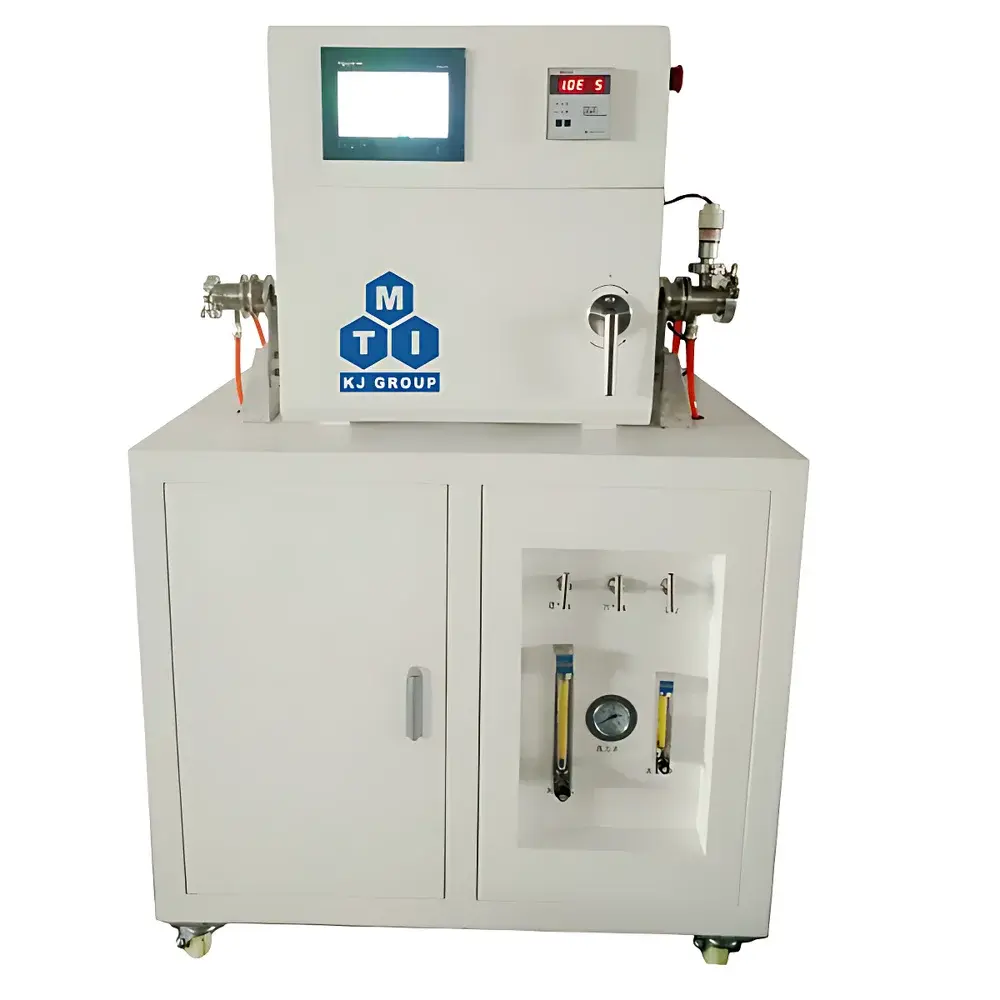
KJ GROUP LZG Series Microwave High-Temperature Vertical Tube Furnace
| Brand | KJ GROUP |
|---|---|
| Origin | Liaoning, China |
| Manufacturer Type | Authorized Distributor |
| Country of Origin | China |
| Model | LZG |
| Voltage | 220±10 V / 380±10 V, 50 Hz |
| Rated Power | 4 kW / 6 kW |
| Microwave Output Power | 0.01–1.40 kW / 0.01–2.80 kW (continuously adjustable) |
| Microwave Frequency | 2.45 GHz |
| Maximum Operating Temperature | ≤1200 °C or ≤1600 °C (model-dependent) |
| Heating Zone Dimensions | Φ40×130 mm or Φ60×120 mm (diameter × length) |
| Temperature Measurement | Type S or K thermocouple |
| Temperature Range | 0–1300 °C or 0–1600 °C |
| Temperature Control Accuracy | ±0.1% of reading |
| Control System | Mitsubishi PLC + Schneider HMI touchscreen |
| Programmable Steps | 40-segment ramp-soak profile with data logging, real-time curve display, and USB export |
| Vacuum Level | ≤100 Pa (static) |
| Atmosphere Compatibility | Oxidizing, inert, weakly reducing gases |
| Microwave Leakage | <0.5 mW/cm² (per IEC 61000-4-3 & GB 10436) |
| Safety Interlocks | Door-closed sensing switch, overtemperature/overcurrent protection, magnetron fault monitoring |
| External Dimensions (approx.) | 700×550×900 mm or 800×600×1000 mm (L×W×H) |
Overview
The KJ GROUP LZG Series Microwave High-Temperature Vertical Tube Furnace is an engineered solution for advanced materials synthesis and thermal processing under controlled atmospheres or vacuum. Unlike conventional resistance-heated tube furnaces, the LZG leverages 2.45 GHz industrial-grade microwave energy to induce volumetric heating within dielectric or susceptive materials—enabling rapid, uniform, and energy-efficient thermal treatment. This principle eliminates thermal gradients typical of conductive/convective heating, resulting in superior microstructural control during sintering, calcination, reduction, oxidation, and solid-state reactions. Designed for laboratory-scale R&D and pilot process development, the furnace supports reproducible high-temperature experimentation up to 1600 °C while maintaining strict electromagnetic safety compliance and operational robustness.
Key Features
- Industrial-grade magnetron source with continuously adjustable microwave output (0.01–2.80 kW), ensuring stable long-duration operation and precise power modulation across reaction kinetics.
- Integrated vacuum-tight chamber and pumping interface—enabling rapid gas exchange via pre-vacuum purge cycles, reducing atmosphere stabilization time by up to 70% compared to continuous flow methods.
- Vertical configuration optimized for gravity-assisted sample handling and optional automated push-rod feed systems—minimizing operator exposure and improving repeatability in sequential batch processing.
- Dual-zone thermal architecture: high-emissivity ceramic insulation combined with reflective cavity design maximizes microwave coupling efficiency while limiting external surface temperature rise.
- Comprehensive safety architecture including interlocked door mechanism, real-time microwave leakage monitoring (<0.5 mW/cm²), and redundant thermal/electrical fault detection per IEC 61000-4-3 and GB 10436 standards.
- Mitsubishi programmable logic controller (PLC) paired with Schneider Human-Machine Interface (HMI) enables 40-segment programmable thermal profiles, dynamic curve visualization, timestamped data logging, and CSV export for traceability and regulatory reporting.
Sample Compatibility & Compliance
The LZG accommodates cylindrical samples up to Φ60 mm × 120 mm in inert (Ar, N₂), oxidizing (O₂, air), or weakly reducing (5% H₂/Ar, CO) atmospheres. Its vacuum-rated construction (≤100 Pa static base pressure) supports low-oxygen sintering of oxide ceramics, nitride precursors, and metastable intermetallics. The system complies with GLP-aligned data integrity requirements: all temperature setpoints, actual readings, power levels, and alarm events are time-stamped and stored internally with audit-trail capability. While not certified to FDA 21 CFR Part 11 out-of-the-box, the firmware architecture supports third-party validation protocols required for GMP-compliant process development in pharmaceutical excipient synthesis or battery cathode material qualification.
Software & Data Management
The embedded control software provides three operational modes: manual (direct parameter override), automatic (profile-driven), and isothermal hold. Each 40-step program stores ramp rates (°C/min), dwell durations, power limits, and gas flow triggers (when interfaced with mass flow controllers). Real-time graphs overlay measured temperature, applied microwave power, and vacuum level—rendered on the 7-inch resistive touchscreen with configurable scaling and freeze-frame capture. Logged datasets include ISO 8601 timestamps, instrument ID, user login (if network-enabled), and CRC-verified checksums. Export occurs via USB 2.0 to FAT32-formatted drives in comma-separated values (CSV), compatible with MATLAB, Python pandas, and statistical process control (SPC) platforms.
Applications
- High-temperature synthesis of functional oxides (e.g., LiFePO₄, YBCO), carbides, and MAX phases under controlled pO₂.
- Rapid densification of nanoceramics with suppressed grain growth—leveraging selective microwave absorption to retain sub-100 nm crystallite size.
- Thermal decomposition studies of MOFs and coordination polymers under dynamic vacuum or staged gas environments.
- Pre-oxidation of SiC fiber precursors and carbothermal reduction of TiO₂ to TiC at ≤1600 °C with <±1 °C spatial uniformity across the hot zone.
- Accelerated aging tests for nuclear fuel matrix materials (e.g., UO₂–ZrO₂ composites) requiring isotropic heating and minimal thermal stress.
FAQ
What types of crucibles are compatible with the LZG furnace?
Quartz, alumina, silicon carbide, and graphite crucibles are supported—provided their dielectric loss tangent permits efficient microwave coupling at 2.45 GHz and thermal expansion coefficients match the heating profile.
Can the LZG be integrated into an automated lab workflow?
Yes—RS-485 Modbus RTU and optional Ethernet/IP interfaces enable integration with SCADA systems, robotic sample handlers, and centralized LIMS platforms for unattended multi-run campaigns.
Is calibration traceable to national standards?
Thermocouple inputs support NIST-traceable calibration certificates; users may perform in-situ verification using reference materials (e.g., Au, Ag, Al melting points) per ASTM E2924 guidelines.
Does the system meet electromagnetic compatibility (EMC) requirements for installation in shared lab spaces?
Yes—the fully shielded cavity and filtered power supply comply with EN 61326-1 (industrial EMC) and FCC Part 18 Class A emission limits, permitting deployment adjacent to sensitive analytical instrumentation.
What maintenance is required for sustained microwave performance?
Annual inspection of waveguide integrity, magnetron cooling airflow, and vacuum seal elastomers is recommended; magnetrons are field-replaceable with alignment-free mounting per manufacturer specifications.



