
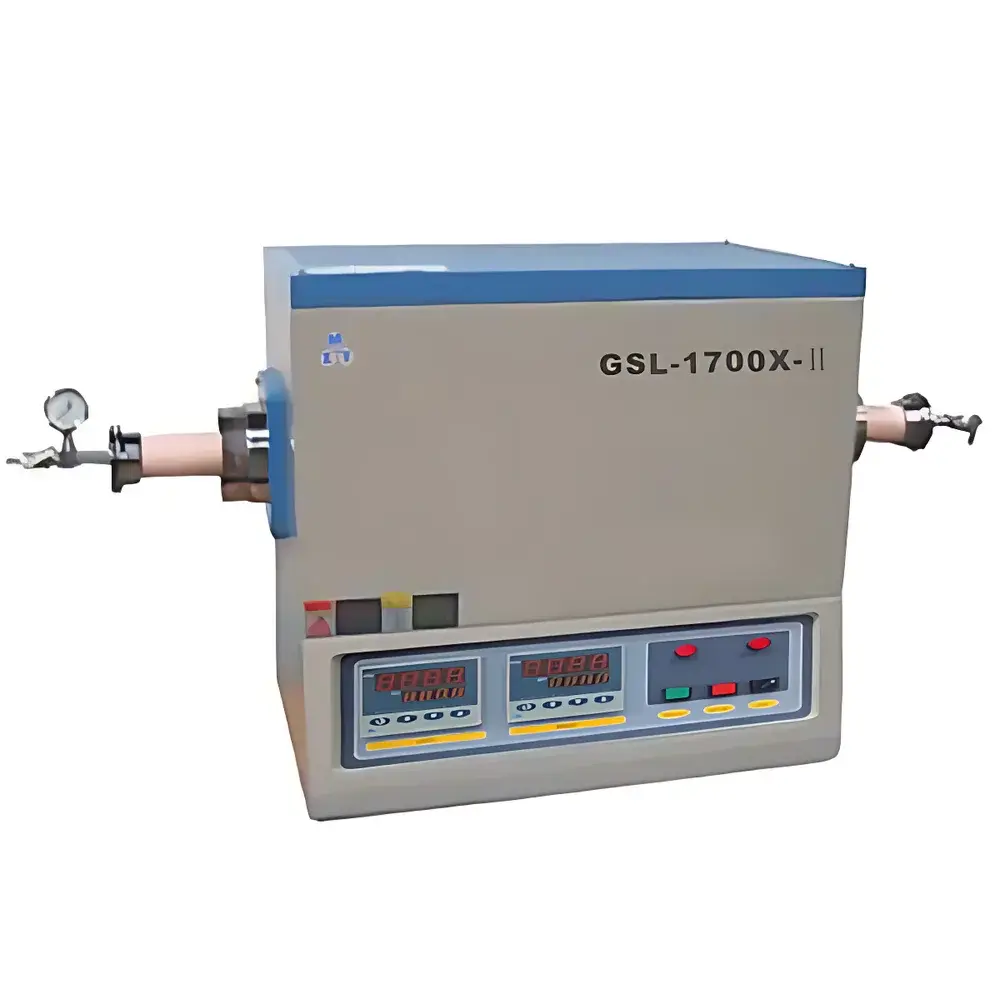
KJ GROUP GSL-1700X-II Dual-Zone High-Temperature Vacuum Tube Furnace
| Brand | KJ GROUP |
|---|---|
| Origin | Liaoning, China |
| Manufacturer Type | Authorized Distributor |
| Country of Origin | China |
| Model | GSL-1700X-II |
| Power Supply | AC 220 V, 50/60 Hz, 9 kW |
| Maximum Temperature | 1700 °C (Zone II), 1400 °C (Zone I) |
| Heating Elements | SiC rods (Zone I), MoSi₂ rods (Zone II) |
| Heating Zone Length | 300 mm per zone |
| Uniform Temperature Zone | 100 mm per zone |
| Temperature Control | 30-segment programmable PID, ±1 °C accuracy |
| Thermocouple Type | Type B |
| Tube Dimensions | Al₂O₃ ceramic, OD 60 mm, ID 54 mm, L 1000 mm |
| External Dimensions | 780 × 450 × 720 mm |
| Weight | 150 kg |
| Cooling | Forced-air dual-shell system |
| Surface Temperature | <60 °C |
Overview
The KJ GROUP GSL-1700X-II is a precision-engineered dual-zone high-temperature vacuum tube furnace designed for controlled thermal processing under inert, reducing, or low-pressure atmospheres. It operates on the principle of resistive heating via high-purity silicon carbide (SiC) and molybdenum disilicide (MoSi₂) heating elements—each optimized for distinct temperature domains—enabling independent thermal profiling across two axially aligned 300 mm zones. This architecture supports the establishment of stable axial temperature gradients (e.g., source–substrate configurations), making it suitable for physical vapor deposition (PVD), chemical vapor deposition (CVD), crystal growth, annealing of functional ceramics, and synthesis of 1D/2D nanomaterials (e.g., carbon nanotubes, transition metal dichalcogenides). The furnace chamber features high-purity alumina fiber insulation with US-sourced alumina surface coating to enhance emissivity and thermal uniformity, while its double-layer steel housing incorporates an integrated forced-air cooling system to maintain external surface temperatures below 60 °C during continuous operation at 1700 °C.
Key Features
- Dual independent PID temperature controllers, each supporting up to 30 programmable ramp-hold segments with real-time deviation monitoring and auto-corrective response
- Zone-specific heating elements: 1500 °C-rated SiC rods in Zone I; 1800 °C-rated MoSi₂ rods in Zone II—ensuring optimal lifetime and thermal stability across operational ranges
- High-purity α-alumina ceramic tube (OD 60 mm, ID 54 mm, L 1000 mm) with low thermal conductivity and excellent resistance to thermal shock and chemical corrosion
- CE-certified electrical architecture with over-temperature cutoff, thermocouple break detection, and grounded safety interlock circuitry
- Optimized thermal insulation using vacuum-grade alumina fiber modules with proprietary surface-enhanced coating to reduce radiant heat loss and improve energy efficiency
- Robust mechanical design: stainless-steel flange assembly (standard), reinforced support frame, and vibration-damped mounting base compatible with cleanroom and Class 1000 lab environments
Sample Compatibility & Compliance
The GSL-1700X-II accommodates substrates and precursors ranging from silicon wafers and quartz boats to graphite crucibles and custom ceramic holders, provided dimensional constraints (max OD 52 mm for tube insertion) and thermal expansion compatibility are observed. It complies with IEC 61000-6-3 (EMC emission standards) and IEC 61000-6-2 (immunity), and carries full CE marking per Machinery Directive 2006/42/EC and Low Voltage Directive 2014/35/EU. When integrated into GMP-compliant material synthesis workflows, the furnace supports audit-ready documentation—including calibration traceability to NIST-traceable reference thermocouples—and is compatible with 21 CFR Part 11–compliant data logging systems when paired with optional digital vacuum gauges and third-party SCADA interfaces.
Software & Data Management
While the standard configuration uses embedded 30-segment programmable controllers with LED interface, the GSL-1700X-II is fully compatible with RS485 Modbus RTU communication protocols. Optional integration with KJ GROUP’s LabFurnaceControl™ software (Windows-based) enables remote parameter setting, real-time temperature curve visualization, automated recipe storage, and CSV-exportable log files timestamped to millisecond resolution. All thermal profiles retain full metadata—including operator ID, ambient conditions (via optional external sensor input), and alarm event logs—supporting GLP-aligned record retention and FDA-submission readiness.
Applications
- CVD synthesis of graphene, MoS₂, and hexagonal boron nitride on catalytic metal foils or insulating substrates
- Two-step thermal treatment for solid-state battery cathode materials (e.g., LiCoO₂ annealing followed by oxygen reintegration)
- Controlled pyrolysis of polymer-derived ceramics under dynamic vacuum or gas-flow conditions
- Diffusion bonding and transient liquid-phase sintering of refractory metal alloys
- Thermal calibration of high-temperature sensors and reference materials per ASTM E230/E230M
- Inert-atmosphere annealing of optical fibers and photonic crystal preforms
FAQ
What vacuum level can be achieved with the standard configuration?
The base system does not include a vacuum pump; when paired with a turbomolecular pumping station and KF25-compatible fittings, ultimate pressures of ≤5×10⁻⁵ mbar are routinely attainable.
Can the furnace operate continuously at 1700 °C?
Yes—MoSi₂ heating elements and alumina fiber insulation are rated for continuous duty at 1700 °C; recommended maximum dwell time per cycle is 12 hours to preserve element longevity.
Is Type B thermocouple calibration included with purchase?
A factory-calibrated Type B thermocouple is supplied; NIST-traceable recalibration certificates are available as a value-added service upon request.
Are custom tube lengths or diameters supported?
Yes—KJ GROUP offers OEM-compatible alumina and quartz tubes in OD 40–100 mm and lengths up to 1500 mm, subject to minimum order quantities and lead time confirmation.
Does the unit meet ISO 17025 requirements for accredited labs?
When operated with documented calibration intervals, validated installation qualification (IQ), and preventive maintenance logs, the GSL-1700X-II satisfies critical infrastructure criteria for ISO/IEC 17025:2017 Clause 6.4 (Equipment).



