
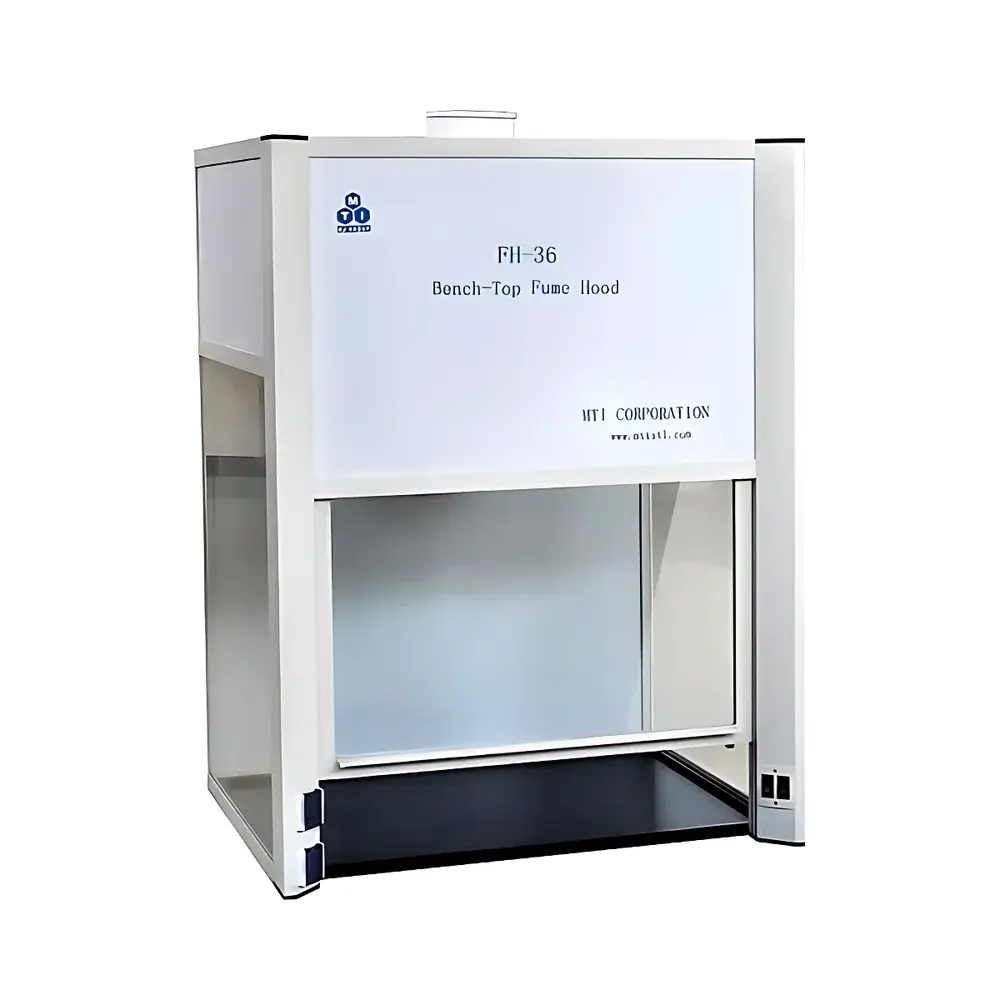
FH-36 Desktop Fume Hood
| Brand | KJ GROUP (Shenyang Kejing) |
|---|---|
| Origin | Liaoning, China |
| Manufacturer Type | Authorized Distributor |
| Country of Manufacture | China |
| Model | FH-36 |
| Pricing | Upon Request |
| Power Input | 220 V, 50/60 Hz, Single-Phase |
| Cabinet Construction | Steel Frame with Tempered Glass Sliding Sash |
| Airflow System | Ducted, Fan-Driven |
| Blower | Explosion-Proof Centrifugal Fan |
| Airflow Rate | 1900 m³/h |
| Static Pressure | 190 Pa |
| Blower Power | 180 W, 208–240 VAC |
| Lighting | 30 W Airtight Explosion-Proof LED Lamp |
| Control Interface | Touchscreen Panel with Dedicated Push-Button Controls |
| Internal Power Outlets | Two 10-A, 250-V AC Socket Ports |
| Internal Power Supply | Dual Switching Mode Power Supplies (SMPs) |
Overview
The FH-36 Desktop Fume Hood is an engineered containment solution designed for low-volume, non-continuous chemical handling in research laboratories, quality control environments, and small-scale R&D settings. Unlike full-height walk-in hoods, the FH-36 operates on the principle of directional airflow containment—drawing ambient air horizontally across the work surface and expelling it through a dedicated ducted exhaust system. Its compact footprint (typical dimensions: 360 mm W × 450 mm D × 520 mm H) enables integration onto standard laboratory benches without structural modification. The hood employs a constant-volume airflow strategy, regulated via integrated blower feedback and sash-position sensing, ensuring stable face velocity (typically maintained at 0.5 ± 0.1 m/s at full sash opening) in accordance with ANSI/ASHRAE 110-2016 and EN 14175-3:2021 performance criteria. All internal surfaces are constructed from electrogalvanized steel with epoxy-polyester powder coating to resist corrosion from incidental exposure to organic solvents, weak acids, and alkaline reagents.
Key Features
- Explosion-proof centrifugal blower certified to IEC 60079-0 and GB 3836.1–2010 standards, rated for Class I, Division 2 hazardous locations when installed per manufacturer guidelines
- Tempered glass sliding sash with smooth linear bearing mechanism and calibrated stop positions (0%, 25%, 50%, 75%, 100% opening) to support ergonomic workflow and consistent face velocity control
- Integrated touchscreen interface with real-time display of blower RPM, static pressure differential (ΔP), and sash height—enabling immediate operator verification of operational status
- Airtight, 30 W explosion-proof LED lamp compliant with IP65 ingress protection and UL 1598 certification, delivering uniform 450–500 lux illumination across the work plane
- Dual internal switching-mode power supplies (12 VDC / 5 A and 24 VDC / 3 A) for powering auxiliary instrumentation without requiring external adapters
- Two recessed 10-A, 250-V AC socket ports located on the rear interior wall, rated to GB 2099.1–2008 and compatible with IEC 60884-1 plug types
Sample Compatibility & Compliance
The FH-36 is intended for use with low-to-moderate volatility chemicals—including ethanol, acetone, methanol, dilute hydrochloric acid (≤10%), and sodium hydroxide solutions (≤5%)—under intermittent operation (≤2 hr/day cumulative exposure). It is not suitable for perchloric acid, hydrogen fluoride, or radioactive aerosols. The unit complies with Chinese national standards GB/T 24817.1–2019 (General Requirements for Laboratory Fume Hoods) and meets the minimum containment performance requirements outlined in ISO 10964:2020 (Laboratory fume cupboards — Determination of containment performance). Structural integrity has been verified per GB/T 13384–2008 (General Specifications for Packaging of Mechanical and Electrical Products). While not inherently compliant with NFPA 45 or OSHA 1910.1450, the FH-36 may be deployed in environments adhering to those frameworks when paired with site-specific risk assessment, proper duct routing, and third-party commissioning validation.
Software & Data Management
The FH-36 does not incorporate embedded data logging or network connectivity. However, its touchscreen interface retains operational history (last 50 event timestamps including sash movement, blower start/stop, and fault alerts) accessible via password-protected service mode. All parameter thresholds—including minimum acceptable face velocity (0.4 m/s) and maximum allowable static pressure drop (250 Pa)—are factory-configured and non-user-adjustable to preserve safety-critical calibration integrity. Audit trails are generated in plain-text CSV format upon USB export and include timestamp, event type, and operator ID (if configured via optional RFID badge reader module). For GLP/GMP-regulated laboratories, manual logbook entries remain the primary compliance method; electronic records must be validated per FDA 21 CFR Part 11 if used in regulated submissions.
Applications
- Preparation and dispensing of analytical standards in pharmaceutical QC labs
- Small-batch solvent-based sample digestion prior to ICP-MS or AAS analysis
- Handling of catalyst precursors and organometallic compounds in synthetic chemistry screening
- Safe manipulation of volatile calibration gases during gas chromatography system setup
- Enclosed weighing operations involving hygroscopic or dust-generating powders (e.g., APIs, excipients)
- Electrodeposition and thin-film precursor handling in materials science prototyping
FAQ
Is the FH-36 certified for use with flammable solvents?
Yes—the explosion-proof blower and airtight lighting assembly meet Class I, Division 2 requirements for Group D vapors (e.g., acetone, ethanol, toluene) when installed with grounded ductwork and bonded electrical systems.
Can the FH-36 be retrofitted with variable air volume (VAV) control?
No—its blower operates at fixed speed and lacks motor driver interfaces or external analog/digital I/O ports required for VAV integration.
What maintenance intervals are recommended?
Blower filter inspection every 90 days; sash track cleaning and lubrication biannually; static pressure sensor calibration annually by authorized KJ GROUP service personnel.
Does the unit include ducting or installation support?
No—ducting, roof penetrations, and fan mounting hardware must be sourced separately and installed per local building codes and ASHRAE 110 commissioning protocols.
Is third-party performance testing available?
Yes—KJ GROUP partners with CNAS-accredited laboratories in Beijing and Shanghai to provide ASHRAE 110 tracer gas containment testing and face velocity mapping reports (fee-based, lead time: 10–14 business days).



