
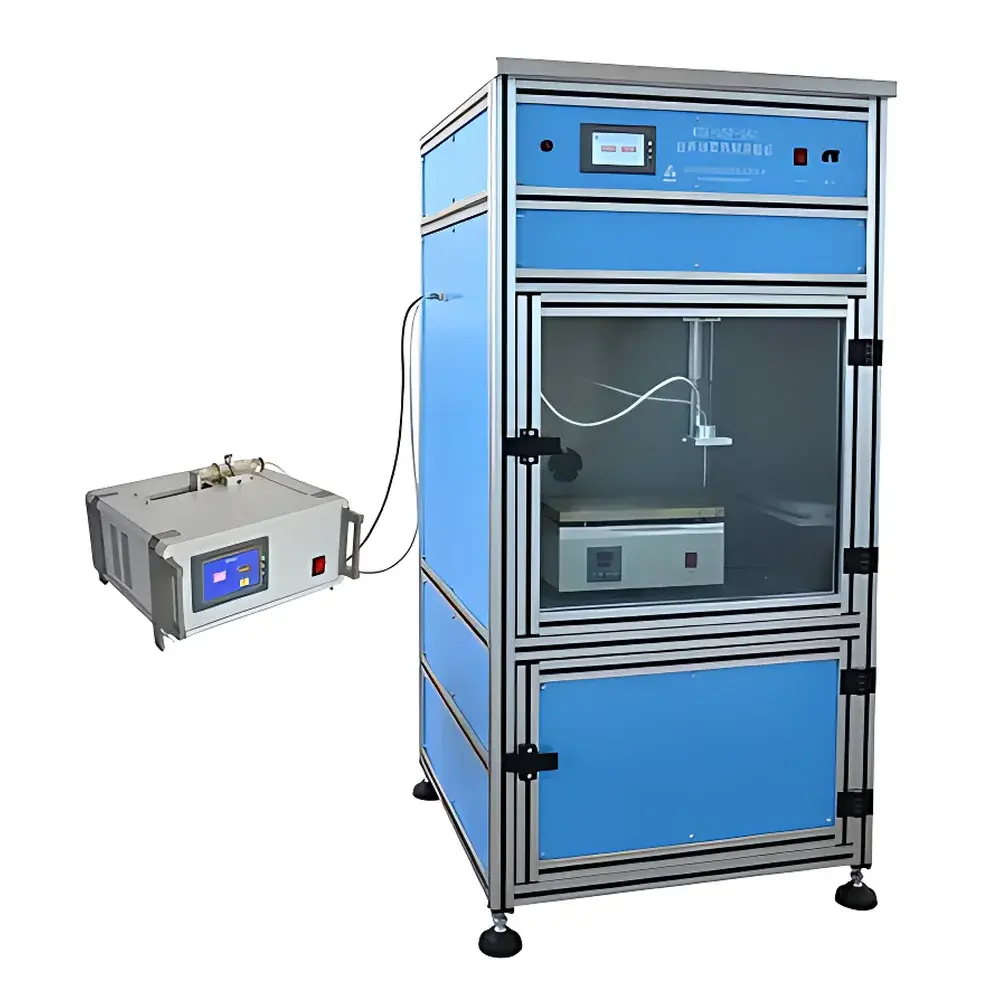
KJ GROUP MSK-USP-04C Ultrasonic Spray Pyrolysis Coating System
| Brand | KJ GROUP |
|---|---|
| Origin | Liaoning, China |
| Manufacturer Type | Authorized Distributor |
| Country of Origin | China |
| Model | MSK-USP-04C |
| Price | Upon Request |
| Ultrasonic Frequency | 40 kHz |
| Ultrasonic Power | 100 W |
| X/Y Travel Range | 1–200 mm |
| X-Axis Speed | 10–800 mm/s |
| Y-Axis Speed | 10–100 mm/s |
| Droplet Size | 10–20 µm |
| Flow Rate | 0.6 pL/min – 4 mL/min |
| Max Substrate Temperature | 500 °C |
| Heater Platform Dimensions | 350 mm × 220 mm |
| Z-Axis Adjustment Range | 0–60 mm |
| Syringe Capacity | 20 mL |
| Syringe Diameter Limit | ≤ Ø30 mm |
| Syringe Drive Speed | 0.1–45 mm/min (fine adjustment: 0.01–8 mm/min) |
| Syringe Stroke Range | 0.001–120 mm |
| Max Solid Content | ≤ 10 wt% |
| Max Viscosity | ≤ 100 cP |
| Nozzle-to-Substrate Distance | 1–100 mm |
| Footprint | ≥ 2 m² |
| Operating Altitude | ≤ 1000 m |
| Ambient Temp | 25 °C ± 15 °C |
| Relative Humidity | 55 %RH ± 10 %RH |
| Power Supply | AC 220 V, 50/60 Hz, Grounded |
| Pneumatic Requirement | Compressed Air or Gas Cylinder with Regulator |
Overview
The KJ GROUP MSK-USP-04C Ultrasonic Spray Pyrolysis Coating System is a precision-engineered platform for the deposition of uniform, conformal thin films via ultrasonic-assisted solution-based pyrolysis. It operates on the principle of ultrasonic atomization—where piezoelectric transducers generate high-frequency mechanical vibrations (40 kHz) to break precursor solutions into fine, monodisperse droplets (10–20 µm). These aerosolized particles are transported onto a thermally controlled substrate, where rapid solvent evaporation and in situ thermal decomposition yield crystalline or amorphous functional thin films. Unlike spin coating or dip coating, this method enables scalable, maskless, non-contact deposition over irregular or large-area substrates without vacuum infrastructure. The system integrates coordinated motion control (X/Y translation), programmable thermal ramping (up to 500 °C), and closed-loop fluid delivery—making it suitable for research and process development in transparent conductive oxides (TCOs), metal oxide semiconductors, perovskite photovoltaic layers, and catalytic coatings.
Key Features
- Ultrasonic雾化核心:40 kHz, 100 W piezoelectric transducer ensures stable, low-energy droplet generation with narrow size distribution (10–20 µm), minimizing overspray and improving material utilization efficiency.
- Programmable 2D Translation Stage:Stepper motor-driven X/Y gantry with travel range of 1–200 mm and speed control from 10 to 800 mm/s (X) and 10 to 100 mm/s (Y), enabling customizable scan patterns and repeatable coating uniformity across 350 mm × 220 mm substrates.
- High-Temperature Heated Substrate Platform:Resistive heating stage with PID-controlled temperature regulation up to 500 °C, supporting rapid thermal decomposition of metal-organic precursors and crystallization of metal oxides such as SnO₂, TiO₂, NiO, and FTO.
- Precision Syringe Pump Module:Motorized linear actuator compatible with syringes up to Ø30 mm and 20 mL capacity; flow rate adjustable from 0.6 pL/min to 4 mL/min with micro-step resolution (0.01 mm/min fine drive), ensuring reproducible dosing for low-volume, high-value formulations.
- Modular Pneumatic Integration:Air-assisted nozzle design requires external compressed air or regulated gas supply (via cylinder or compressor), allowing controlled carrier gas flow to enhance droplet transport and prevent nozzle clogging during extended runs.
- Z-Axis Height Adjustment:Manual or motorized vertical positioning (0–60 mm range) facilitates optimization of standoff distance (1–100 mm) between nozzle and substrate—critical for controlling film morphology, edge definition, and thermal gradient effects.
Sample Compatibility & Compliance
The MSK-USP-04C accommodates a broad range of solution-processable precursors, including aqueous and organic solvent-based metal nitrates, acetates, chlorides, and alkoxides, provided solid content remains ≤10 wt% and dynamic viscosity does not exceed 100 cP. It supports rigid and flexible substrates—glass, silicon wafers, stainless steel foils, PET, and ceramic tiles—up to 300 mm × 200 mm in footprint. All thermal and motion control parameters are digitally logged and exportable, facilitating adherence to GLP-compliant documentation workflows. While the system itself is not certified to ISO/IEC 17025 or ASTM E2917, its operational repeatability and parameter traceability support validation protocols required for R&D-scale process transfer toward ISO 9001 or IEC 61215 (for PV layer development). Ventilation is mandatory per local laboratory safety codes due to potential aerosol and thermal decomposition byproduct generation.
Software & Data Management
The system operates via an embedded microcontroller interface with dedicated firmware for synchronized control of spray duration, translation path, heater ramp/soak profiles, and pump displacement. Parameter sets—including coordinate maps, temperature ramps, flow schedules, and pause intervals—are saved as ASCII-based configuration files (.cfg) for version control and inter-laboratory reproducibility. Real-time status indicators (temperature, position, flow state) are displayed on the front-panel LCD. Optional RS-232 or USB-to-serial connectivity enables integration with LabVIEW or Python-based automation frameworks for batch scripting, statistical process monitoring (SPC), and audit trail generation aligned with FDA 21 CFR Part 11 principles (when paired with validated third-party software and electronic signature modules).
Applications
- Perovskite Solar Cell Fabrication:Deposition of compact TiO₂ electron transport layers (ETLs) and NiOₓ hole transport layers (HTLs) with tunable stoichiometry and crystallinity.
- Transparent Conductive Oxide (TCO) Development:Scalable synthesis of fluorine-doped tin oxide (FTO) and aluminum-doped zinc oxide (AZO) films for display and touch panel applications.
- Gas Sensor & Catalyst Thin Films:Uniform coating of WO₃, SnO₂, or In₂O₃ nanostructures on interdigitated electrodes for chemiresistive detection.
- Electrochromic & Battery Electrode Research:Layer-by-layer deposition of VO₂, Ni(OH)₂, or LiCoO₂ precursors followed by thermal conversion in inert or oxidizing atmospheres.
- Functional Ceramic Coatings:Low-temperature (<500 °C) formation of dielectric BaTiO₃ or ferroelectric BiFeO₃ films on temperature-sensitive polymer substrates.
FAQ
What types of solvents are compatible with the MSK-USP-04C?
Aqueous, ethanol, isopropanol, ethylene glycol, and N,N-dimethylformamide (DMF) are commonly used—provided viscosity remains ≤100 cP and boiling point allows full evaporation before substrate contact.
Is vacuum operation required?
No. The system operates at ambient pressure and relies on thermal decomposition kinetics rather than vacuum-assisted reactions.
Can the system be integrated into a glovebox environment?
Yes—the modular pneumatic and electrical interfaces permit installation inside nitrogen- or argon-purged gloveboxes, subject to feedthrough compatibility and heat dissipation constraints.
What maintenance is required for long-term reliability?
Monthly cleaning of the ultrasonic transducer surface and nozzle orifice with isopropanol; annual calibration of temperature sensor and syringe pump displacement accuracy using traceable standards.
Does the system support multi-layer sequential deposition?
Yes—by programming discrete spray cycles with intermediate thermal annealing steps, users can fabricate heterostructured bilayers (e.g., TiO₂/NiO) without breaking ambient conditions.



