
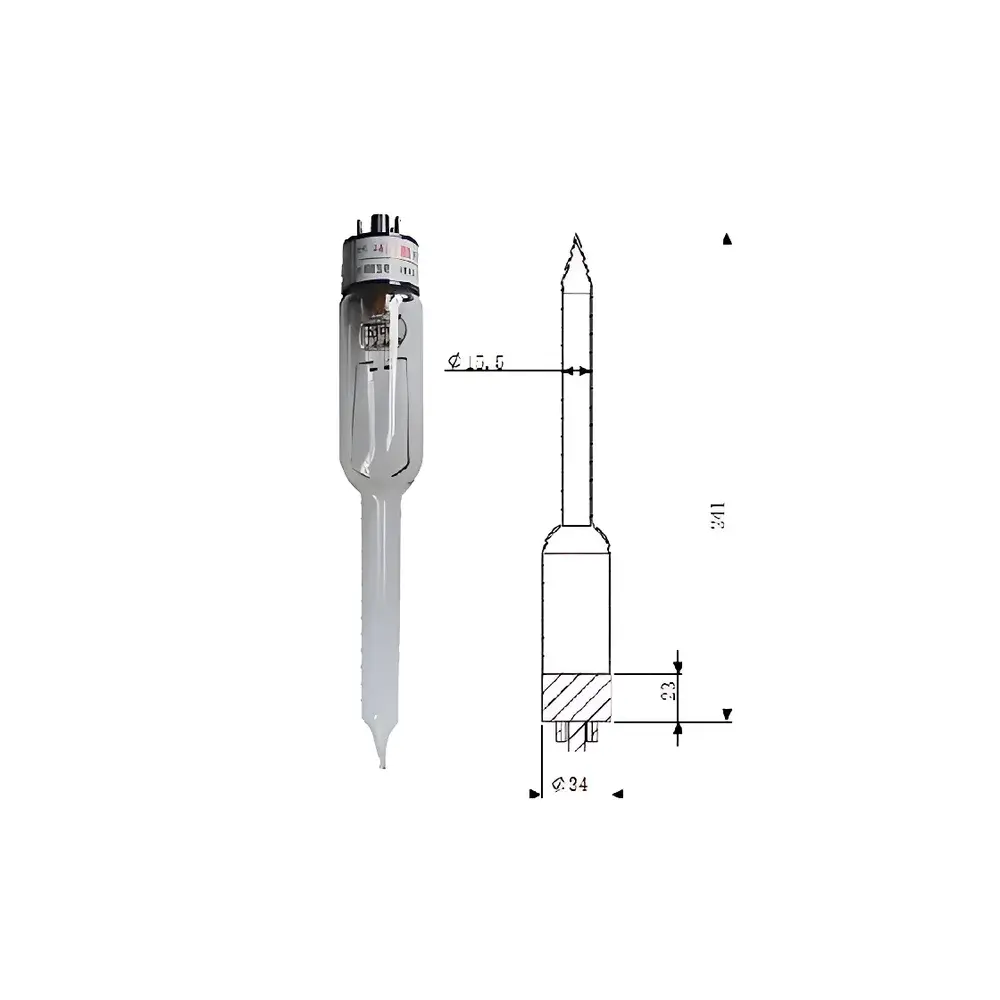
ZJ-51 Thermocouple Vacuum Gauge Tube (KJ GROUP)
| Brand | KJ GROUP (Shenyang Kejing) |
|---|---|
| Origin | Liaoning, China |
| Manufacturer Type | Authorized Distributor |
| Country of Origin | China |
| Model | ZJ-51 |
| Measurement Range | 6.5×10¹–1×10⁻¹ Pa |
| Heating Current | 90–130 mA |
| Cold Filament Resistance | 7 ± 1 Ω @ 23 ± 3 °C |
| Operating Filament Temperature | 40–150 °C |
| Accuracy | ±15% of reading |
| Electrical Interface | Thermocouple Output (Type T or K, unamplified) |
| Mechanical Interface | φ15.5 mm Glass Flange (Max. Bakeout Temp: 80 °C) |
Overview
The ZJ-51 Thermocouple Vacuum Gauge Tube is a legacy-style, directly heated thermocouple vacuum sensor engineered for reliable low-vacuum pressure measurement in industrial and laboratory environments. Based on the classical thermocouple gauge principle, it operates by monitoring the temperature-dependent voltage generated at the junction of two dissimilar metals—typically copper-constantan (Type T) or chromel-alumel (Type K)—attached to a resistively heated filament. As ambient gas density decreases within the measured chamber, the rate of conductive and convective heat loss from the filament declines, resulting in a measurable rise in filament temperature and corresponding thermoelectric output. This analog signal is linearly proportional to pressure over its operational range and is conditioned externally by a compatible vacuum gauge controller. The ZJ-51 remains widely deployed in applications where moderate accuracy, mechanical robustness, and compatibility with glass vacuum systems are prioritized over high-speed response or ultra-low-pressure capability.
Key Features
- Classic long-filament thermocouple design with proven stability across decades of industrial use
- Direct-heating architecture eliminates need for separate heater and sensing elements, reducing thermal lag and component count
- Glass-sealed φ15.5 mm flange interface ensures hermetic compatibility with standard borosilicate vacuum tubing and diffusion pump manifolds
- Maximum allowable bakeout temperature of 80 °C supports controlled outgassing procedures without risk of seal degradation
- Cold filament resistance of 7 ± 1 Ω at 23 ± 3 °C enables consistent current sourcing and predictable thermal behavior across units
- Heating current range of 90–130 mA allows fine-tuning for optimal signal-to-noise ratio under varying thermal loads and ambient conditions
Sample Compatibility & Compliance
The ZJ-51 gauge tube is compatible with non-corrosive, non-reactive gases including nitrogen, argon, helium, and dry air. It is not suitable for use with oxidizing, reducing, or condensable vapors (e.g., water vapor above 10⁻² Pa, organic solvents, or halogenated compounds), which may alter filament emissivity or cause irreversible surface contamination. Its glass-metal construction complies with standard vacuum hardware dimensional tolerances per GB/T 6071 (Chinese national equivalent to ISO 2861). While the sensor itself does not carry CE, UKCA, or UL certification, it is routinely integrated into vacuum systems that conform to IEC 61000-6-2 (EMC immunity) and ISO 27462 (vacuum system safety guidelines) when paired with appropriately certified controllers. No intrinsic safety rating is assigned; installation must follow local electrical codes and vacuum safety protocols.
Software & Data Management
As an analog passive sensor, the ZJ-51 produces a millivolt-level thermocouple output requiring external signal conditioning. It is compatible with any vacuum controller supporting Type T or K thermocouple inputs and configurable gain/offset calibration—such as the KJ GROUP VC-300 series, INFICON Transpector line, or custom LabVIEW-based DAQ systems. Controllers typically apply polynomial or piecewise-linear correction algorithms to compensate for nonlinearity inherent in thermocouple gauges. Full audit trails, calibration history logging, and 21 CFR Part 11-compliant electronic signatures are supported only when used with validated, GxP-ready controllers—not by the gauge tube itself. Raw output data is accessible via RS-232, RS-485, or analog 0–10 V outputs depending on the host instrument.
Applications
- Routine monitoring of rough vacuum stages in rotary vane and diaphragm pump systems
- Process pressure verification in vacuum drying ovens, freeze dryers, and degassing chambers
- Education and training platforms for fundamental vacuum physics and instrumentation labs
- Backup or redundant sensing in multi-gauge vacuum interlocks for furnace and coating systems
- Low-cost integration into OEM vacuum gloveboxes and sample transfer modules
FAQ
Can the ZJ-51 be used in ultra-high vacuum (UHV) systems?
No. Its lower detection limit is approximately 1×10⁻¹ Pa; operation below 10⁻¹ Pa yields unstable, non-reproducible readings due to insufficient gas conduction and dominant radiation losses.
Is the ZJ-51 compatible with automatic pressure control loops?
Yes—when interfaced with a controller featuring analog output and PID functionality, it can serve as the feedback element in simple closed-loop rough vacuum regulation.
What is the typical lifetime of the filament under continuous operation?
At nominal heating current (110 mA) and clean gas environment, filament life exceeds 5,000 hours; lifetime decreases significantly in presence of hydrocarbons or oxygen-rich atmospheres above 10 Pa.
Does the ZJ-51 require periodic recalibration?
Yes. Drift of up to ±15% is specified; users should verify calibration annually against a reference capacitance manometer or transfer standard in accordance with ISO 2533 or ASTM E1973.
Can it be mounted in any orientation?
Yes—unlike convection-enhanced variants, the ZJ-51’s direct-heating design is orientation-insensitive and functions reliably in horizontal, vertical, or inverted configurations.



