
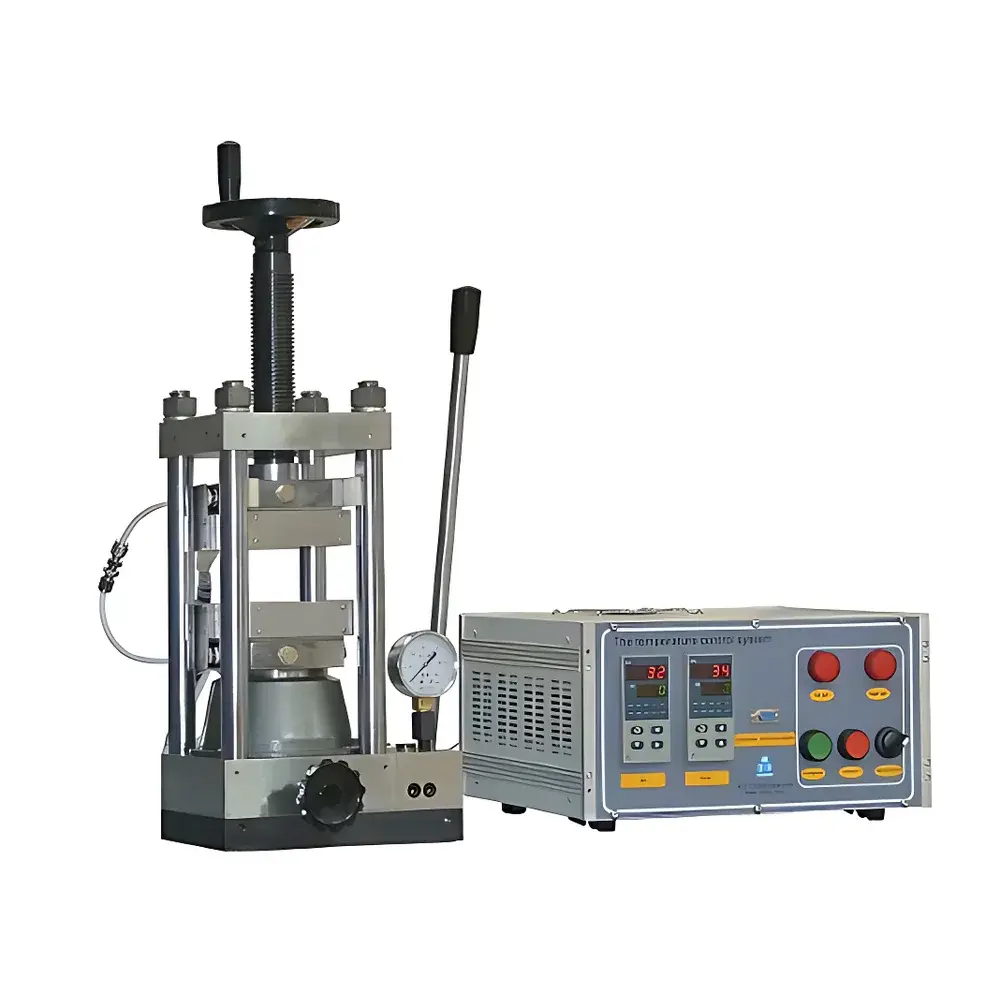
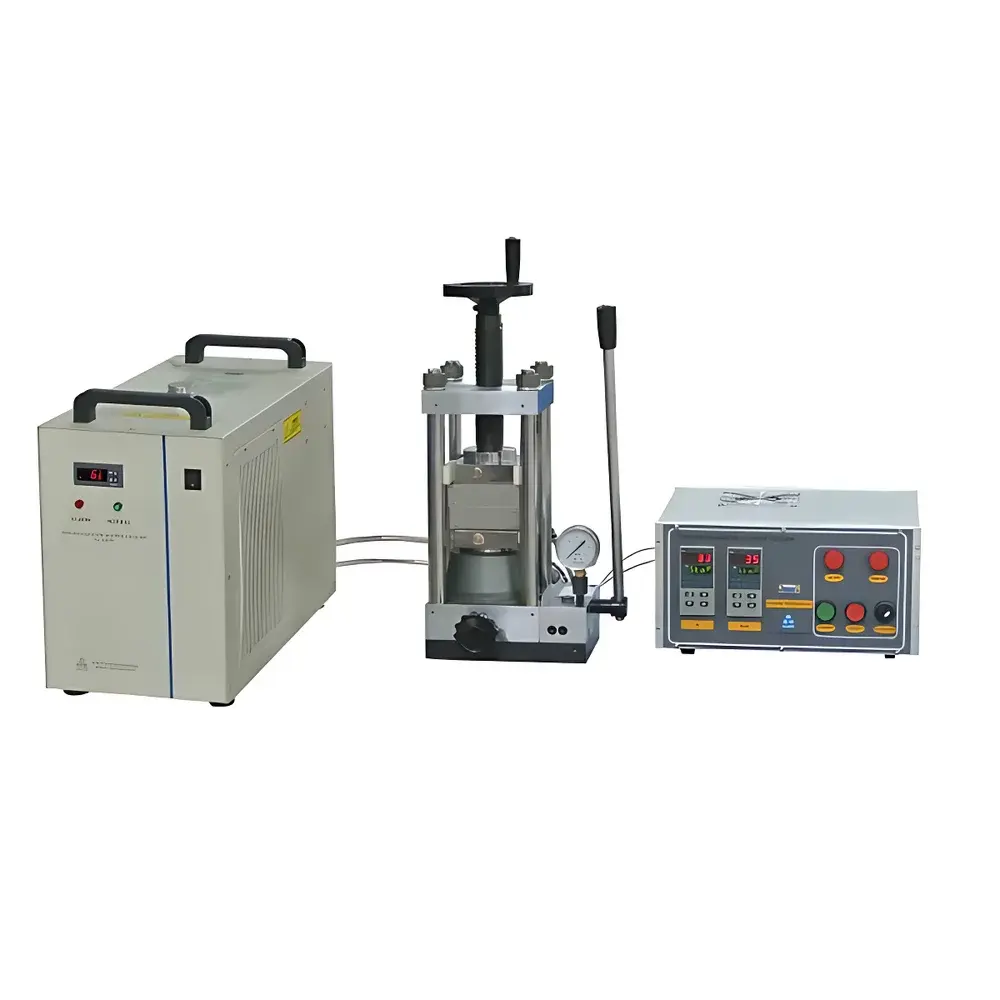
KJ GROUP HP-100 24-Ton Hot Press
| Brand | KJ GROUP |
|---|---|
| Origin | Liaoning, China |
| Manufacturer Type | Authorized Distributor |
| Country of Origin | China |
| Model | HP-100 |
| Heating Plate Material | Cr12MoV Tool Steel |
| Max Operating Temperature | 500 °C (<30 min) |
| Continuous Operating Temperature | 450 °C (with water cooling) |
| Max Applied Pressure (heated) | 12 Ton (20 MPa gauge reading) |
| Heating Plate Dimensions | 90 mm × 90 mm |
| Temperature Control Precision | ±1 °C |
| Programmable Ramp/Soak | 30-segment |
| Cooling | Integrated 1/4" BSP water-cooling ports |
| Power Supply | Single-phase AC 208–240 V, 50/60 Hz |
| Max Power Consumption | 1.6 kW |
| Max Stroke | 50 mm |
| Unit Weight | 60 kg |
| Optional Accessory | External Chiller Unit |
Overview
The KJ GROUP HP-100 24-Ton Hot Press is a precision-engineered, laboratory-scale thermal lamination system designed for controlled high-pressure sintering, consolidation, and hot pressing of advanced materials—including polymer composites, ceramic green bodies, metal powders, and layered functional devices. It operates on the principle of simultaneous uniaxial mechanical compression and resistive heating within a thermally symmetric, dual-zone heated platen architecture. Unlike conventional hydraulic presses, the HP-100 integrates independent temperature control for upper and lower platens—enabling precise thermal gradient management across the sample thickness. Its Cr12MoV tool steel heating plates offer exceptional thermal stability, wear resistance, and uniform heat distribution up to 500 °C (short-term), with continuous operation at 450 °C supported by integrated water-cooling channels. This combination of mechanical load capacity, thermal fidelity, and programmable thermal profiling makes the HP-100 suitable for R&D workflows requiring reproducible densification, interfacial bonding, or phase transformation under defined thermo-mechanical conditions.
Key Features
- Dual independent temperature control systems for upper and lower platens—enabling asymmetric heating profiles and thermal gradient studies.
- 30-segment programmable temperature ramp/soak sequences, supporting complex thermal cycles required for sintering, debinding, and annealing protocols.
- Integrated water-cooling channels embedded directly within Cr12MoV heating plates—allowing rapid quenching from elevated temperatures with minimal thermal lag.
- CE-certified electrical and mechanical architecture compliant with IEC 61000-6-2 (EMC immunity) and IEC 61000-6-4 (EMC emissions) standards.
- Digital pressure monitoring with real-time display of applied force (up to 12 Ton at elevated temperature) and gauge pressure (20 MPa).
- Compact footprint (hydraulic unit: 260 × 210 × 610 mm; controller: 360 × 300 × 180 mm) optimized for fume hood or glovebox integration.
Sample Compatibility & Compliance
The HP-100 accommodates samples up to 90 mm × 90 mm in planar dimension and 50 mm in maximum compressed thickness. It is routinely employed for processing polymer matrix composites (e.g., PEEK, PI, PVDF), oxide and non-oxide ceramics (Al2O3, SiC, ZrO2), battery electrode laminates, thermoelectric modules, and multilayer thin-film substrates. All operational parameters—including temperature setpoints, ramp rates, dwell times, and pressure hold durations—are fully configurable and loggable, supporting GLP/GMP-aligned documentation requirements. While the system itself does not include FDA 21 CFR Part 11-compliant audit trails, its digital controller outputs timestamped CSV logs compatible with third-party LIMS or ELN platforms for regulatory traceability.
Software & Data Management
The HP-100 operates via an embedded microcontroller-based interface with tactile keypad navigation and backlit LCD display. Real-time process data—including platen temperatures (Tupper, Tlower), applied pressure, elapsed time, and active program segment—are continuously displayed and stored internally (non-volatile memory). Data export is supported via USB port (standard FAT32 format); exported logs contain ISO 8601 timestamps, sensor IDs, and engineering units. Optional RS-485 Modbus RTU communication enables integration into centralized lab automation networks for remote monitoring and scheduled batch execution.
Applications
- Hot pressing of ceramic green compacts prior to sintering—achieving >95% theoretical density with minimized grain growth.
- Thermocompression bonding of polymer films in flexible electronics fabrication.
- Consolidation of metal injection molded (MIM) parts under inert atmosphere (when used inside gloveboxes).
- Preparation of solid-state electrolyte pellets for Li-ion and Na-ion battery research.
- Interfacial adhesion testing of multilayer laminates via controlled delamination under thermal stress.
- Process development for powder metallurgy, including diffusion bonding and transient liquid phase sintering.
FAQ
What is the maximum sustained operating temperature with continuous water cooling?
The HP-100 supports continuous operation at 450 °C when connected to a regulated water-cooling supply (flow rate ≥2 L/min, inlet temperature ≤25 °C).
Can the HP-100 be operated inside a nitrogen-purged glovebox?
Yes—the unit’s external dimensions, cable routing, and absence of internal air-moving components permit safe integration into Class I or II gloveboxes; optional feedthroughs for power and cooling lines are available.
Is pressure calibration traceable to national standards?
The hydraulic pressure transducer is factory-calibrated against NIST-traceable deadweight testers; calibration certificates are provided with each unit.
Does the system support vacuum or inert gas environments?
The HP-100 itself is not vacuum-rated; however, it is compatible with externally mounted vacuum chambers or gas-tight pressing dies—commonly used for oxygen-sensitive ceramic processing.
What chiller specifications are recommended for optimal cooling performance?
A recirculating chiller with minimum 1.5 kW cooling capacity, 10–25 °C setpoint range, and 1/4″ quick-connect fittings is advised for full thermal cycle repeatability.



