
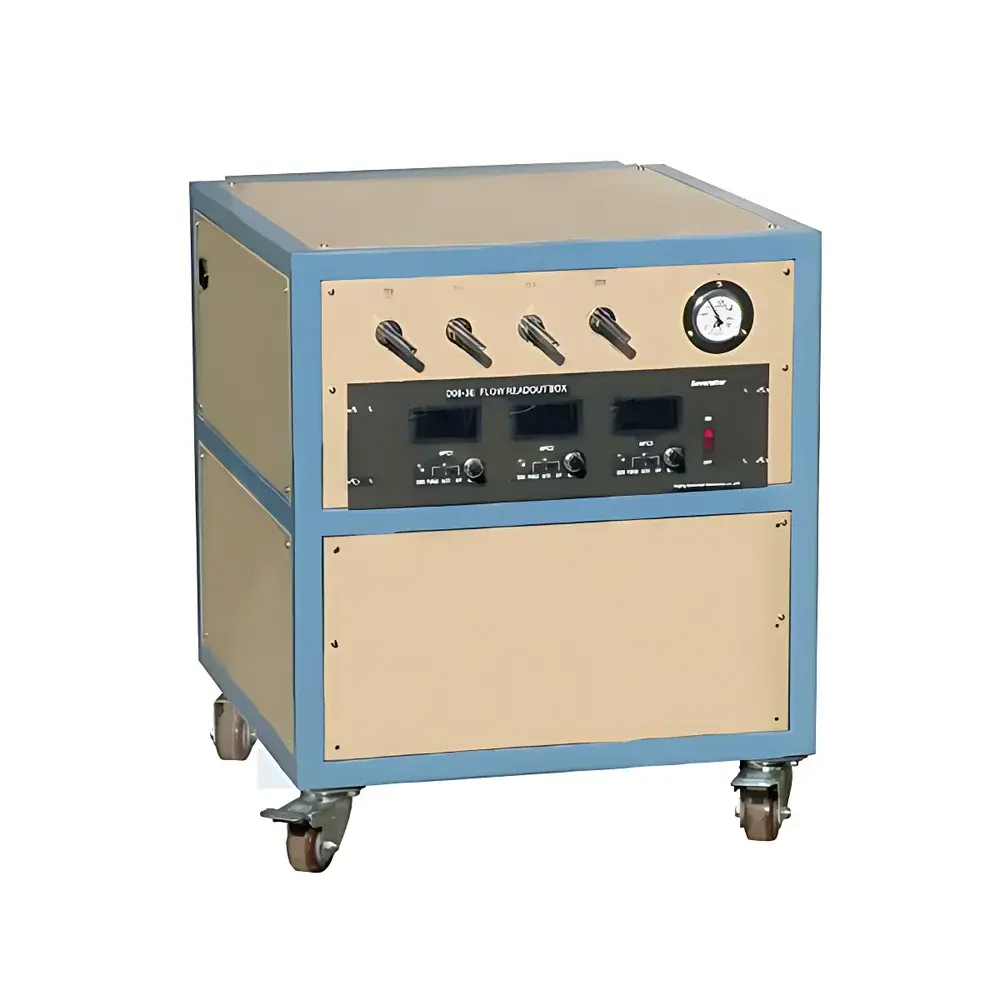
KJ GROUP GSL-3Z Triple-Channel Mass Flow Controlled Gas Mixing System
| Brand | KJ GROUP |
|---|---|
| Origin | Liaoning, China |
| Manufacturer Type | Authorized Distributor |
| Country of Origin | China |
| Model | GSL-3Z |
| Pricing | Contact for Quotation |
| Power Supply | 185–245 V AC, 50 Hz |
| Max. Output Power | 18 W |
| Flow Control Ranges | MFC #1: 0–100 SCCM |
| MFC #2 | 1–199 SCCM |
| MFC #3 | 1–499 SCCM |
| Accuracy | ±1% FS |
| Linearity | ±0.5–1.5% FS |
| Repeatability | ±0.2% FS |
| Response Time (Gas) | 1–4 s |
| Response Time (Electrical) | ≤10 s |
| Needle Valve Material | 316 Stainless Steel |
| Operating Pressure Differential | 0.1–0.5 MPa |
| Vacuum/Pressure Gauge Range | −0.1 to +0.15 MPa (0.01 MPa per division) |
| Mixing Chamber Dimensions | Ø80 mm × 120 mm |
| Shut-off Valves | 1/4″ BSP, 316 stainless steel |
| Ambient Operating Temperature | 5–45 °C |
| Overall Dimensions (W×D×H) | 600 × 600 × 650 mm |
Overview
The KJ GROUP GSL-3Z Triple-Channel Mass Flow Controlled Gas Mixing System is an engineered solution for precise, independent regulation and blending of up to three process gases in vacuum-compatible thermal processing environments. Designed explicitly for integration with horizontal tube furnaces—particularly those used in chemical vapor deposition (CVD), annealing, oxidation, and diffusion applications—the GSL-3Z employs thermal mass flow controllers (MFCs) operating on the principle of constant-temperature anemometry. Each channel delivers real-time, closed-loop flow control without requiring gas-specific calibration factors when used within specified operating conditions, enabling stable stoichiometric gas delivery under dynamic pressure gradients. Its modular architecture allows direct mounting onto mobile furnace stands, minimizing dead volume and reducing contamination risk from external tubing. The system maintains operational integrity across a wide differential pressure range (0.1–0.5 MPa), supporting both positive-pressure inert or reactive atmospheres and low-pressure (<100 Pa) vacuum-assisted processes common in semiconductor fabrication and advanced materials synthesis.
Key Features
- Three independently programmable thermal mass flow controllers with full-scale ranges optimized for low-, medium-, and high-flow applications (0–100 SCCM, 1–199 SCCM, and 1–499 SCCM respectively)
- High-stability 316 stainless steel needle valves and 1/4″ BSP shut-off valves rated for corrosive and ultra-high-purity gas service
- Integrated mixing chamber (Ø80 mm × 120 mm) with laminar flow geometry to ensure homogeneous gas composition prior to furnace inlet
- Dual-range compound pressure/vacuum gauge (−0.1 to +0.15 MPa) with 0.01 MPa resolution for real-time monitoring of system backpressure and leak integrity
- Compact footprint (600 × 600 × 650 mm) and standardized mounting interface compatible with KJ GROUP’s GSL-series tube furnaces and third-party vacuum flange systems (KF-40/KF-50)
- Robust front-panel interface with analog knob adjustment, LED digital displays, and status indicators for immediate visual verification of setpoint vs. actual flow
Sample Compatibility & Compliance
The GSL-3Z supports compatibility with a broad spectrum of industrial and research-grade gases—including N2, Ar, O2, H2, NH3, SiH4, PH3, and B2H6—provided they remain chemically inert toward 316 stainless steel and internal elastomer seals (Viton® standard). All wetted components conform to ASTM F519 and ISO 8502-3 surface cleanliness requirements for high-vacuum applications. While not certified to IEC 61000-6-3 or UL 61010-1 as a standalone unit, the system complies with electromagnetic compatibility guidelines for laboratory instrumentation when installed per manufacturer-specified grounding protocols. It meets functional requirements for GLP-compliant process documentation when paired with external data loggers recording time-stamped MFC outputs and pressure readings.
Software & Data Management
The GSL-3Z operates in standalone mode via its analog front panel; however, optional RS-485 (Modbus RTU) or analog 0–5 VDC output interfaces enable integration into centralized process control systems. When connected to supervisory software (e.g., LabVIEW, MATLAB, or custom SCADA platforms), users can log timestamped flow values, generate composition profiles over time, and trigger alarms based on deviation thresholds. Audit trails—including operator ID, parameter changes, and system start/stop events—can be maintained externally to satisfy FDA 21 CFR Part 11 requirements for electronic records in regulated environments. Firmware updates are performed via USB port using KJ GROUP’s validated configuration utility, which enforces checksum verification and rollback capability.
Applications
- Controlled-atmosphere annealing of graphene, transition metal dichalcogenides (TMDs), and perovskite thin films
- In-situ CVD precursor blending for SiO2, SiNx, and Al2O3 dielectric growth
- Multi-gas thermal treatment of battery cathode materials (e.g., NMC, LFP) under graded O2/Ar ratios
- Atmospheric simulation for catalyst testing (e.g., CO oxidation, NOx reduction) in fixed-bed reactors
- Calibration gas generation for FTIR, QCM, and residual gas analyzers (RGAs) requiring ppm-level accuracy
- Process development for optical fiber preform consolidation under Cl2/He mixtures
FAQ
Can the GSL-3Z be used with reactive gases such as chlorine or silane?
Yes—provided appropriate material compatibility verification is conducted and all downstream piping is passivated. Use only with Viton® or Kalrez® seals for halogenated compounds.
Is remote computer control supported out of the box?
No. RS-485 or analog output modules are optional accessories requiring separate ordering and configuration.
What is the maximum allowable inlet pressure for the MFCs?
The specified operating pressure differential (0.1–0.5 MPa) refers to the drop across each MFC. Inlet pressure must not exceed 0.6 MPa absolute to maintain accuracy and valve longevity.
Does the system include gas filtration or purification stages?
No. External particulate and moisture filters (e.g., Swagelok SS-4F-10, Parker BHA series) must be installed upstream per gas purity specifications.
How often does calibration verification need to be performed?
Annual verification against NIST-traceable flow standards is recommended for ISO/IEC 17025-compliant labs; more frequent checks may be required in high-use production settings.



