
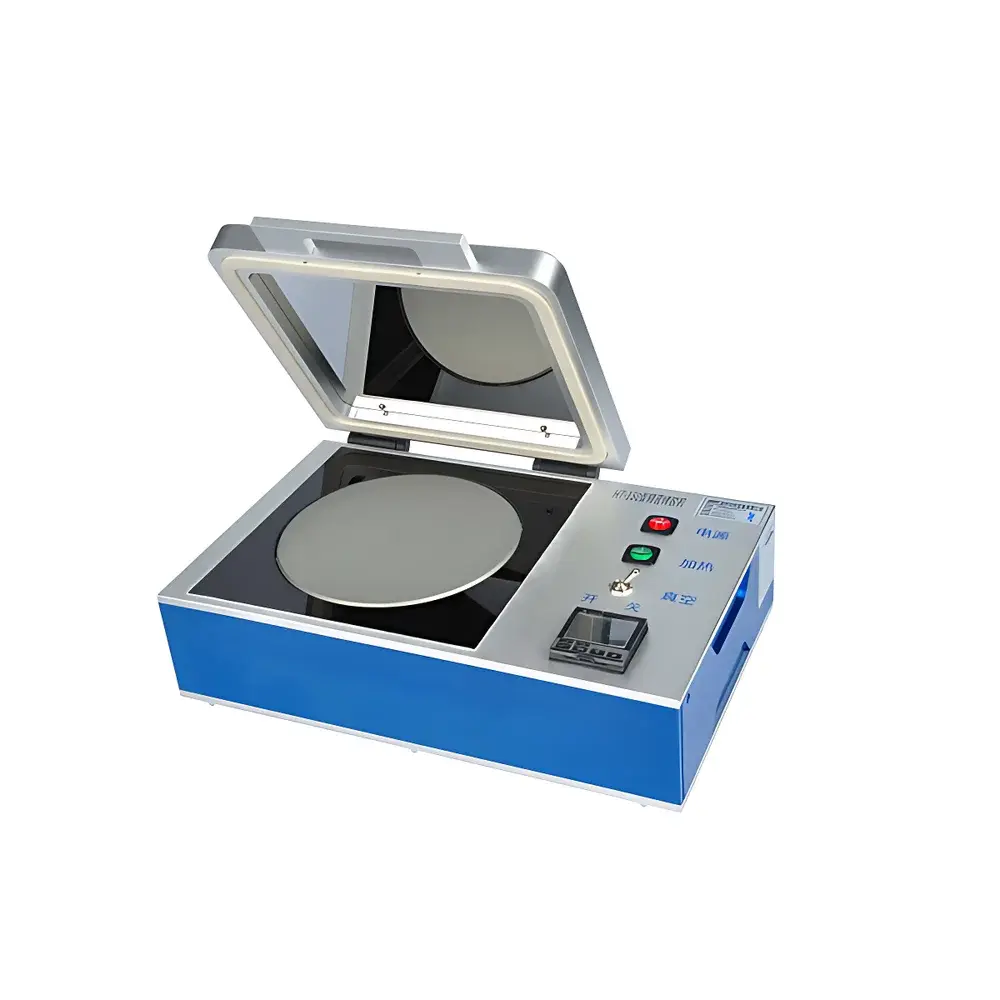
KJ GROUP HT-150 Precision Hot Plate for Photoresist Baking
| Brand | KJ GROUP |
|---|---|
| Origin | Liaoning, China |
| Manufacturer Type | Authorized Distributor |
| Origin Category | Domestic (China) |
| Model | HT-150 |
| Pricing | Available Upon Request |
| Heating Plate Diameter | 170 mm |
| Max Substrate Size | 6-inch round wafer |
| Max Temperature | 250 °C |
| Temperature Resolution | 0.1 °C |
| Temperature Stability | ±0.2 °C (at setpoint) |
| Surface Uniformity | < ±1% |
| Power Input | 220 V, 5 A, 800 W |
| Dimensions (W×D×H) | 369 × 270 × 126 mm |
| Weight | 8 kg |
Overview
The KJ GROUP HT-150 Precision Hot Plate for Photoresist Baking is an engineered thermal platform designed specifically for controlled, reproducible soft-bake and post-exposure bake (PEB) processes in microfabrication laboratories. Operating on resistive heating principles with closed-loop PID temperature regulation, the HT-150 delivers high spatial and temporal thermal stability essential for lithographic process fidelity. Its compact footprint (369 × 270 × 126 mm) and low-profile architecture enable seamless integration into nitrogen-purged or inert-atmosphere gloveboxes—critical for moisture-sensitive photoresist processing. The unit employs a solid-state, high-uniformity heating element embedded beneath a microcrystalline aluminum oxide top plate, thermally isolated via multi-layer ceramic insulation to minimize edge effects and radial gradients. With a maximum operating temperature of 250 °C and real-time stabilization within ±0.2 °C at steady state, the HT-150 meets the thermal repeatability requirements defined in SEMI Standard F27–12 for photolithography equipment qualification.
Key Features
- 170 mm diameter anodized aluminum heating surface—optimized for uniform thermal transfer across 6-inch (150 mm) silicon wafers and quartz substrates
- Manual vacuum chuck system (integrated vacuum port with external pump interface) ensures consistent substrate-to-plate contact, eliminating air-gap-induced thermal resistance and improving bake repeatability
- High-resolution digital temperature controller with linear ramp/soak programming capability—supports up to 10-segment time-temperature profiles with independent ramp rate and dwell settings
- Full anodized aluminum chassis—provides mechanical rigidity, corrosion resistance, and electromagnetic shielding compatibility in cleanroom environments
- Dedicated heater power circuit with independent ON/OFF toggle—enables rapid thermal shutdown and isolation during maintenance or emergency protocols
- Multi-zone thermal barrier design incorporating low-conductivity ceramic spacers and reflective microcrystalline top layer—reduces lateral heat loss and enhances radial uniformity to < ±1% across the active zone
- Integrated thermal radiation shield and hinged safety cover—minimizes operator exposure and prevents ambient drafts from perturbing surface temperature distribution
Sample Compatibility & Compliance
The HT-150 accommodates standard semiconductor substrates including Si, SiO₂, quartz, glass, and flexible polymer films (e.g., PET, PI) up to 150 mm in diameter. Its vacuum-assisted clamping mechanism ensures flatness retention for thin or warped wafers (< 500 µm thickness), reducing bow-induced pattern distortion during resist crosslinking. The device complies with IEC 61000-6-3 (EMC emission limits) and IEC 61010-1 (safety requirements for laboratory electrical equipment). While not certified to ISO/IEC 17025, its temperature stability and uniformity performance align with calibration traceability practices recommended in ASTM E220–22 (Standard Test Method for Calibration of Thermocouples by Comparison Techniques) when used with NIST-traceable reference sensors. It supports GLP-compliant documentation workflows when paired with external data loggers recording time-stamped temperature profiles per batch.
Software & Data Management
The HT-150 operates via front-panel keypad interface with no embedded firmware-based software; however, it features analog voltage output (0–5 V DC) proportional to measured surface temperature—enabling direct integration with third-party SCADA systems, PLCs, or PC-based acquisition platforms (e.g., LabVIEW, MATLAB, Python + DAQ hardware). Users may record full thermal cycles—including ramp rates, soak durations, and deviation logs—for audit trails required under internal quality management systems (QMS) aligned with ISO 9001:2015 Clause 8.5.1. Optional RS-485 Modbus RTU interface (available upon request) permits remote parameter setting and real-time monitoring in networked lab environments, supporting 21 CFR Part 11–compatible electronic signature configurations when implemented with validated host software.
Applications
- Photolithography process steps: pre-bake (dehydration bake), soft bake (solvent removal), and post-exposure bake (PEB) for chemically amplified resists (CARs)
- Thin-film annealing of spin-coated metal oxides (e.g., ITO, TiO₂) and conductive polymers prior to patterning
- Thermal curing of SU-8, PDMS, and other epoxy-based microstructuring resists
- Controlled solvent evaporation studies in R&D labs developing novel resist formulations
- Substrate preconditioning for atomic layer deposition (ALD) and physical vapor deposition (PVD) tool loading protocols
- Calibration reference platform for thermal mapping validation using infrared thermography or thermocouple arrays
FAQ
What vacuum pressure level is required for optimal substrate adhesion?
A minimum vacuum of –60 kPa (gauge) is recommended; typical operation ranges between –70 kPa and –85 kPa depending on substrate flatness and surface roughness.
Can the HT-150 be operated inside a nitrogen-filled glovebox?
Yes—the unit is rated for continuous operation in inert atmospheres; all electrical components are sealed to IP20, and no outgassing materials are used in the heating assembly.
Is NIST-traceable calibration available for this model?
KJ GROUP provides factory calibration certificates (as-delivered); users may perform in-house verification using Class A platinum RTDs or calibrated thermocouples per ASTM E220 procedures.
Does the HT-150 support non-linear temperature ramps (e.g., exponential or stepwise profiles)?
No—the controller implements only linear ramp/soak segments; complex profiles require external programmable logic controllers or data acquisition systems.
What maintenance is required to sustain temperature uniformity over time?
Annual inspection of thermal interface integrity and cleaning of vacuum channels with dry nitrogen is advised; no consumable parts require replacement under normal usage conditions.



