
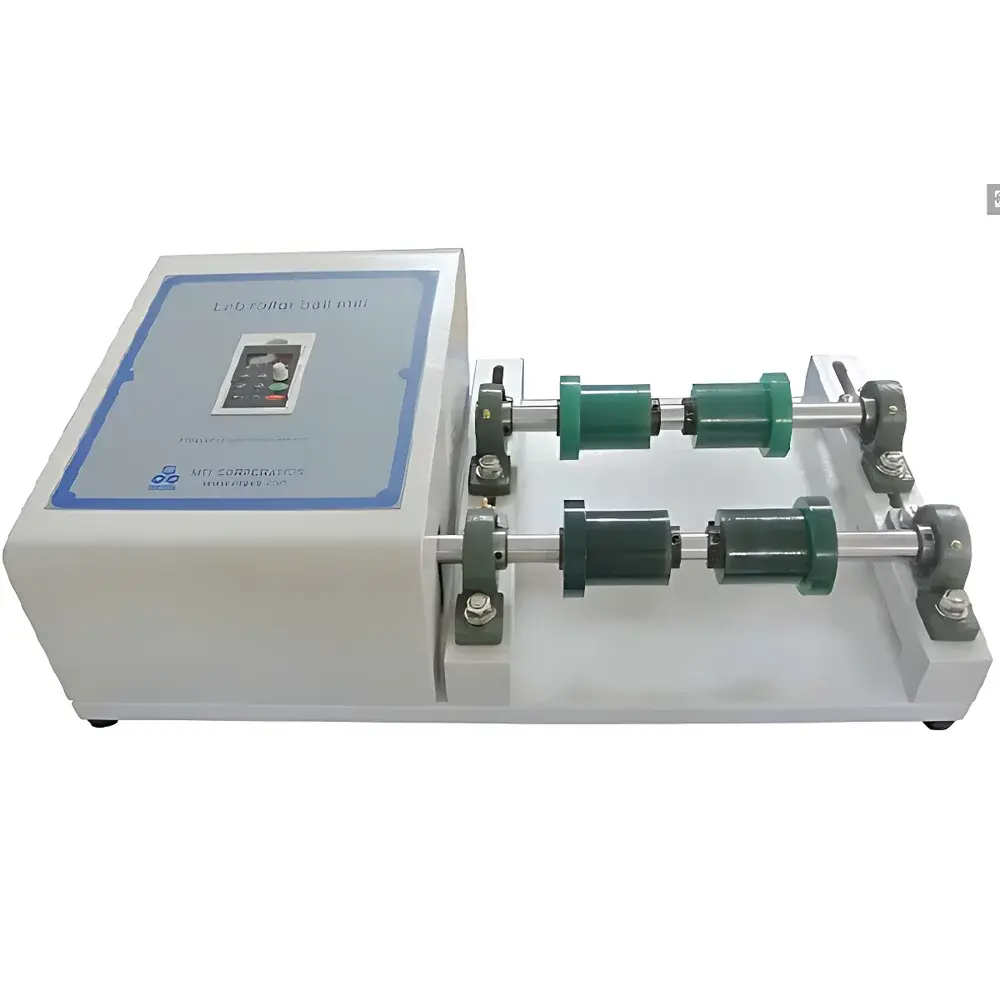
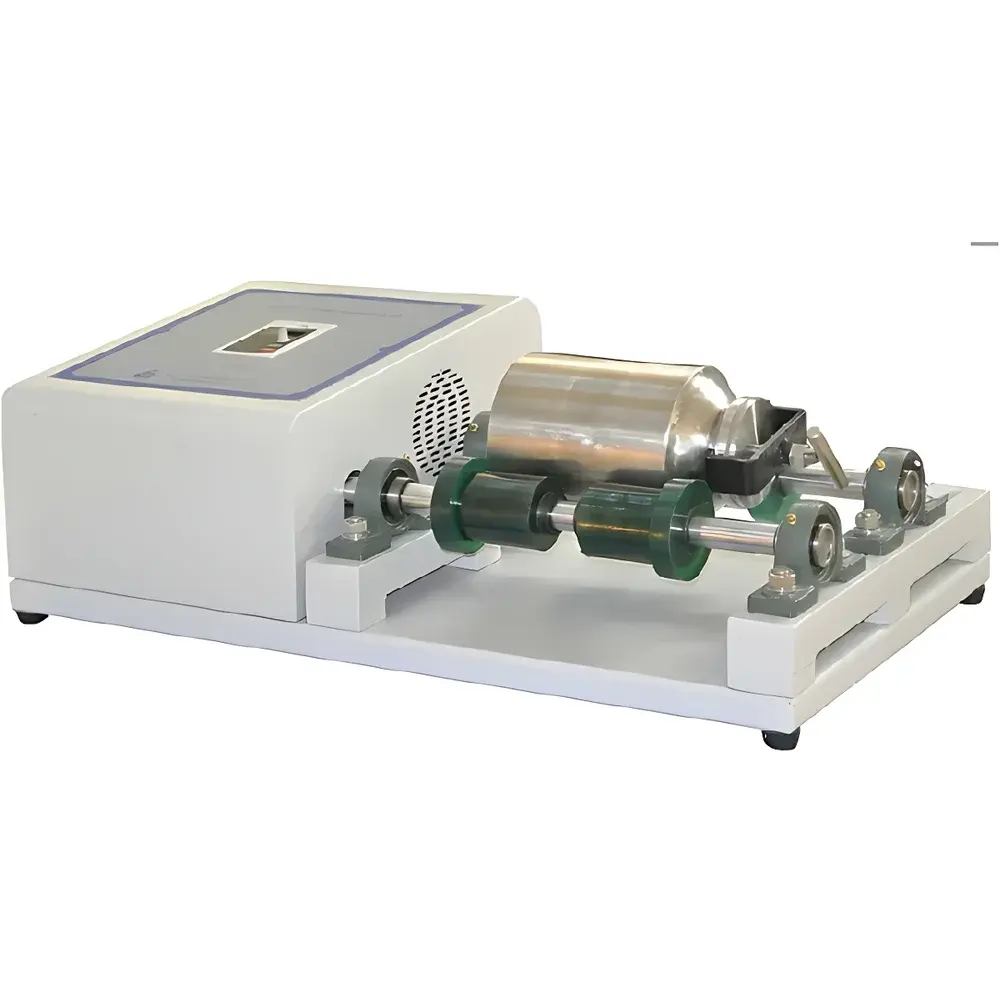
KJ GROUP MSK-SFM-14 Rotary Drum Mixer
| Brand | KJ GROUP |
|---|---|
| Origin | Liaoning, China |
| Manufacturer Type | Authorized Distributor |
| Country of Origin | China |
| Model | MSK-SFM-14 |
| Power Supply | AC 220 V, 50/60 Hz, 400 W |
| Rotation Mode | Programmable continuous bidirectional rotation (CW/CCW) |
| Speed Range | 60–600 rpm |
| Timer Range | 1–9999 min |
| Maximum Load Capacity | 25 kg |
| Max. Compatible Jar Dimensions | Ø250 mm × 175 mm |
| Standard Jar Dimensions | Ø130 mm × 162 mm |
| Jar Materials | Ceramic, Alumina, Stainless Steel, Polyurethane, Nylon |
| Grinding Media Compatibility | Alumina, Zirconia, Agate, Chrome Steel, Stainless Steel |
| Overall Dimensions | 730 mm × 415 mm × 250 mm |
| Net Weight | 60 kg |
Overview
The KJ GROUP MSK-SFM-14 Rotary Drum Mixer is an engineered laboratory-scale powder mixing and homogenization system designed for reproducible, low-shear blending of dry or slurry-based materials. It operates on the principle of controlled rotational motion—two parallel drive rollers rotate a cylindrical mixing jar along its longitudinal axis, generating gentle tumbling action that promotes uniform particle distribution without excessive attrition or thermal buildup. Unlike high-energy ball mills, this drum mixer emphasizes process stability and operator safety while maintaining compatibility with sensitive formulations, including battery electrode slurries, ceramic precursors, pharmaceutical blends, and advanced composite powders. Its programmable bidirectional rotation sequence mitigates material stratification and wall adhesion, enabling consistent batch-to-batch repeatability across R&D and pilot-scale production environments.
Key Features
- Programmable bidirectional rotation control: Alternating clockwise and counterclockwise motion prevents material segregation and ensures symmetrical mixing dynamics.
- Digital speed regulation: Precise adjustment from 60 to 600 rpm with real-time LED display for traceable parameter monitoring.
- Extended timer range: Adjustable operation duration from 1 minute to 9999 minutes (166.6 hours), supporting both short-cycle optimization and long-duration aging protocols.
- Modular jar interface: Accommodates interchangeable jars up to Ø250 mm × 175 mm; standard stainless steel jar measures Ø130 mm × 162 mm.
- Multi-material jar compatibility: Supports chemically inert and wear-resistant options—including alumina, zirconia, agate, polyurethane, and nylon—for diverse application requirements.
- Robust mechanical architecture: Heavy-duty steel frame with vibration-dampening base and precision-machined roller shafts ensure long-term operational stability under repeated loading cycles.
Sample Compatibility & Compliance
The MSK-SFM-14 is validated for use with free-flowing powders, granules, and low-viscosity slurries. It supports common grinding media such as aluminum oxide (Al₂O₃), yttria-stabilized zirconia (YSZ), natural agate, chrome steel, and austenitic stainless steel—enabling simultaneous mixing and mild size reduction where appropriate. All contact surfaces are constructed from corrosion-resistant stainless steel (AISI 304 standard), compliant with ISO 8502-3 for surface cleanliness verification. While not certified to GLP or GMP out-of-the-box, the device’s repeatable digital controls, non-volatile timer memory, and absence of software-based audit trails make it suitable for internal SOP-driven workflows in ISO 9001-certified laboratories. Users implementing this instrument in regulated environments may integrate external logging systems to satisfy 21 CFR Part 11 data integrity requirements.
Software & Data Management
The MSK-SFM-14 operates via embedded microcontroller-based hardware with no onboard PC interface or proprietary software suite. All operational parameters—including speed setpoint, direction sequence, and elapsed time—are configured directly through the front-panel keypad and displayed on a dual-digit LED screen. Parameter settings persist through power cycling, ensuring protocol continuity between sessions. For laboratories requiring electronic recordkeeping, optional RS-232 or analog voltage output modules (sold separately) enable connection to SCADA systems, PLCs, or custom LabVIEW-based acquisition platforms. No firmware updates or driver installation is required; configuration remains fully manual and deterministic—ideal for environments prioritizing simplicity, validation transparency, and minimal cybersecurity surface area.
Applications
- Battery materials processing: Homogenization of cathode/anode slurries (e.g., NMC, LFP, graphite) prior to coating or drying steps.
- Ceramic and refractory formulation: Uniform dispersion of dopants, binders, and sintering aids in oxide-based systems.
- Pharmaceutical solid dosage development: Blending of APIs with excipients under low-shear conditions to preserve crystal structure integrity.
- Advanced composites: Pre-mixing of polymer matrix fillers (e.g., carbon nanotubes, graphene oxide) before extrusion or molding.
- Geological and metallurgical sample preparation: Gentle comminution and homogenization of ore samples for XRF or ICP-OES analysis.
- Academic research: Teaching and method development in powder technology, granulation science, and mechanochemical synthesis.
FAQ
What jar materials are compatible with the MSK-SFM-14?
Ceramic, alumina, zirconia, stainless steel (AISI 304), polyurethane, and nylon jars are supported—selected based on chemical resistance, density, and abrasion tolerance for specific media and sample types.
Can the mixer be used for wet milling?
Yes, provided the jar is sealed and compatible with the slurry composition; however, it is optimized for low-energy mixing rather than high-intensity grinding.
Is speed calibration traceable to national standards?
The unit employs a calibrated optical encoder on the main drive shaft; users may perform periodic verification using a handheld tachometer per ISO 5348.
Does the device support automatic batch logging?
No—data recording requires external instrumentation; the mixer itself maintains only volatile runtime status and non-volatile parameter presets.
What safety certifications does the MSK-SFM-14 hold?
It complies with IEC 61000-6-2 (immunity) and IEC 61000-6-4 (emissions); CE marking is available upon request for EU shipment configurations.



