
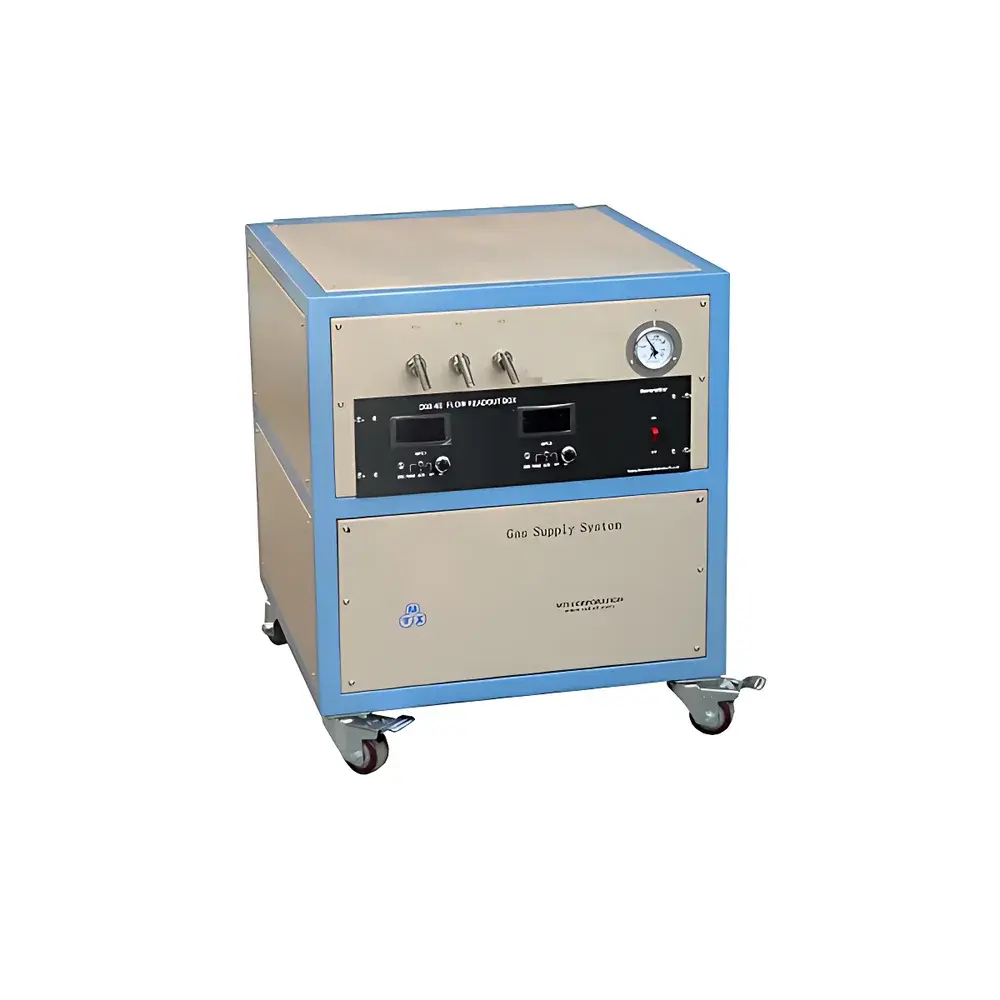
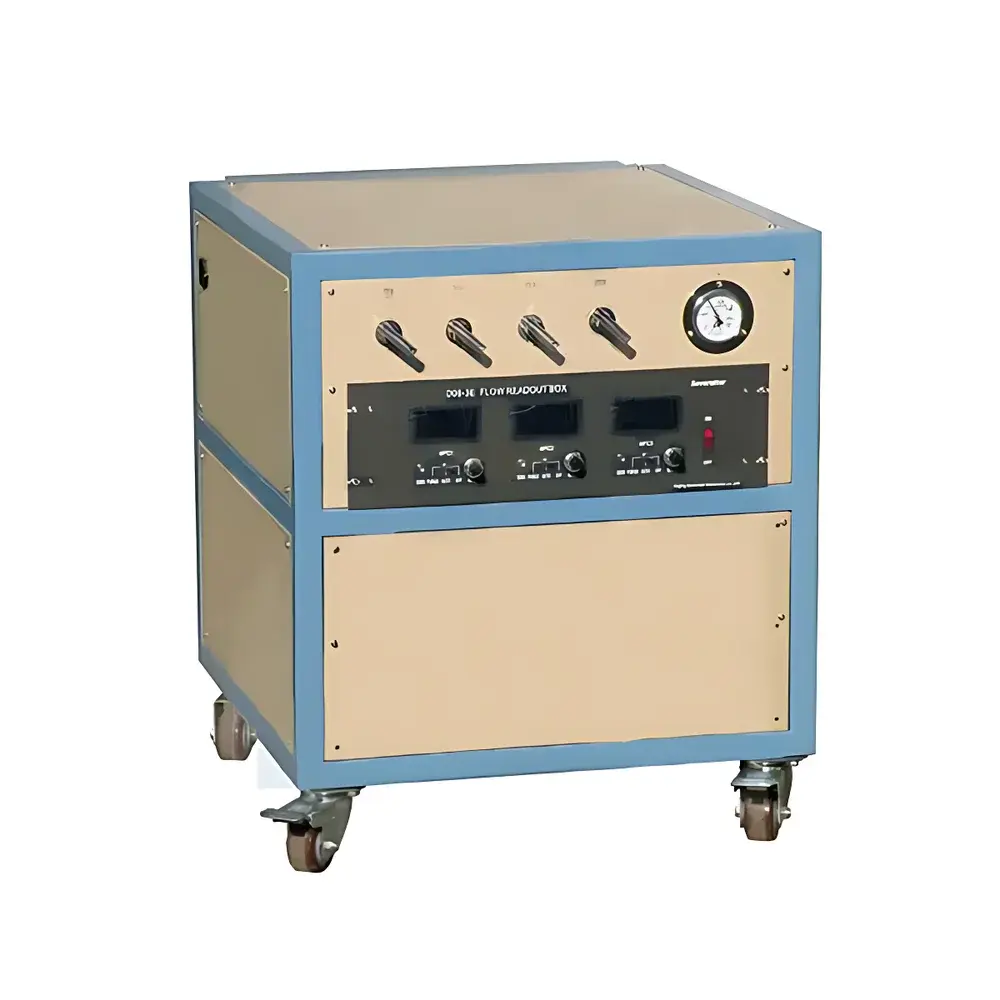
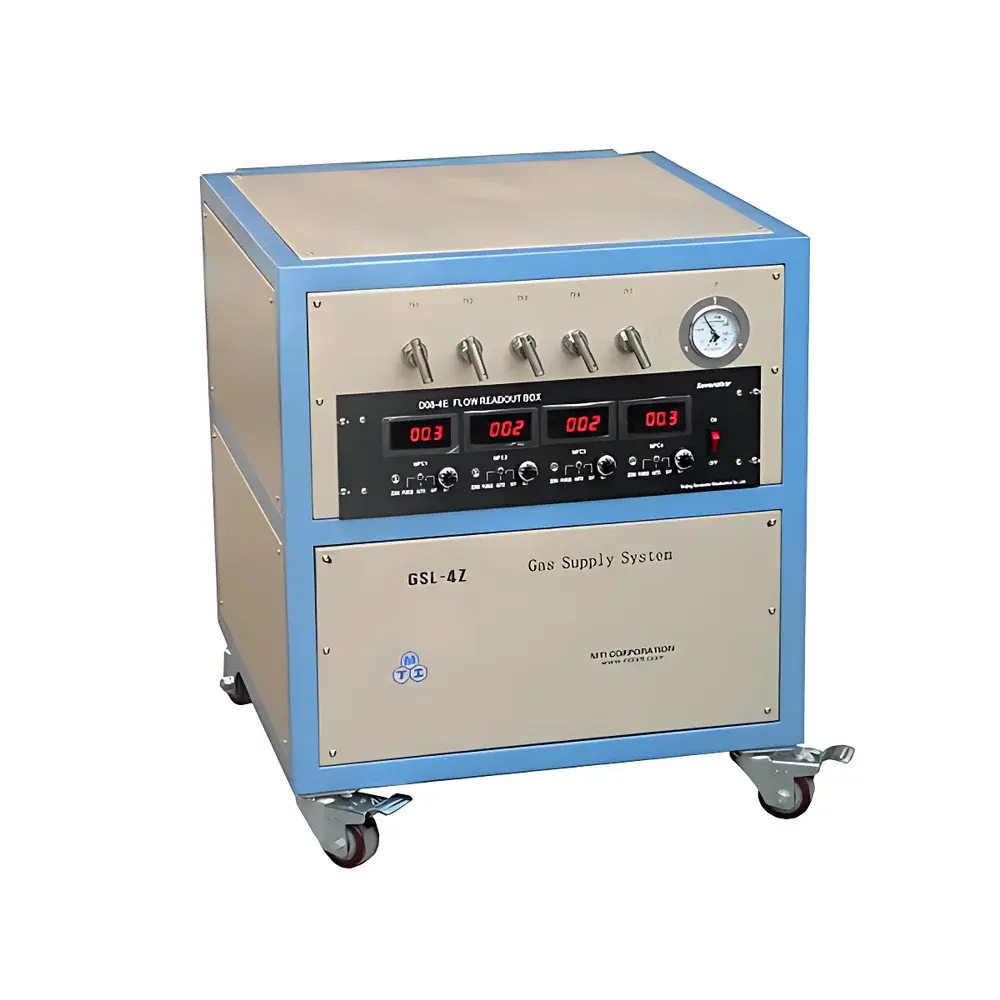
KJ GROUP GSL-Series Multi-Channel Mass Flow Gas Delivery System
| Brand | KJ GROUP |
|---|---|
| Origin | Liaoning, China |
| Manufacturer Type | Authorized Distributor |
| Country of Origin | China |
| Model | GSL-2Z / GSL-3Z / GSL-4Z |
| Power Supply | 185–245 VAC, 50 Hz |
| Max. Output Power | 18 W |
| Flow Range (per Channel) | GSL-2Z — Ch1: 1–199 SCCM, Ch2: 1–499 SCCM |
| GSL-3Z — Ch1 | 0–100 SCCM, Ch2: 1–199 SCCM, Ch3: 1–499 SCCM |
| GSL-4Z — Ch1 | 0–100 SCCM, Ch2: 1–199 SCCM, Ch3: 1–199 SCCM, Ch4: 1–499 SCCM |
| Max. Operating Pressure | 3 MPa |
| Accuracy | ±1% FS |
| Linearity | ±0.5–1.5% FS |
| Repeatability | ±0.2% FS |
| Response Time (Gas) | 1–4 s |
| (Electrical) | ≤10 s |
| Needle Valve Material | 316 Stainless Steel |
| Operating Pressure Differential | 0.1–0.5 MPa |
| Vacuum/Pressure Gauge Range | –0.1 to +0.15 MPa (0.01 MPa/div) |
| Mixing Chamber | Ø80 mm × 120 mm |
| Shut-off Valve | 1/4″ BSP, 316 SS |
| Ambient Operating Temperature | 5–45 °C |
| Dimensions (W×D×H) | 600 × 600 × 650 mm |
Overview
The KJ GROUP GSL-Series Multi-Channel Mass Flow Gas Delivery System is an engineered solution for precise, independent control of multiple gas streams in vacuum-compatible high-temperature processing environments. Designed specifically for integration with tube furnaces, CVD reactors, annealing systems, and plasma-enhanced deposition tools, this system operates on thermal mass flow measurement principles—utilizing constant-temperature anemometry to deliver real-time, temperature-compensated volumetric flow data referenced to standard conditions (SCCM, STP). Each channel incorporates a calibrated thermal mass flow sensor and a high-stability 316 stainless steel needle valve, enabling stable operation across wide pressure differentials—from rough vacuum (–0.1 MPa gauge) up to 3 MPa absolute—without requiring downstream pressure regulation. Its modular architecture supports 2-, 3-, or 4-channel configurations (GSL-2Z, GSL-3Z, GSL-4Z), making it suitable for binary gas mixing, multi-step sequential purging, or complex reactive gas dosing protocols common in semiconductor process development and advanced materials synthesis.
Key Features
- Thermally compensated mass flow control with ±1% full-scale accuracy and ±0.2% FS repeatability—validated per ISO 17025-accredited calibration procedures.
- Independent channel configuration: each flow path features dedicated digital setpoint control, local analog metering, and fail-safe shut-off capability via integrated 1/4″ 316 SS ball valves.
- Vacuum-rated mixing chamber (Ø80 mm × 120 mm) constructed from electropolished 316 stainless steel, compliant with ASTM A269 for ultra-high-purity gas handling.
- Front-panel interface with tactile rotary knobs and dual-range digital displays—enabling intuitive manual adjustment without software dependency.
- Robust mechanical design: rigid welded frame, vibration-damped mounting platform, and IP54-rated enclosure for laboratory and pilot-line deployment.
- Wide operating differential pressure range (0.1–0.5 MPa) ensures compatibility with both low-flow precision doping and high-velocity purge applications.
Sample Compatibility & Compliance
The GSL-Series is compatible with inert gases (Ar, N₂, He), reactive precursors (NH₃, SiH₄, PH₃), oxidizing agents (O₂, O₃), and corrosive species (Cl₂, HCl) when used with appropriate wetted-material options (e.g., VCR fittings, Kalrez seals). All gas pathways meet USP extractables criteria for Class VI polymers where applicable, and the system conforms to CE marking requirements under the EU Pressure Equipment Directive (PED 2014/68/EU) for Category I equipment. It supports GLP-compliant operation through traceable calibration certificates (NIST-traceable reference standards) and optional audit-ready log files when paired with external data acquisition systems. While not inherently 21 CFR Part 11 compliant, its analog front-end allows integration into validated environments via third-party SCADA or LabVIEW-based supervisory control layers.
Software & Data Management
The base GSL-Series operates as a stand-alone analog-controlled instrument; however, optional RS-485 Modbus RTU or 0–10 VDC analog output interfaces enable connection to programmable logic controllers (PLCs), furnace automation suites, or centralized lab management platforms. When interfaced with KJ GROUP’s optional GSL-Link software (Windows-based), users gain access to synchronized multi-channel logging, ramp-hold profile programming, alarm threshold configuration, and CSV export for post-processing in MATLAB or Python. All logged data includes timestamp, channel ID, setpoint, measured flow, and ambient temperature—supporting ISO/IEC 17025 documentation requirements for method validation.
Applications
- Controlled atmosphere annealing of silicon wafers and 2D materials (e.g., graphene, MoS₂) under graded O₂/N₂ ratios.
- Precise dopant delivery in low-pressure CVD for SiGe epitaxy and III–V compound growth.
- Inert gas purging and leak-check sequencing in vacuum furnace load-lock chambers.
- Multi-gas calibration of environmental SEM/TEM gas injection systems.
- Reproducible synthesis of metal–organic frameworks (MOFs) requiring stoichiometric co-flow of ligand vapor and metal precursor.
- Process qualification of ALD reactors where pulse-to-pulse gas ratio consistency directly impacts film conformality.
FAQ
Is the GSL-Series certified for use with explosive or pyrophoric gases?
No. While constructed from 316 stainless steel and rated for high-pressure operation, the standard GSL-Series lacks intrinsically safe certification (ATEX/IECEx) and is not approved for Class I Division 1 hazardous locations. Custom configurations with explosion-proof enclosures and purge systems are available upon engineering review.
Can flow sensors be recalibrated in-house?
Yes—each thermal mass flow sensor includes a removable calibration module. Recalibration requires a NIST-traceable primary standard (e.g., Brooks 5850E or Mesa Labs DryCal) and must follow the procedure outlined in KJ GROUP Technical Bulletin TB-GSL-03.
What is the minimum detectable flow rate for the 0–100 SCCM channel?
The lower limit of quantitation (LLOQ) is 0.5 SCCM at ±5% relative uncertainty, verified per ISO 5167 Annex C guidelines for low-flow thermal sensors.
Does the system support automatic gas switching during thermal ramps?
Not natively—but when connected via Modbus RTU to a compatible tube furnace controller (e.g., Eurotherm 3508), time-synchronized gas profile execution is achievable using user-defined script triggers.
Are replacement flow sensors field-swappable?
Yes. All sensors mount via standardized Swagelok 1/4″ compression fittings and retain factory calibration coefficients via embedded EEPROM—no reconfiguration required after physical replacement.



