
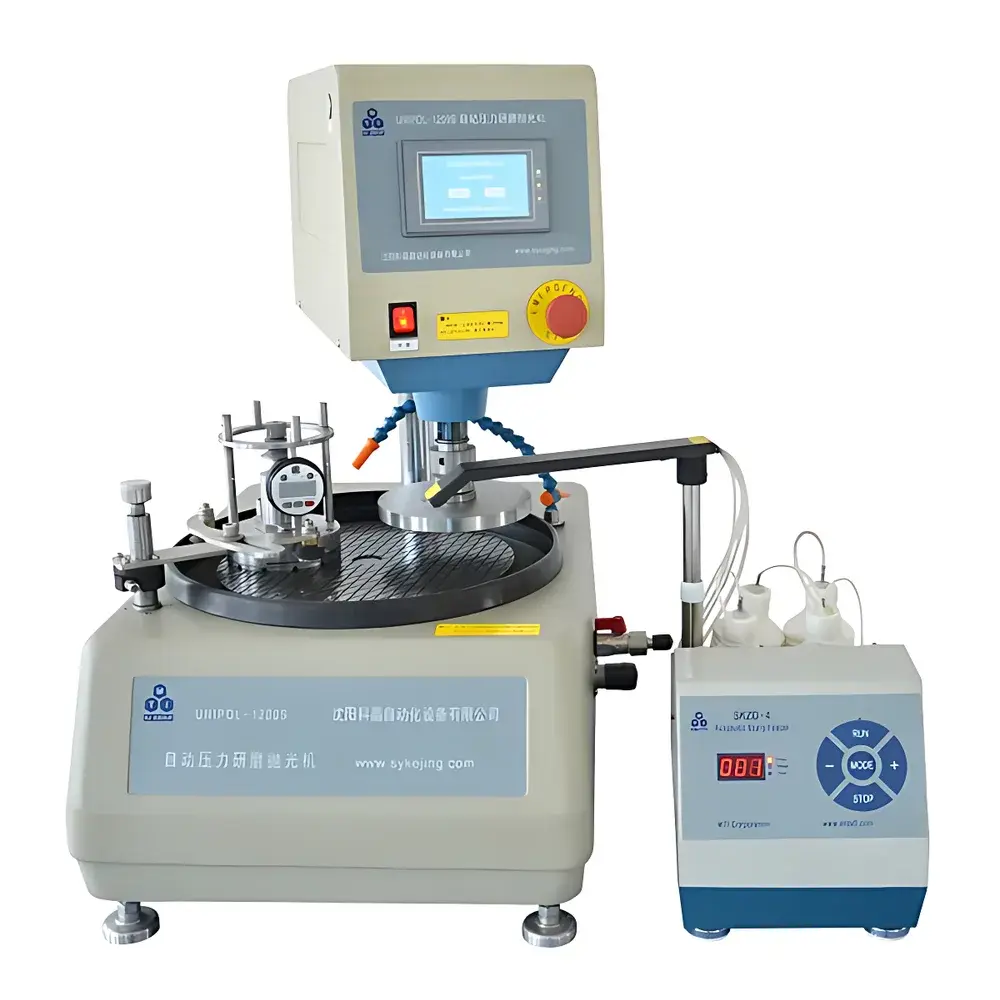
KJ GROUP UNIPOL-1200S Automated Pressure-Controlled Grinding and Polishing System
| Brand | KJ GROUP |
|---|---|
| Origin | Liaoning, China |
| Model | UNIPOL-1200S |
| Dimensions (L×W×H) | 660 mm × 460 mm × 800 mm |
| Grinding/Polishing Plate Count | 1 |
| Plate Diameter | Ø300 mm |
| Rotational Speed Range | 20–240 rpm (10 rpm incremental adjustment) |
| Load Application Method | Mechanical center-loading pressure system |
| Applied Load Range | 0.5–20 kg (programmable) |
| Upper Sample Holder Speed | 10–80 rpm |
| Power Supply | AC 220 V, 50 Hz |
| Total Power Consumption | 550 W |
| Net Weight | ≈95 kg |
| Operating Environment | 0–45 °C, 10–85% RH (non-condensing) |
| Control System | PLC + Touchscreen HMI |
| Compliance | Designed for GLP-compliant sample preparation workflows |
Overview
The KJ GROUP UNIPOL-1200S Automated Pressure-Controlled Grinding and Polishing System is an engineered solution for precision planar surface preparation of hard and brittle materials in research, quality control, and small-batch production environments. It operates on the principle of controlled mechanical abrasion under programmable axial load and synchronized rotational motion—enabling reproducible removal rates, minimal subsurface damage, and high geometric fidelity across diverse specimen types. Unlike manually loaded or spring-based systems, the UNIPOL-1200S employs a rigid mechanical center-loading mechanism that delivers stable, non-drifting force application throughout the entire grinding and polishing cycle. This architecture ensures consistent material removal kinetics essential for quantitative metallography, semiconductor wafer beveling validation, infrared optical substrate finishing (e.g., ZnSe, ZnS, Si, Ge), geological thin-section preparation, and composite interface analysis. The system supports both conventional gravity-loaded and robotic-arm-assisted modes—allowing safe processing of cleavage-prone crystals, layered perovskites, or low-fracture-toughness ceramics without chipping or delamination.
Key Features
- Programmable mechanical pressure loading (0.5–20 kg) with real-time force stability monitoring via calibrated actuation linkage—no hydraulic or pneumatic components required.
- Dual independent drive system: DC motor-driven lower plate (20–240 rpm, 10 rpm increments) and upper sample holder (10–80 rpm), enabling optimized relative velocity profiles for coarse grinding, fine lapping, and final polishing stages.
- Integrated robotic-arm grinding/polishing station (single-position swing arm) for adaptive load distribution—critical for anisotropic or mechanically sensitive specimens such as single-crystal sapphire wafers or polymer-matrix composites.
- PLC-based control architecture with industrial-grade touchscreen HMI, supporting multi-step protocols, time-based termination (up to 999 minutes), and parameter recall for method standardization.
- Modular platen interface accommodating Ø300 mm consumable plates—including cast iron, aluminum, ceramic, glass, and magnetic resin-bonded diamond discs—with optional quick-change tooling kits.
- Standardized mounting for auxiliary modules: automatic slurry dispensers (SKZD series), recirculating coolant pumps (YJXZ-12), precision thickness gauges (SKCH-1A), and heating platforms (HEATER-3040) to support thermal stabilization during extended polishing cycles.
Sample Compatibility & Compliance
The UNIPOL-1200S is validated for use with metallic alloys (Fe-, Al-, Ti-, Ni-based), technical ceramics (Al₂O₃, SiC, Si₃N₄), IR-transmissive crystals (ZnSe, ZnS, CaF₂, Ge), geological specimens (granite, basalt, shale), polymer composites (CFRP, GFRP), and semiconductor substrates (Si, GaAs, sapphire). Its mechanical loading design conforms to ASTM E3-22 “Standard Guide for Preparation of Metallographic Specimens” and ISO 14704:2021 “Metallic materials — Determination of hardness — Instrumented indentation test”, ensuring traceable surface integrity prior to microstructural characterization (SEM, EBSD, TEM lamella preparation). All electrical subsystems meet IEC 61000-6-2/6-4 immunity and emission requirements. The control firmware supports audit trail logging and user-level access control—facilitating alignment with GLP documentation standards and internal SOP enforcement.
Software & Data Management
The embedded HMI provides full-cycle protocol definition: speed ramping profiles, dwell time per stage, load setpoints, and auto-shutdown triggers. While the base unit does not include PC connectivity, optional RS-485 or Ethernet interfaces (via GPC-80A controller add-on) enable integration into centralized lab management systems. Process logs—including actual applied load (derived from motor torque feedback), rotational deviations, elapsed time, and operator ID—are stored locally for ≥10,000 cycles and exportable via USB to CSV format. When paired with FDA 21 CFR Part 11-compliant third-party LIMS software, the system supports electronic signatures, version-controlled method libraries, and change history tracking—meeting regulatory expectations for pharmaceutical excipient particle morphology studies or medical device material qualification.
Applications
- Metallographic specimen preparation for grain size analysis (ASTM E112), inclusion rating (ASTM E45), and phase quantification (ISO 643).
- Surface planarization of IR optics prior to anti-reflective coating deposition—ensuring λ/10 surface flatness repeatability.
- Thin-section fabrication of geological samples for transmitted light microscopy and cathodoluminescence mapping.
- Edge beveling and surface conditioning of silicon carbide power electronics substrates prior to die attach evaluation.
- Controlled abrasion testing of protective coatings (e.g., DLC, AlTiN) using standardized abrasive media and fixed-load conditions.
- Preparation of cross-sectional TEM samples from multilayer battery electrodes (NMC/LiCoO₂/graphite) with minimized ion-beam artifact introduction.
FAQ
What types of consumables are compatible with the UNIPOL-1200S?
Standard consumables include Ø300 mm cast iron grinding plates, aluminum lapping plates, magnetic resin-bonded diamond discs (mesh sizes 80–3000), woven and non-woven polishing cloths (polyurethane, synthetic leather), and water-soluble slurries (SiC, Al₂O₃, diamond suspensions). Custom plate geometries and specialized carriers (e.g., φ105 mm flat gravity holders, φ160 mm quick-clamp chucks) are available upon request.
Is cooling water mandatory during operation?
Yes—continuous tap water flow through the integrated inlet/outlet ports is required to dissipate heat generated at the interface between specimen and abrasive medium, particularly during prolonged high-speed grinding (>180 rpm) or high-load polishing (>12 kg). Failure to maintain coolant flow may accelerate pad degradation and induce thermal warping in thermally sensitive samples.
Can the UNIPOL-1200S be integrated into automated lab workflows?
With optional GPC-80A controller and RS-485/Ethernet module, the system accepts Modbus RTU/TCP commands for remote start/stop, parameter upload, and status polling—enabling synchronization with robotic sample handlers or MES-driven batch scheduling systems.
What safety certifications does the unit carry?
The UNIPOL-1200S complies with GB 4793.1-2019 (Chinese equivalent of IEC 61010-1) for laboratory electrical equipment safety. CE marking is not applicable as the device is manufactured for domestic-market compliance; however, it meets EMC and low-voltage directive functional equivalents when operated within specified environmental limits.
How is calibration maintained over long-term use?
Load calibration is factory-set using traceable dead-weight standards and verified annually via optional recalibration service (KJ GROUP Service Bulletin UNIPOL-CAL-2024). Speed accuracy is maintained via closed-loop DC motor control with encoder feedback; no user-performed speed calibration is required.



