
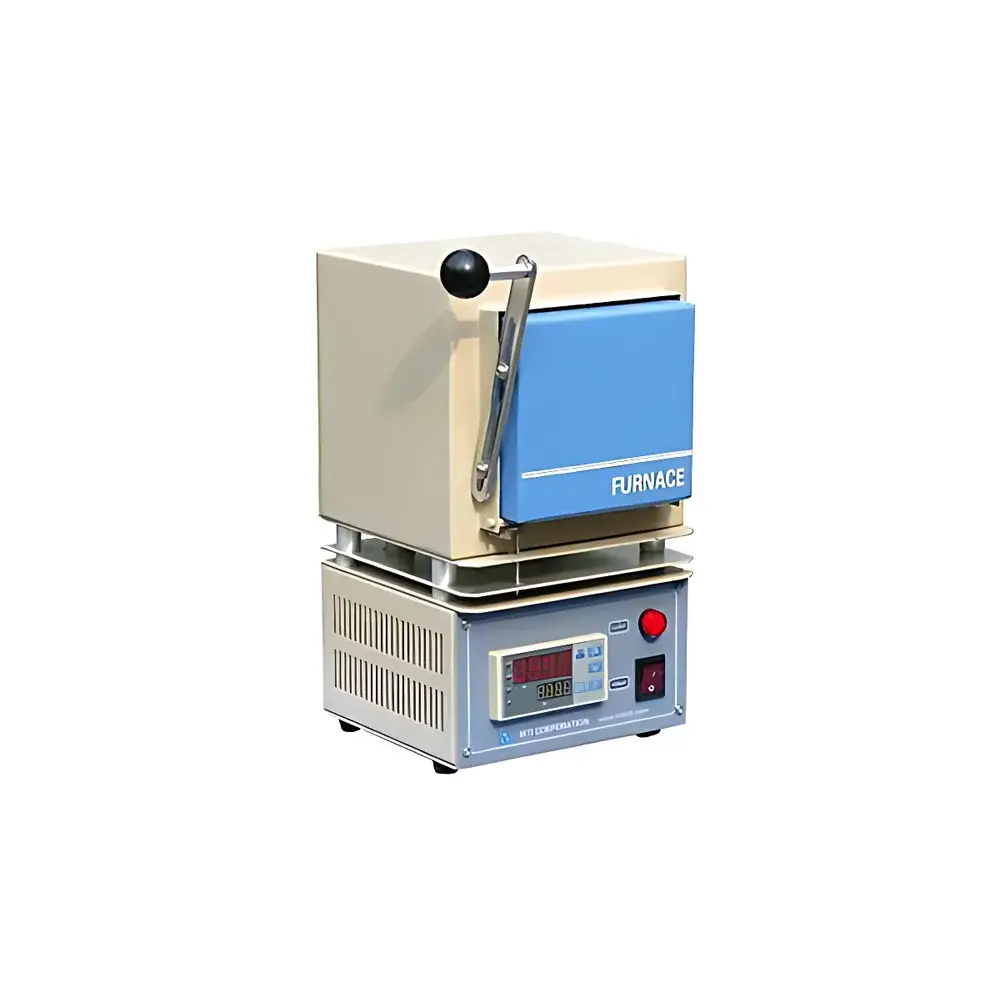
KJ GROUP KSL-1100X-S 1L Mini Benchtop Muffle Furnace (1100°C Max)
| Brand | KJ GROUP |
|---|---|
| Origin | Anhui, China |
| Model | KSL-1100X-S |
| Max Operating Temperature | 1100°C (≤1 h), Continuous Use at 1000°C |
| Temperature Control Accuracy | ±1°C |
| Power Supply | 110V/220V, 50 Hz, 700W / 1 kW |
| Heating Rate | Up to 30°C/min |
| Heating Element | Kanthal A1 Resistance Wire |
| Internal Chamber Dimensions | 100 mm × 100 mm × 100 mm (1 L) |
| Thermocouple Type | K-type |
| Gas Inlet/Outlet | 8 mm barbed fittings |
| Certified | CE |
Overview
The KJ GROUP KSL-1100X-S is a compact, high-performance benchtop muffle furnace engineered for precise thermal processing in research laboratories, materials science departments, and quality control facilities. Designed around resistive heating via high-stability Kanthal A1 alloy wire elements, it delivers uniform temperature distribution across its 1-liter alumina-fiber insulated chamber—enabling reliable heat treatment up to 1100°C for short-duration cycles or sustained operation at 1000°C. Its vertical downward-lifting door architecture minimizes heat loss during sample loading/unloading while integrating a safety interlock that de-energizes the heating circuit upon door opening. The furnace’s thermally optimized cavity—lined with US-sourced high-emissivity alumina coating over polycrystalline mullite fiber insulation—ensures rapid thermal response, low standby power consumption (up to 30% less than comparable units), and extended service life under repeated thermal cycling.
Key Features
- High-efficiency thermal design: Polycrystalline alumina fiber insulation combined with proprietary US-imported alumina reflective coating enhances radiant heat retention and improves heating efficiency.
- Programmable PID temperature controller supporting up to 30 segment ramp-soak profiles, enabling complex thermal protocols including controlled cooling rates.
- Gas-compatible chamber with dual 8 mm barbed ports for inert (N₂, Ar), oxidizing (O₂), or reducing (H₂/N₂ mix) atmospheres—requires external gas regulation system and appropriate tubing.
- CE-certified construction meeting EN 61000-6-3 (EMC) and EN 61000-6-2 (immunity) standards; designed for integration into gloveboxes or vacuum systems (vacuum-rated seal optional).
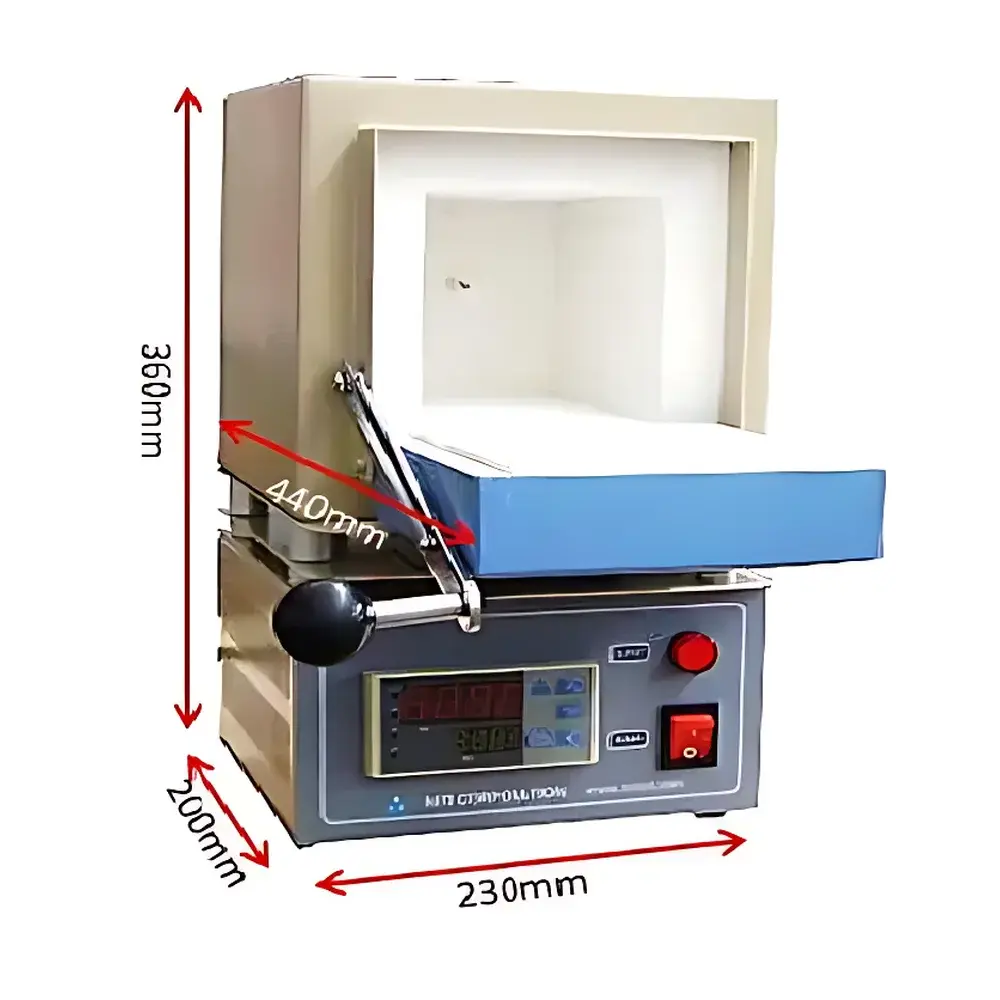
- Compact footprint (200 × 230 × 360 mm) and lightweight chassis (8 kg) facilitate placement on standard lab benches or inside controlled-atmosphere enclosures.
- Integrated safety features: Door-activated cut-off switch, over-temperature protection (independent of main controller), and K-type thermocouple redundancy monitoring.
Sample Compatibility & Compliance
The KSL-1100X-S accommodates standard ceramic crucibles (e.g., Al₂O₃, ZrO₂), quartz boats, and metal substrates up to 80 mm in height or diameter. It complies with ISO/IEC 17025 requirements for calibration traceability when used with NIST-traceable K-type thermocouples. While not intrinsically rated for explosive atmospheres, it may be operated within Class I, Division 2 gloveboxes when configured with compatible gas delivery hardware. Users must avoid introducing flammable, corrosive (e.g., HCl, HF, SO₂), or halogen-containing gases without prior consultation—customized corrosion-resistant lining options are available upon request. The unit supports GLP-compliant documentation workflows when paired with validated data logging software.
Software & Data Management
The built-in PID controller includes RS485 communication interface (Modbus RTU protocol) for integration with LabVIEW, MATLAB, or SCADA platforms. Optional firmware upgrades enable audit-trail functionality compliant with FDA 21 CFR Part 11 requirements—including user access logs, parameter change history, and electronic signature support. Real-time temperature profiles can be exported as CSV files for post-processing and statistical analysis (e.g., ANOVA of thermal homogeneity across multiple runs). Firmware updates are delivered via USB memory stick with version-controlled release notes and validation reports.
Applications
- Materials synthesis: Solid-state reaction sintering of oxides, phosphors, and battery cathode precursors (e.g., LiCoO₂, NMC).
- Metallurgical processing: Annealing of thin-film metallic samples, stress relief of microfabricated components, and grain growth studies.
- Quality assurance: Ash content determination per ASTM D3174, loss-on-ignition (LOI) testing per ISO 1171, and thermal stability screening of polymer composites.
- Academic research: Kinetic modeling of phase transformations, TGA-correlative annealing, and pre-treatment of catalyst supports prior to BET surface area analysis.
- Electronics manufacturing: Reflow simulation for low-temperature solder pastes and thermal aging of passive components.
FAQ
Can this furnace be operated under vacuum?
Yes—when equipped with optional vacuum-rated door gasket and sealed feedthroughs, it achieves base pressures down to 10⁻² mbar using standard two-stage rotary vane pumps.
Is the internal chamber resistant to acidic vapors?
Standard configuration is not acid-resistant; exposure to sulfur- or sodium-containing atmospheres requires custom alumina-zirconia composite lining—contact technical support before deployment.
What is the recommended maintenance schedule?
Inspect insulation integrity and thermocouple calibration every 200 operational hours; recoat interior surface with alumina slurry if microcracking exceeds 0.5 mm width.
Does the unit include data logging capability out-of-the-box?
Basic real-time temperature readout is provided; full interval logging requires optional USB data logger module (KJ-DL-USB) or third-party Modbus-compatible recorder.
Can multiple furnaces be networked for synchronized thermal profiling?
Yes—via RS485 daisy-chaining with master-slave addressing; maximum node count is 32 per bus segment with proper termination and shielding.



