
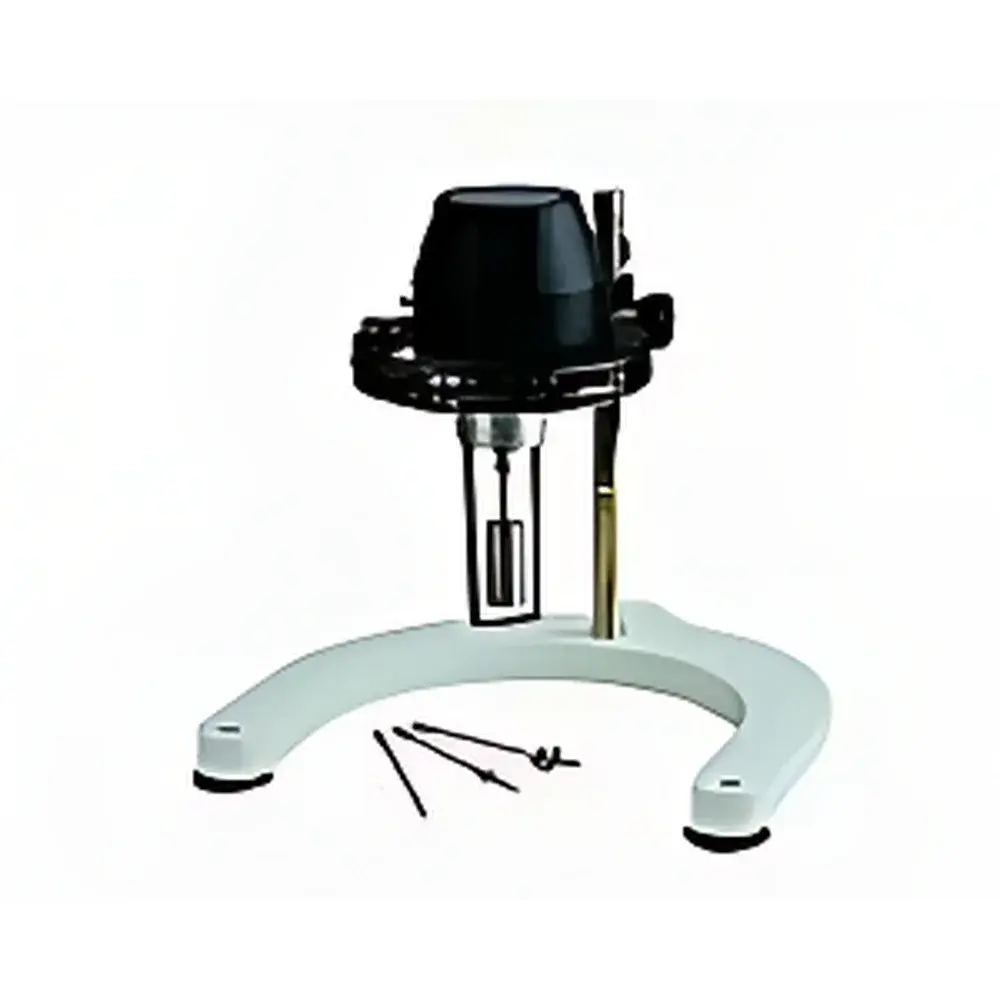
Truelab NDJ-1 Mechanical Rotational Viscometer for Ultra-Low Viscosity Measurement (0.1–100,000 mPa·s)
| Brand | Truelab |
|---|---|
| Origin | Shanghai, China |
| Manufacturer Type | Authorized Distributor |
| Product Category | Domestic |
| Model | NDJ-1 Ultra-Low Viscosity |
| Instrument Type | Benchtop Fixed Rotational Viscometer |
| Operating Environment | Ambient Temperature |
| Viscosity Range | 0.1–2,000,000 mPa·s |
| Speed Settings | 6, 12, 30, 60 rpm (manual gear shift) |
| Accuracy | ±5% (for Newtonian fluids) |
| Spindle Set | #0, #1, #2, #3, #4 |
| Gear Ratio Units | I (1:1), II (1:10, 1:100), III (×0.1, ×0.2, ×0.4, ×0.5) |
| Power Supply | 220 V AC, 50 Hz |
Overview
The Truelab NDJ-1 Mechanical Rotational Viscometer is a precision-engineered benchtop instrument designed for reliable viscosity measurement of Newtonian and near-Newtonian liquids across an extended low-to-mid range—from 0.1 mPa·s to 100,000 mPa·s—when equipped with the optional #0 spindle. Based on classical Couette flow rheometry, the NDJ-1 operates by rotating a calibrated spindle immersed in the sample at defined angular velocities (6, 12, 30, or 60 rpm). The resulting torque is transmitted mechanically via a calibrated spring-and-pointer system, enabling direct analog readout without electronic signal processing. This mechanical architecture ensures long-term stability, minimal drift, and immunity to electromagnetic interference—making it especially suitable for quality control laboratories operating under GLP-compliant workflows where traceability and operational simplicity are prioritized over digital automation.
Key Features
- Mechanical torque-sensing mechanism with analog pointer display—no battery or firmware required
- Dual-range capability via interchangeable spindles (#0 for ultra-low viscosity down to 0.1 mPa·s; #1–#4 for standard ranges up to 100,000 mPa·s)
- Three selectable gear ratio units (I: 1:1; II: 1:10 and 1:100; III: multipliers ×0.1, ×0.2, ×0.4, ×0.5) for optimized sensitivity across orders of magnitude
- Benchtop fixed configuration with robust cast-aluminum housing and precision-machined spindle shaft
- Manual speed selection via mechanical gear lever—no motor controller or software interface needed
- Compliant with ASTM D1084 and ISO 2555 for rotational viscosity testing of polymer solutions, adhesives, coatings, and pharmaceutical suspensions
Sample Compatibility & Compliance
The NDJ-1 accommodates samples requiring minimal volume (≥20 mL typical for #1–#4 spindles; ≥40 mL for #0 spindle) and moderate thermal stability at ambient conditions. It is routinely deployed for routine QC of industrial lubricants, ink formulations, food emulsions (e.g., salad dressings, dairy bases), and aqueous polymer solutions (e.g., PVA, CMC, xanthan gum). While not temperature-controlled internally, the instrument is compatible with external thermostatic baths (e.g., Truelab TC-200 series) and standardized viscosity calibration oils (NIST-traceable standards, e.g., Cannon N-series). Its mechanical design meets basic requirements for ISO/IEC 17025 laboratory accreditation when operated within documented SOPs—including spindle cleaning protocols, zero-point verification, and periodic calibration against reference fluids.
Software & Data Management
As a fully mechanical instrument, the NDJ-1 does not incorporate embedded electronics, data logging, or connectivity features. All measurements are recorded manually in laboratory notebooks or LIMS-compatible spreadsheets. This architecture inherently satisfies regulatory constraints where electronic record integrity is difficult to validate—such as certain USP or pharmacopoeial compendial methods requiring operator-verified analog readings. For laboratories requiring audit trails, users may pair the NDJ-1 with validated manual entry procedures compliant with FDA 21 CFR Part 11 (via handwritten signature + timestamp + witness verification), or integrate it into paper-based GLP documentation systems approved under Annex 11 principles.
Applications
- Batch release testing of low-viscosity solvents, thin resins, and monomer blends in chemical manufacturing
- Consistency verification of topical pharmaceutical gels and ophthalmic solutions per USP
- Routine monitoring of inkjet ink viscosity prior to printing line deployment
- Educational demonstration of Newtonian fluid behavior in university physical chemistry labs
- Stability assessment of colloidal dispersions during shelf-life studies (e.g., silica nanoparticle suspensions)
- Pre-screening of formulation candidates during R&D—especially where rapid, repeatable pass/fail decisions are required without software overhead
FAQ
Does the NDJ-1 support temperature-controlled measurements?
No—the NDJ-1 lacks integrated temperature regulation. Accurate viscosity data at non-ambient temperatures require external thermostatic baths and appropriate spindle immersion depth correction per ISO 3219.
What calibration standards are recommended for routine verification?
NIST-traceable silicone oil standards (e.g., Cannon N2, N10, N100) are recommended for quarterly verification. Calibration must include all spindle/gear combinations used in production testing.
Is the NDJ-1 compliant with GMP documentation requirements?
Yes—when operated under controlled conditions with documented calibration records, operator training logs, and SOPs covering spindle handling and zero adjustment, the NDJ-1 supports GMP-aligned QC environments per EU Annex 15 and ICH Q5C.
Can the #0 spindle be used with all gear units?
The #0 spindle is only compatible with Gear Unit III (multiplier settings ×0.1 to ×0.5) to maintain measurable torque within the instrument’s mechanical range.
How often should mechanical zero-point verification be performed?
Before each testing session—and immediately after spindle change or transport—to ensure baseline accuracy per ASTM D1084 Section 7.2.



