
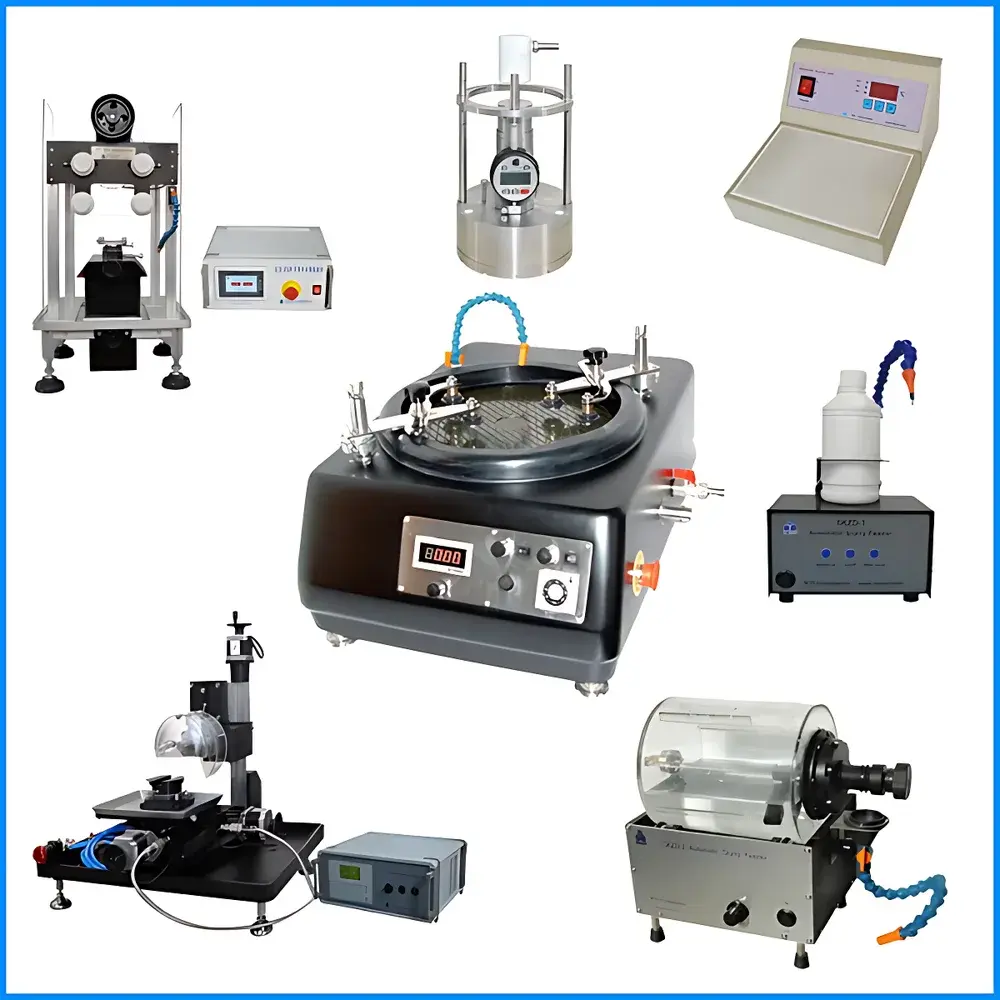
KJ GROUP GPC-1200 Series Integrated脆性材料制样系统 (Ceramic, Glass & Crystal Sample Preparation System – Mid-Tier Configuration)
| Brand | KJ GROUP |
|---|---|
| Origin | Liaoning, China |
| Manufacturer Type | Authorized Distributor |
| Country of Origin | China |
| Model | GPC-1200 Series Integrated脆性材料制样系统 |
| Pricing | Available Upon Request |
| Core Modules | STX-202A Diamond Wire Saw, SYJ-400 CNC Scribing/Cutting Machine, MTI-250 Hot Plate, GPC-100A Precision Lapping/Polishing Controller, UNIPOL-1202 Automated Lapping & Polishing System, SKZD-2 Abrasive Dispenser, SKZD-3 Polishing Slurry Dispenser |
Overview
The KJ GROUP GPC-1200 Series Integrated脆性材料制样系统 is a purpose-engineered, mid-tier laboratory platform designed for reproducible, high-fidelity sample preparation of brittle inorganic materials—including optical crystals (e.g., quartz, sapphire, LiNbO₃), technical ceramics (Al₂O₃, SiC, ZrO₂), borosilicate and fused silica glasses, geological specimens, and hard metals. Unlike generic machining systems, this integrated suite implements a sequential, metrology-aware workflow grounded in controlled material removal mechanics: diamond wire slicing under tension-controlled feed, CNC-guided scribing for stress-free kerf definition, thermally assisted wax bonding for rigid sample fixation, vacuum-assisted sample clamping during lapping/polishing, and closed-loop dispensing of abrasives and slurries to maintain consistent removal rates. The system adheres to the fundamental principles of brittle fracture mechanics and subsurface damage control—critical for downstream characterization via SEM, XRD, TEM, or optical interferometry—where surface integrity, planarity (< 0.1 µm TIR), and minimal subsurface damage (< 50 nm) are non-negotiable.
Key Features
- Modular architecture with interoperable hardware interfaces: All units (cutting, heating, lapping, dispensing) share synchronized timing protocols and mechanical mounting standards for seamless workflow integration.
- GPC-100A Precision Lapping/Polishing Controller: Implements real-time thickness monitoring via capacitive displacement sensing (±0.2 µm resolution) and closed-loop feedback to regulate rotational speed, pressure, and dwell time—enabling layer-by-layer removal control down to sub-micron increments per cycle.
- STX-202A Diamond Wire Saw: Equipped with adjustable wire tension (0.5–3.0 N), programmable feed rate (0.01–5 mm/min), and coolant flow regulation to suppress thermal cracking and micro-chipping in low-toughness materials.
- SYJ-400 CNC Scribing/Cutting Machine: Features 3-axis motion control (X/Y/Z ±0.005 mm repeatability), interchangeable diamond-tipped or carbide tools, and optimized toolpath algorithms for low-stress grooving prior to cleavage or dicing.
- MTI-250 Hot Plate: Provides uniform temperature distribution (±1.5 °C across 250 × 250 mm surface) from ambient to 250 °C, calibrated for consistent wax melting (e.g., Buehler MetPrep™ or Struers Epofix® compatible formulations) and residue-free debonding.
- SKZD-2/SKZD-3 Precision Dispensers: Deliver volumetrically accurate abrasive (e.g., 15 µm Al₂O₃ suspension) and polishing slurry (e.g., colloidal silica, pH 10.5) doses (±1% CV) via peristaltic pumping, synchronized with rotation phase and load profile.
Sample Compatibility & Compliance
The GPC-1200 Series accommodates samples ranging from 5 mm × 5 mm × 0.3 mm wafers to 100 mm diameter × 25 mm thick ingots. It supports ISO 14782:2021 (preparation of ceramic test specimens), ASTM C1327-22 (standard practice for polishing optical glasses), and USP (glass container quality assessment). Vacuum chuck design complies with SEM/TEM specimen mounting requirements (ISO 13706), while coolant containment meets IEC 61000-6-3 EMC emission limits. All wet-process components are constructed from 316 stainless steel and PTFE-lined fluid paths to resist chemical degradation from acidic or alkaline slurries.
Software & Data Management
The integrated control software (v3.2, Windows 10/11 compatible) provides full audit trail functionality compliant with FDA 21 CFR Part 11: electronic signatures, user-level access controls (admin/operator/technician roles), immutable operation logs (timestamp, parameter set, operator ID, error codes), and exportable CSV/Excel reports for GLP/GMP documentation. Process recipes—including feed profiles, temperature ramps, dispensing schedules, and endpoint criteria—are version-controlled and recallable. Raw sensor data (capacitance, torque, flow rate) is logged at 10 Hz and archived in HDF5 format for traceable post-analysis.
Applications
- Preparation of TEM lamellae from single-crystal sapphire substrates with minimized amorphous layer thickness.
- Routine cross-sectional polishing of multilayer glass-ceramic composites (e.g., Gorilla Glass® variants) for interfacial defect analysis.
- High-yield wafer dicing of piezoelectric LiTaO₃ crystals without edge chipping for SAW device fabrication.
- Standardized lapping of geological thin sections (rock/mineral) meeting Petrographic Microscopy Society (PMS) thickness specifications (30 ± 2 µm).
- Reproducible surface planarization of YAG laser gain media prior to HR coating deposition.
FAQ
Does the GPC-1200 Series support automated recipe transfer between instruments?
Yes—via Ethernet-connected OPC UA server; all modules expose standardized UA nodes for process parameters, status flags, and alarm conditions.
What vacuum level does the GPC-100A chuck achieve, and is it suitable for porous ceramics?
The system delivers ≥85 kPa (absolute) vacuum using a diaphragm pump; optional porous-sample adapter plates with distributed micro-vacuum channels are available for low-permeability specimens.
Can the SKZD-3 dispenser handle abrasive-free colloidal silica slurries without clogging?
Yes—the 0.8 mm internal diameter fluoropolymer tubing and pulse-free peristaltic drive prevent particle aggregation and ensure stable delivery of 50 nm SiO₂ suspensions at flow rates from 0.1 to 5 mL/min.
Is calibration documentation provided for metrological traceability?
Each unit ships with NIST-traceable calibration certificates for displacement sensors (GPC-100A), temperature sensors (MTI-250), and flow meters (SKZD-2/SKZD-3), valid for 12 months.
What maintenance intervals are recommended for long-term reliability?
Wire saw guide blocks: every 200 operational hours; lapping plate conditioning: before each new material batch; vacuum filter replacement: quarterly or after 500 hr runtime—detailed service logs are embedded in the software.



