
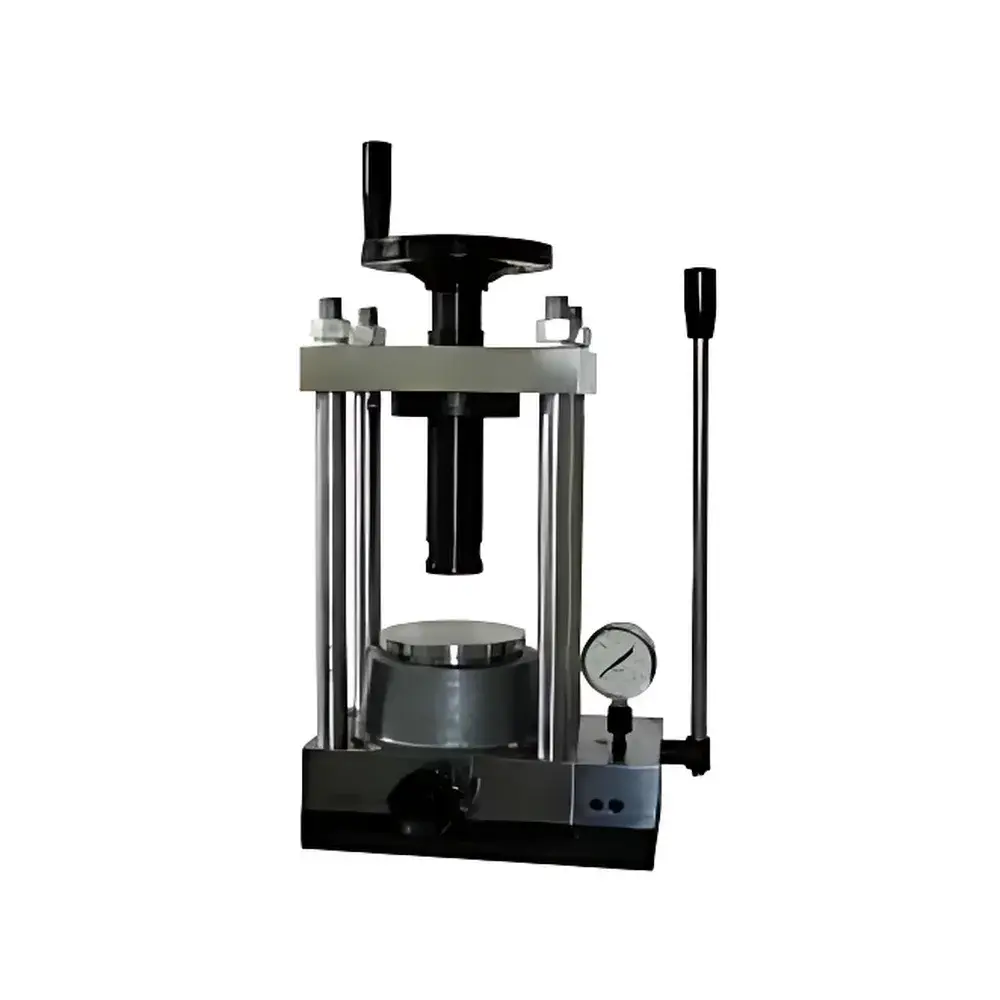
KJ GROUP YLJ-40T Manual Hydraulic Pellet Press
| Brand | KJ GROUP |
|---|---|
| Origin | Liaoning, China |
| Manufacturer Type | Authorized Distributor |
| Country of Origin | China |
| Model | YLJ-40T |
| Instrument Type | Manual Hydraulic Pellet Press |
| Maximum Pressure | 40 T (392 kN) |
| Gauge Pressure Range | 0–33.3 MPa |
| Piston Diameter | Ø100 mm |
| Piston Stroke | 40 mm |
| Pressure Stability | ≤1 MPa/5 min |
| Working Chamber Dimensions | 180 mm × 180 mm × 210 mm |
| Overall Dimensions | 350 mm × 260 mm × 620 mm |
| Net Weight | 100 kg |
Overview
The KJ GROUP YLJ-40T Manual Hydraulic Pellet Press is a precision-engineered laboratory press designed for reproducible, high-force sample compaction under controlled mechanical loading. It operates on the principle of manual hydraulic force multiplication—lever-actuated fluid displacement generates uniform compressive stress across the sample surface via a robust Ø100 mm piston. With a rated maximum load of 40 metric tons (392 kN), the press delivers stable, non-pulsating pressure up to 33.3 MPa gauge pressure, enabling consistent pellet formation for quantitative spectroscopic and elemental analysis. Its compact footprint (350 × 260 × 620 mm) and 100 kg mass ensure structural rigidity without requiring anchoring, making it suitable for benchtop deployment in analytical labs, materials R&D centers, and university teaching facilities.
Key Features
- Manual hydraulic actuation with ergonomic lever mechanism ensures rapid pressure build-up and controlled, smooth decompression—typical pressurization time to full 40 T is under 60 seconds.
- Sealed hydraulic circuit with high-grade O-ring seals and low-viscosity ISO VG 32 hydraulic oil minimizes leakage risk; pressure retention remains within ≤1 MPa drift over any 5-minute holding period at maximum load.
- Stable force transmission achieved through hardened steel frame, precision-machined guide columns, and concentric piston alignment—ensuring parallelism tolerance < ±0.02 mm across full stroke (40 mm).
- Open-top working chamber (180 × 180 × 210 mm H) accommodates standard die sets—including ASTM E1757-compliant stainless-steel dies—and permits real-time visual monitoring during compression.
- No electrical or pneumatic dependencies: fully mechanical operation eliminates electromagnetic interference, supports use in explosion-proof or low-power environments, and complies with IEC 61000-6-2 immunity requirements for laboratory equipment.
Sample Compatibility & Compliance
The YLJ-40T supports diverse powder-based sample matrices including ceramic oxides (e.g., Al₂O₃, ZrO₂), battery cathode precursors (LiCoO₂, NMC), catalyst supports (γ-Al₂O₃, SiO₂), metallurgical powders (Fe, Cu, W), and geological standards (rock powders, soil digests). Compatible with industry-standard die geometries (Ø10–32 mm flat-faced, stepped, or cavity dies), it enables preparation of pellets meeting ISO 12885 (XRF pellet standards), ASTM C114 (cement analysis), and USP (pharmaceutical tablet hardness testing protocols). All wetted components are 304 stainless steel or hard-anodized aluminum, ensuring chemical inertness during acid-digestion residue pressing. The press conforms to EN 692:2005 (mechanical press safety) and carries CE marking per Machinery Directive 2006/42/EC.
Software & Data Management
As a manually operated hydraulic system, the YLJ-40T does not incorporate embedded electronics or digital control. However, it integrates seamlessly into GLP/GMP workflows through traceable mechanical calibration: each unit ships with a NIST-traceable pressure calibration certificate (valid for 12 months), documenting force vs. gauge reading correlation across 0–40 T in 5-T increments. Users may log compression parameters (target load, dwell time, die ID, ambient temperature/humidity) in LIMS-compatible spreadsheets or ELN platforms. Optional analog pressure gauge upgrades (0–40 MPa, Class 0.25 accuracy per EN 837-1) support audit-ready manual recording aligned with FDA 21 CFR Part 11 Annex 11 data integrity principles.
Applications
- X-ray fluorescence (XRF) sample preparation: production of homogeneous, binder-free pressed pellets from fused or milled powders for major/minor element quantification.
- Infrared (FTIR) spectroscopy: fabrication of KBr or polyethylene dispersion pellets with minimal scattering artifacts and optimal transparency in 4000–400 cm⁻¹ range.
- Battery material R&D: densification of cathode/anode slurries for electrochemical impedance spectroscopy (EIS) substrate evaluation.
- Catalyst characterization: cold compaction of supported metal oxide powders prior to BET surface area or TPR analysis.
- Geochemical reference material certification: reproducible pellet formation for inter-laboratory round-robin studies under ISO/IEC 17043 guidelines.
FAQ
What is the recommended maintenance schedule for the hydraulic system?
Perform oil level inspection before each use; replace ISO VG 32 hydraulic oil annually or after 500 operating cycles. Clean filter elements quarterly and verify seal integrity during oil changes.
Can the YLJ-40T be used with evacuated or heated dies?
Yes—its open-frame design allows integration with vacuum-assisted die holders (up to 10⁻² mbar) and externally heated platens (max. 200 °C); however, thermal expansion compensation must be applied manually per ASTM E29.
Is third-party calibration available post-warranty?
KJ GROUP’s ISO/IEC 17025-accredited service center provides biannual recalibration with uncertainty reporting per ISO/IEC 17025:2017 Clause 6.5.
Does the press meet requirements for pharmaceutical QC laboratories?
While not GMP-certified as a standalone system, its mechanical repeatability (±0.8% RSD at 30 T, n=10) and documentation traceability support use in pharmaceutical excipient and API pellet preparation per ICH Q5E and USP .
How is force accuracy verified during routine operation?
Users perform daily zero-point verification and cross-check gauge readings against certified deadweight tester values at three points (10 T, 25 T, 40 T) per ASTM E4-22 Section 8.3.



