
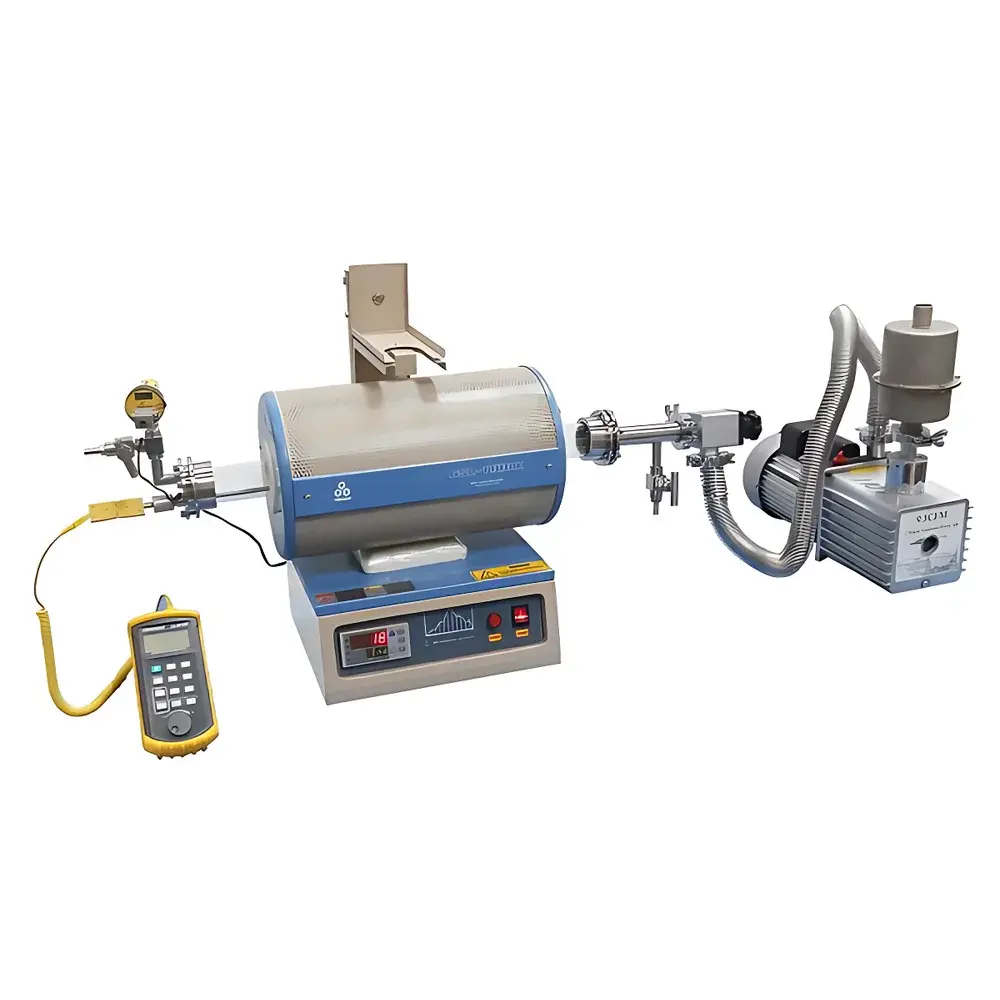
KJ GROUP GSL-1100X-50-LVT Split-Type Vacuum Tube Furnace with Integrated Temperature Calibration System
| Brand | KJ GROUP |
|---|---|
| Origin | Liaoning, China |
| Manufacturer Type | Authorized Distributor |
| Product Origin | Domestic (China) |
| Model | GSL-1100X-50-LVT |
| Price | Upon Request |
| Max Temperature | 1100 °C |
| Operating Temperature | ≤1000 °C |
| Heating Zone | 200 mm |
| Uniform Zone | 100 mm |
| Heating Rate | ≤20 °C/min |
| Control | 30-Stage Programmable PID Controller |
| Thermocouple | K-Type (Calibrated,铠装, 305 mm) |
| Temperature Accuracy | ±1 °C |
| Vacuum System | Dual-Stage Rotary Vane Pump (226 L/min, 220 V) |
| Ultimate Vacuum | 1×10⁻² torr |
| Tube Dimensions | Φ50 mm × 600 mm (ID Φ43 mm) |
| Insulation | High-Purity Al₂O₃ Polycrystalline Fiber |
| Power | 1.2 kW |
| Voltage/Frequency | AC 220 V / 50 Hz |
| Calibration Instrument | Portable Digital Temperature Calibrator (K-Type, ≤1335 °C) |
Overview
The KJ GROUP GSL-1100X-50-LVT is a split-type high-temperature vacuum tube furnace engineered for precision thermal processing in materials science, thin-film synthesis, and controlled-atmosphere annealing applications. It operates on resistive heating via molybdenum-doped Fe-Cr-Al alloy elements embedded within a high-purity polycrystalline alumina fiber insulation chamber—ensuring low thermal mass, rapid response, and exceptional temperature uniformity across its 100 mm isothermal zone. The furnace integrates a traceable temperature calibration architecture: a calibrated K-type armored thermocouple is inserted directly into the quartz tube through the left-side flange, interfacing with an OMEGA digital temperature indicator for real-time, in-situ sample-zone monitoring. This configuration supports ISO/IEC 17025-aligned thermal validation protocols when used with the included portable digital temperature calibrator (rated to 1335 °C), enabling laboratory-grade verification of thermal profiles without external reference probes. Designed for compatibility with CVD, annealing, sintering, and reduction processes, the system maintains operational integrity under vacuum down to 1×10⁻² torr—though sustained operation above this threshold is restricted to prevent quartz tube deformation or seal degradation.
Key Features
- Split-body architecture enables safe, tool-free access to the hot zone during cooldown—reducing maintenance downtime and improving workflow efficiency in shared lab environments.
- 30-segment programmable PID temperature controller with ramp-soak profiles, over-temperature cutoff, and thermocouple break detection—fully compliant with GLP documentation requirements for thermal process validation.
- High-density polycrystalline alumina fiber insulation (≥1700 °C rated) minimizes radial heat loss and ensures stable ambient surface temperatures (<60 °C at 1000 °C operation), meeting IEC 61000-3-2 harmonic emission standards.
- Integrated OMEGA temperature display unit with dual-input capability (process + calibration channels) supports simultaneous readout of furnace setpoint and verified thermocouple output—facilitating real-time deviation tracking per ASTM E2882-22 guidelines.
- CE-marked design includes reinforced stainless-steel vacuum flanges, KF-25 compatible sealing hardware, and a 226 L/min dual-stage rotary vane pump with integrated oil mist filter—ensuring repeatable vacuum establishment and hydrocarbon-free chamber conditions.
Sample Compatibility & Compliance
The GSL-1100X-50-LVT accommodates standard Φ43 mm ID quartz tubes (supplied as Φ50 mm OD × 600 mm length), suitable for powder samples, substrates up to 40 mm diameter, and wafer-scale specimens. Its vacuum-rated construction complies with ISO 2740:2019 (vacuum equipment safety) and EN 61000-6-3 (EMC emissions). The furnace meets CE Directive 2014/35/EU (Low Voltage) and 2014/30/EU (EMC), and its control firmware supports audit-trail generation for FDA 21 CFR Part 11–aligned environments when paired with validated data acquisition software. All electrical grounding, ventilation, and ambient condition specifications (altitude ≤1000 m; ambient 10–40 °C; RH 45–65%) are defined per IEC 60068-2-1/2 environmental testing standards.
Software & Data Management
While the furnace operates via standalone hardware controls, its analog voltage output (0–5 V) and RS485 Modbus RTU interface enable integration with third-party SCADA platforms (e.g., LabVIEW, Ignition, or Delta Tau PMAC). Temperature logging—including setpoint, actual reading, and alarm status—is supported at user-defined intervals (1–60 s) using optional USB data loggers compliant with NIST-traceable timestamping. Calibration records generated with the portable digital calibrator adhere to ISO/IEC 17025 clause 6.6 (measurement traceability), and raw thermocouple voltage outputs can be post-processed using ITS-90 polynomial coefficients for uncertainty propagation analysis.
Applications
- Controlled-atmosphere annealing of transition metal oxides (e.g., LiCoO₂, Ni-rich NMC cathodes) under inert or reducing gas flows.
- Thermal decomposition studies of MOFs and precatalysts under dynamic vacuum ramping (10⁻² → 10⁰ torr).
- Graphene and TMD monolayer growth via low-pressure CVD using pre-calibrated thermal gradients.
- Pre-sintering of ceramic green bodies prior to HIP or spark plasma sintering—leveraging the 100 mm uniform zone for dimensional stability.
- Accelerated aging tests of encapsulation materials per IPC-9701A thermal cycling profiles (−40 °C to 1000 °C).
FAQ
What is the maximum allowable vacuum level during heating?
Operation above 1×10⁻² torr while at or above 800 °C may induce quartz tube creep or flange seal failure. Maintain vacuum ≤10⁻² torr throughout the heating cycle.
Can the furnace be used for hydrogen atmosphere processing?
Yes—provided appropriate leak-tested stainless-steel tubing, explosion-proof fittings, and H₂-compatible pressure regulators are installed upstream of the KF-25 inlet. A dedicated H₂ purge protocol (3× volume exchange) is required before ramping.
Is the included OMEGA meter NIST-traceable?
The unit ships with factory calibration; NIST-traceable certificate (with uncertainty budget) is available upon request at time of order.
How is temperature uniformity verified across the 100 mm zone?
Uniformity is validated per ASTM E220-21 using three calibrated K-type thermocouples positioned at center, +50 mm, and −50 mm along the tube axis—results documented in the出厂 calibration report.
Does the system support remote monitoring via Ethernet or Wi-Fi?
No native Ethernet/Wi-Fi module is included; however, the RS485 port allows connection to industrial gateways (e.g., Moxa EDS-G205A) for secure TLS-enabled cloud telemetry deployment.



