
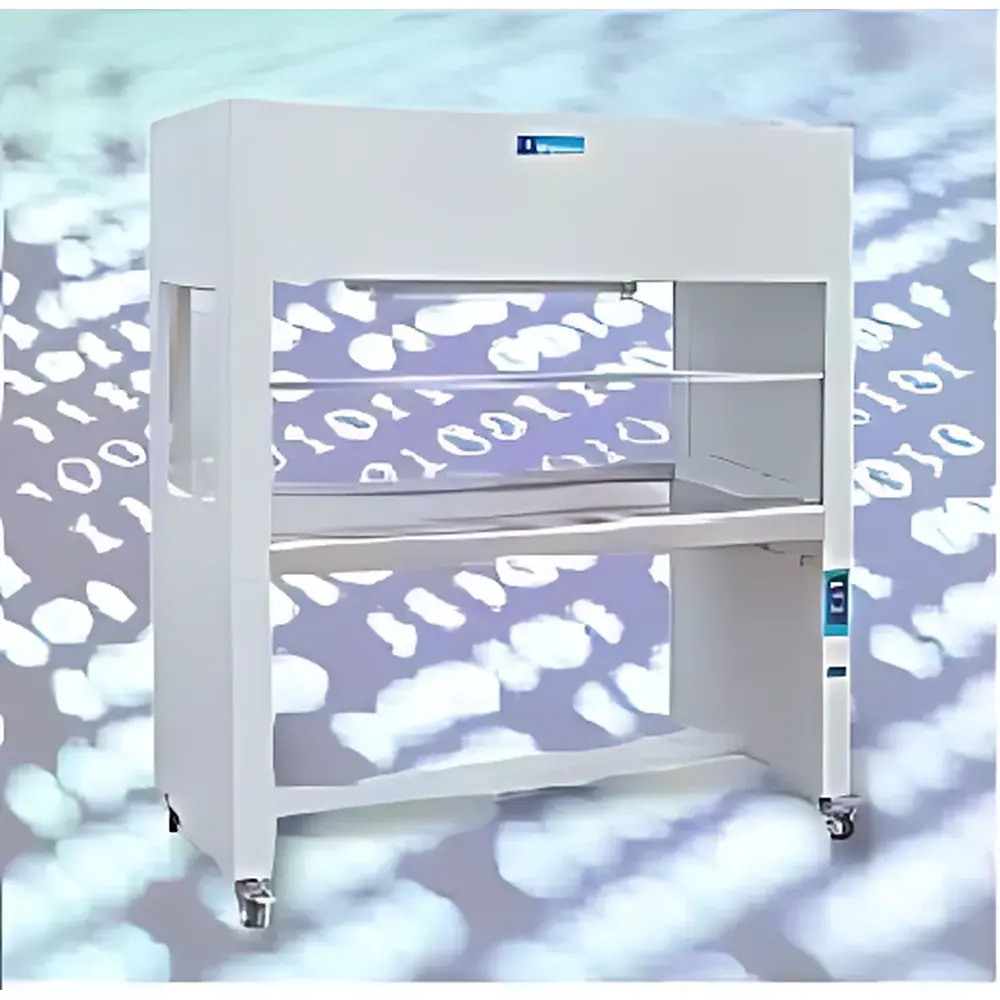
Truelab SW-CJ-1FD Single-Person Dual-Access Vertical Laminar Flow Clean Bench
| Brand | Truelab |
|---|---|
| Origin | Shanghai, China |
| Model | SW-CJ-1FD |
| Airflow Type | Vertical Laminar Flow |
| Cleanliness Class | ISO Class 5 (equivalent to Federal Standard 209E Class 100 @ ≥0.5 µm) |
| Average Air Velocity | 0.3–0.6 m/s (adjustable via 8-step digital control) |
| Noise Level | ≤62 dB(A) |
| Illumination | ≥300 lx |
| Microbial Recovery | ≤0.5 CFU/plate·hour (φ90 mm Petri dish) |
| Vibration Half-Peak | ≤3 µm (X/Y/Z axes) |
| Power Supply | AC 220 V / 50 Hz |
| Power Consumption | 0.3 kW |
| Net Weight | 200 kg |
| Work Area Dimensions | 1300 × 700 × 520 mm (W × D × H) |
| Overall Dimensions | 1460 × 700 × 1650 mm (W × D × H) |
| HEPA Filter Specification | 600 × 600 × 100 mm × 2 units |
| Fluorescent Lamp | 20 W × 1 |
| UV Germicidal Lamp | 20 W × 1 |
Overview
The Truelab SW-CJ-1FD is a single-person, dual-access vertical laminar flow clean bench engineered for reliable particulate and microbial containment in non-sterile but particle-sensitive laboratory workflows. It operates on the principle of unidirectional vertical airflow: ambient air is drawn through a pre-filter, conditioned by a centrifugal blower, and then passed sequentially through medium-efficiency and high-efficiency particulate air (HEPA) filters—meeting ISO 14644-1 Class 5 performance criteria (equivalent to U.S. Federal Standard 209E Class 100 for particles ≥0.5 µm). This validated airflow architecture ensures continuous downward laminar flow across the entire work surface, minimizing turbulence-induced cross-contamination and protecting both samples and operators from ambient airborne particulates. Designed for routine microbiological handling, cell culture preparation, reagent dispensing, and pharmaceutical aseptic sampling—where full ISO Class 5 biosafety cabinet-level protection is not mandated—the SW-CJ-1FD delivers reproducible environmental control without recirculating exhaust air into the lab space.
Key Features
- Intelligent microprocessor-based control system with power-failure memory: retains setpoints (air velocity, lighting, UV timer) and resumes operation automatically after interruption.
- Dual-access configuration enables simultaneous front-and-side operator access—optimized for collaborative or multi-step benchtop procedures without compromising airflow integrity.
- Vertically oriented, quasi-enclosed work chamber with counterweighted sash: permits smooth, tool-free positioning at any height between fully closed and fully open, enhancing ergonomic flexibility and workflow continuity.
- High-visibility 8-segment LED display showing real-time air velocity (0.3–0.6 m/s range), calibrated per ISO 14644-3 Annex B for uniformity verification.
- Corrosion-resistant construction: cold-rolled steel outer casing with electrostatic epoxy coating; mirror-finish 304 stainless steel work surface for easy decontamination and long-term chemical resistance.
- Dedicated, independently switched 20 W fluorescent lamp (≥300 lx at work surface) and 20 W UV-C germicidal lamp (254 nm), both compliant with IEC 62471 photobiological safety requirements.
Sample Compatibility & Compliance
The SW-CJ-1FD supports open-vessel operations involving non-hazardous biological materials (e.g., bacterial cultures, plant tissue explants, media plates), low-risk pharmaceutical intermediates, and precision instrumentation calibration. It is not suitable for handling volatile organic solvents, radioactive isotopes, or pathogenic agents requiring biosafety level 2 (BSL-2) containment. The unit complies with ISO 14644-1:2015 (Cleanrooms and associated controlled environments), ISO 14644-3:2019 (Test methods), and EN 12464-1:2021 (Lighting of indoor workplaces). All electrical components meet IEC 61010-1 safety standards for laboratory equipment. While not certified to NSF/ANSI 49 or EN 12469, its documented performance data—including microbial recovery ≤0.5 CFU/plate·hour (per ISO 14698-1 Annex A using φ90 mm settle plates)—supports GLP-aligned documentation for internal quality assurance protocols.
Software & Data Management
The SW-CJ-1FD operates via embedded firmware with no external software dependency. All operational parameters—including air velocity setpoint, UV exposure duration, lighting status, and runtime hours—are stored in non-volatile memory with timestamped event logging (power-on/off, UV activation, sash position changes). Audit trails are accessible via front-panel menu navigation and exportable via optional RS-232 interface (available as field-upgrade kit) for integration into facility-wide environmental monitoring systems compliant with FDA 21 CFR Part 11 requirements. No cloud connectivity or proprietary drivers are required; data output follows standard ASCII serial format compatible with LabVantage, Empower, or custom SCADA platforms.
Applications
- Preparation of sterile culture media and dilution series in academic and industrial microbiology labs.
- Aseptic transfer of non-pathogenic cell lines during routine passaging and cryopreservation workflows.
- Weighing and dispensing of active pharmaceutical ingredients (APIs) under controlled particulate conditions—supporting ICH Q5A and USP environmental monitoring expectations.
- Assembly and testing of optical sensors, MEMS devices, and semiconductor prototypes where sub-micron particulate exclusion is critical.
- Calibration of particle counters, aerosol generators, and air sampling pumps in metrology laboratories.
FAQ
What is the difference between SW-CJ-1F and SW-CJ-1FD models?
The SW-CJ-1F is a single-access (front-only) configuration with one HEPA filter (820 × 600 × 100 mm) and lower power consumption (0.15 kW); the SW-CJ-1FD features dual-access capability, two HEPA filters (600 × 600 × 100 mm each), higher structural mass (200 kg), and integrated side-panel airflow management.
Does this unit meet ISO Class 5 certification requirements?
Yes—performance validation per ISO 14644-1:2015 confirms sustained ≥99.99% particle removal efficiency for ≥0.5 µm particles at specified airflow velocity, achieving ISO Class 5 (Class 100) in the work area when operated within manufacturer-specified environmental conditions (temperature 15–30°C, humidity ≤70% RH).
Can the UV lamp be interlocked with the sash position?
No—UV activation is manually initiated via dedicated switch; however, the unit includes an audible alarm and visual indicator that activates if UV is energized while the sash is open above 100 mm, supporting safe operational practice per ANSI/IES RP-27.1-22.
Is HEPA filter replacement supported in-house?
Yes—filter access panels are tool-free; replacement procedure requires only basic PPE (gloves, safety glasses) and adherence to ISO 14644-3 Annex D protocols. Filter integrity testing (DOP/PAO scan) is recommended post-replacement and annually thereafter.
What maintenance intervals are recommended?
Pre-filters should be cleaned weekly; HEPA filters replaced every 18–24 months depending on ambient air quality; blower impeller inspected biannually; UV lamp output verified quarterly using calibrated radiometer (254 nm wavelength). Full preventive maintenance checklist available in English-language service manual (P/N: SW-CJ-1FD-SM-EN Rev. 3.1).



