
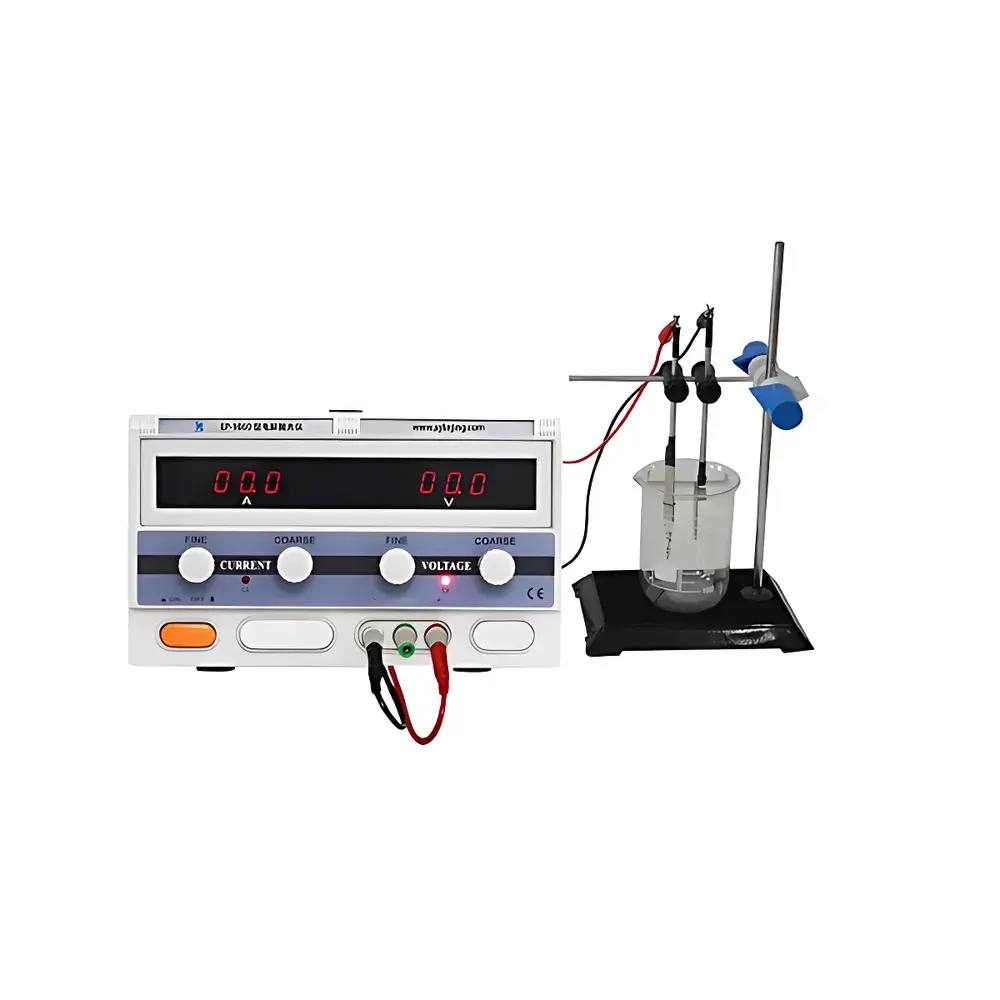
KJ GROUP EP-1060 Electrolytic Polishing and Etching Unit
| Brand | KJ GROUP |
|---|---|
| Origin | Liaoning, China |
| Manufacturer Type | Authorized Distributor |
| Country of Origin | China |
| Model | EP-1060 |
| Price | Upon Request |
| Input Voltage | 220 VAC ±10%, 50 Hz |
| Output Voltage Range | 0–60 VDC |
| Output Current Range | 0–10 ADC |
| Voltage Resolution | 10 mV |
| Current Resolution | 1 mA |
| Operating Environment | 0–40 °C, RH <90% |
| Dimensions (L×W×H) | 520 × 260 × 400 mm |
| Weight | 10 kg |
| Included Accessories | Stainless Steel Cathode Plate (50×20×5 mm), Sample Clip, 250 mL Beaker, Sample Holder Stage, Pair of Petri Dishes |
Overview
The KJ GROUP EP-1060 Electrolytic Polishing and Etching Unit is a compact, benchtop electrochemical instrument engineered for precise surface preparation of metallic specimens in metallurgical and materials science laboratories. It operates on the principle of controlled anodic dissolution in an electrolyte bath—where the specimen serves as the anode and a stainless steel cathode provides counter-electrode functionality. This process enables selective removal of surface material without introducing mechanical deformation, eliminating the subsurface damage inherent to mechanical grinding and polishing. The EP-1060 supports both electropolishing (for mirror-finish surface smoothing and oxide layer removal) and electrochemical etching (for microstructural revelation), making it suitable for routine metallographic sample preparation across ferrous and non-ferrous alloys, including stainless steels, aluminum, titanium, copper, and nickel-based superalloys.
Key Features
- Wide-range, continuously adjustable DC output: 0–60 V and 0–10 A, enabling optimization for diverse alloy systems and electrolytes (e.g., perchloric acid–ethanol for austenitic steels, oxalic acid for aluminum).
- High-resolution digital display showing real-time voltage and current simultaneously—eliminating manual meter switching and reducing operator error.
- Stable voltage and current regulation with low ripple (<0.5% RMS), ensuring reproducible material removal rates and consistent surface finish across replicate samples.
- Compact footprint (520 × 260 × 400 mm) and lightweight design (10 kg), facilitating deployment in space-constrained labs, teaching environments, field-mobile research setups, or quality control stations on production floors.
- Integrated safety features include over-current protection, thermal shutdown, and polarity-reversal prevention—compliant with IEC 61010-1 requirements for laboratory electrical equipment.
Sample Compatibility & Compliance
The EP-1060 accommodates standard metallographic specimens up to 50 mm in diameter or width, secured via the included stainless steel sample clip and holder stage. Its open-bath configuration allows compatibility with common laboratory glassware (e.g., 250 mL beakers, Petri dishes) and optional accessories such as temperature-controlled magnetic stirrers (e.g., SFM-200T) for maintaining electrolyte homogeneity and thermal stability during extended runs. The unit supports standardized metallographic workflows aligned with ASTM E3, ISO 3887, and GB/T 13298—ensuring traceability and inter-laboratory comparability. While not certified for GLP or GMP environments out-of-the-box, its stable output parameters and documented repeatability support validation protocols required under ISO/IEC 17025-accredited testing laboratories.
Software & Data Management
The EP-1060 is a manually operated analog-digital hybrid instrument with no embedded firmware or proprietary software interface. All operational parameters are set and monitored via front-panel controls and dual LED displays. For documentation and audit purposes, users may record voltage, current, time, electrolyte composition, and ambient conditions in laboratory notebooks or LIMS-compatible spreadsheets. No data logging, USB export, or remote control capability is provided; however, the device’s stability and repeatability make it suitable for integration into validated SOPs where manual parameter entry and visual verification meet regulatory expectations (e.g., internal QC procedures compliant with ISO 9001 or AS9100).
Applications
- Routine electropolishing of stainless steel, aluminum, and titanium alloys prior to SEM/EBSD analysis to eliminate deformation-induced artifacts.
- Controlled electrochemical etching of multiphase alloys (e.g., duplex stainless steels, Al–Si castings) to reveal grain boundaries, precipitates, and phase distributions.
- Preparation of transmission electron microscopy (TEM) foils via twin-jet electropolishing when coupled with appropriate fixtures (not included).
- Teaching laboratories: Demonstrating Faraday’s laws of electrolysis, polarization behavior, and the relationship between current density and surface morphology.
- Field-deployable microstructure assessment in offshore, aerospace, or power generation maintenance programs where portability and battery-independent AC operation are critical.
FAQ
What electrolytes are compatible with the EP-1060?
Common electrolytes include perchloric acid–ethanol (for austenitic steels), oxalic acid–water (for aluminum), phosphoric acid–glycerol (for copper), and chromic acid–sulfuric acid mixtures (for nickel alloys). Always consult material-specific ASTM or ISO standards and observe local chemical handling regulations.
Can the EP-1060 be used for TEM foil preparation?
Yes—when paired with a dedicated twin-jet or wedge-type polisher fixture (sold separately), the EP-1060’s stable 0–10 A output supports controlled thinning of conductive metallic foils to electron transparency.
Is the unit compatible with temperature-controlled electrolyte baths?
Yes. Its open-bath design allows seamless integration with external thermostatic stirrers such as the optional SFM-200T, enabling precise thermal management essential for reproducible etch kinetics.
Does the EP-1060 comply with FDA 21 CFR Part 11?
No—it lacks electronic audit trail, user authentication, or data export functionality required for Part 11 compliance. It is intended for research, education, and non-GxP industrial QA applications.
What maintenance is required?
Routine cleaning of electrode contacts, periodic inspection of wiring integrity, and replacement of electrolyte-contaminated components (e.g., cathode plates) per usage frequency. No calibration certificate is supplied; users should verify output accuracy annually using calibrated multimeters traceable to NIST or equivalent national standards.



