
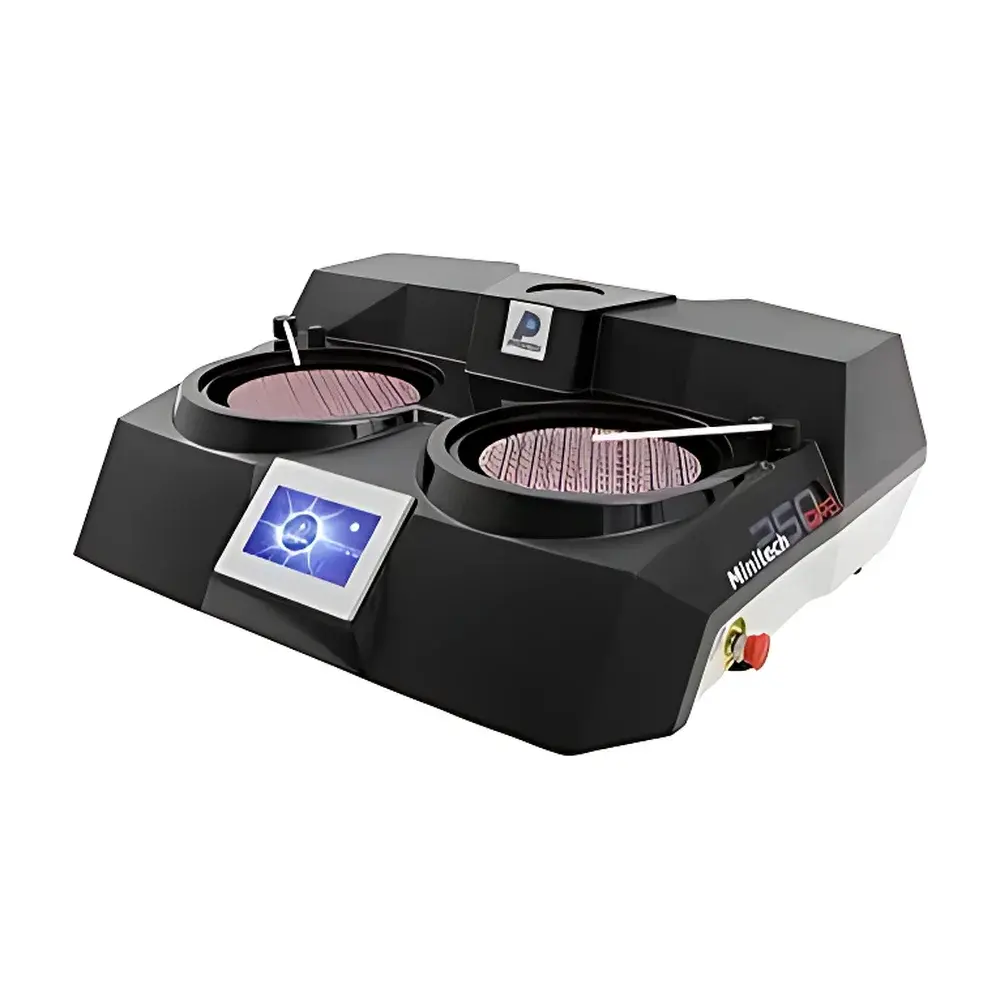
PRESI MINITECH 250 DP2 Manual Dual-Plate Dual-Motor Grinding and Polishing System
| Brand | PRESI |
|---|---|
| Origin | France |
| Manufacturer Type | Authorized Distributor |
| Product Category | Imported Equipment |
| Model | MINITECH 250 DP2 |
| Dimensions (L×W×D) | 920 × 735 × 330 mm |
| Number of Grinding/Polishing Plates | 2 |
| Plate Diameter Options | Ø200 mm or Ø250 mm |
| Speed Range | 20–700 rpm |
| Motor Power | 2 × 750 W |
| Drive Configuration | Independent Dual-Motor |
| Rotation Direction | Clockwise or Counterclockwise |
| Timing Mode | Forward or Reverse Countdown |
| Display Interface | 7-inch Color LCD Touchscreen |
| Load Monitoring | Real-time Manual Force Feedback Display |
| Safety Features | Dual Emergency Stop Buttons, Splash Guard Ring, Tilted Base for Drainage, Elevated Spindle Housing |
| Accessories | Removable Polymer Sample Bowl, Plate Drying Function |
Overview
The PRESI MINITECH 250 DP2 is a precision-engineered manual dual-plate grinding and polishing system designed for reproducible metallographic, ceramic, and geological sample preparation in quality control laboratories, R&D facilities, and accredited testing centers. Built upon a robust mechanical architecture and compliant with EN 61000-6-2 (EMC) and EN 61000-6-4 emission standards, the system employs independent vector-controlled frequency inverters to maintain stable torque and rotational speed across the full 20–700 rpm range—critical for consistent material removal rates and surface finish control. Unlike single-motor shared-drive configurations, the dual-motor design eliminates cross-coupling effects between plates, enabling simultaneous yet fully independent operation of two workstations—each configurable for grinding, rough polishing, or final polishing stages. The system operates under manual operator control, where specimen loading force is continuously monitored and displayed in real time on the front-mounted 7-inch color LCD touchscreen, facilitating standardized pressure application—a key factor in achieving inter-operator repeatability per ISO 1127 and ASTM E3.
Key Features
- Independent dual-motor drive system (2 × 750 W) with vector-controlled inverters ensures constant torque delivery regardless of load variation or speed setting.
- Real-time manual load feedback display enables quantitative pressure monitoring during specimen handling—supporting documented, auditable process consistency.
- 7-inch color LCD touchscreen interface provides intuitive navigation for speed selection, rotation direction (CW/CCW), water valve activation, and timer configuration (forward/reverse countdown).
- Tilted stainless-steel base with integrated drainage channel and splash guard ring minimizes fluid retention and prevents cross-contamination between cycles.
- Elevated spindle housing and sealed high-precision bearings protect critical rotating components from abrasive slurry ingress, extending service life and reducing maintenance intervals.
- Removable polymer sample bowl resists corrosion and chemical degradation, simplifies cleaning, and facilitates rapid replacement during routine maintenance or contamination events.
- Integrated plate drying function automatically spins down the platen at cycle completion to remove residual coolant and suspendent particles from abrasive papers or polishing cloths—reducing storage-related degradation and microbial growth risks.
- Dual emergency stop buttons located on both sides of the chassis comply with EN ISO 13850 requirements for accessible, fail-safe machine shutdown.
Sample Compatibility & Compliance
The MINITECH 250 DP2 accommodates specimens up to Ø100 mm (standard) with optional extended-height clamping fixtures for irregular geometries. It supports all common consumables—including silicon carbide papers (P80–P2500), diamond-impregnated discs (15–1 µm), and woven/non-woven polishing cloths—as defined in ISO 15510 and ASTM E7. The system’s mechanical stability and load-monitoring capability make it suitable for hard materials (e.g., tungsten carbide, sintered ceramics) and brittle phases (e.g., graphite nodules, intermetallics) where uncontrolled pressure induces subsurface damage. Its design aligns with GLP documentation requirements: all user-defined parameters (speed, time, direction, water activation) are logged internally and exportable via USB; password-protected parameter management allows tiered access control (operator vs. supervisor), supporting audit readiness per FDA 21 CFR Part 11 Annex 11 principles.
Software & Data Management
While the MINITECH 250 DP2 operates without external PC dependency, its embedded firmware includes hierarchical user management (three-level password protection), parameter locking, and cycle logging. Each session records timestamp, selected speed, duration, direction, and water-on status. Logs are stored in non-volatile memory and exportable as CSV files for integration into LIMS or QA documentation workflows. Firmware updates are delivered via USB stick, ensuring traceability and version control in regulated environments. No cloud connectivity or remote telemetry is implemented—preserving data sovereignty and minimizing cybersecurity exposure vectors common in networked lab equipment.
Applications
- Metallographic preparation of ferrous and non-ferrous alloys for optical microscopy and SEM analysis.
- Sectioning and planarization of cemented carbides, thermal barrier coatings, and additive-manufactured components.
- Geological thin-section preparation requiring minimal relief and artifact-free surfaces.
- Quality assurance of brazed joints, weld interfaces, and clad materials in aerospace and power generation sectors.
- Routine QC in foundries and heat-treatment facilities where standardized, operator-independent surface conditioning is mandated by internal SOPs or customer specifications (e.g., Boeing D6-17487, GEK 32475).
FAQ
Is the MINITECH 250 DP2 compatible with automated force-control modules?
No—it is a manually operated system. Force application remains operator-dependent, though real-time load feedback enables procedural standardization.
Can both plates run at different speeds simultaneously?
Yes. Each plate is driven by an independent motor and inverter, allowing asynchronous speed and direction settings.
What certifications does the unit carry for international laboratory use?
CE marked per Machinery Directive 2006/42/EC and EMC Directive 2014/30/EU; conforms to EN 61000-6-2 and EN 61000-6-4; meets IP22 ingress protection rating.
Does the system support integration with laboratory information management systems (LIMS)?
Direct API integration is not supported, but exported CSV logs can be ingested into LIMS via standard import protocols.
What maintenance intervals are recommended for optimal performance?
Bearing inspection and lubrication every 1,000 operating hours; touchscreen calibration annually; full verification against factory baseline parameters every 24 months per ISO/IEC 17025 Clause 6.4.6.



